
2017 Annual Report
In 2017 we had another successful year of conserving birds and habitats through science and outreach. Below you can read about our Waterbird Program, Plover Program, Habitats Program, and Landbird Program. This year, in addition to a written annual report, we are also highlighting our accomplishments through mini-videos so our volunteers and supporters can hear from our science team about the impact of their partnership. Below you can also find information about our Outreach Program and our Financials.
A special thanks to volunteer Candace Harvey, who shot and edited all the science videos. If you are interested in hiring Candace for a video project, please contact her at [email protected].
Waterbird Program
Learn about our Shorebird Survey, Gull research, Colonial Waterbird Program, and more from Waterbird Program Director Max Tarjan in the video below.
Plover Program
Plover Program Director Ben Pearl share how our Snowy Plover Program is helping this threatened species, and its Least Tern neighbors in the video below.
Habitats Program
Hear our Habitats Program Director David Thomson has great news about our efforts to help Bay Area tidal marshes adapt to sea level rise in the video below.
Landbird Program
See an update on our Coyote Creek Field Station banding program and Burrowing Owl work from Landbird Program Director Josh Scullen in the video below.
Annual Shorebird Survey – In 2017, we again participated in the annual Pacific Flyway Shorebird Survey. Biologists and community scientists surveyed 40 sites across the South Bay. The SFBBO team counted 116,601 shorebirds and also collected data on habitat conditions. Our data collected for this multi-partner monitoring program provided a Flyway-wide assessment of shorebird communities that is used to identify conservation needs along the Pacific coast.
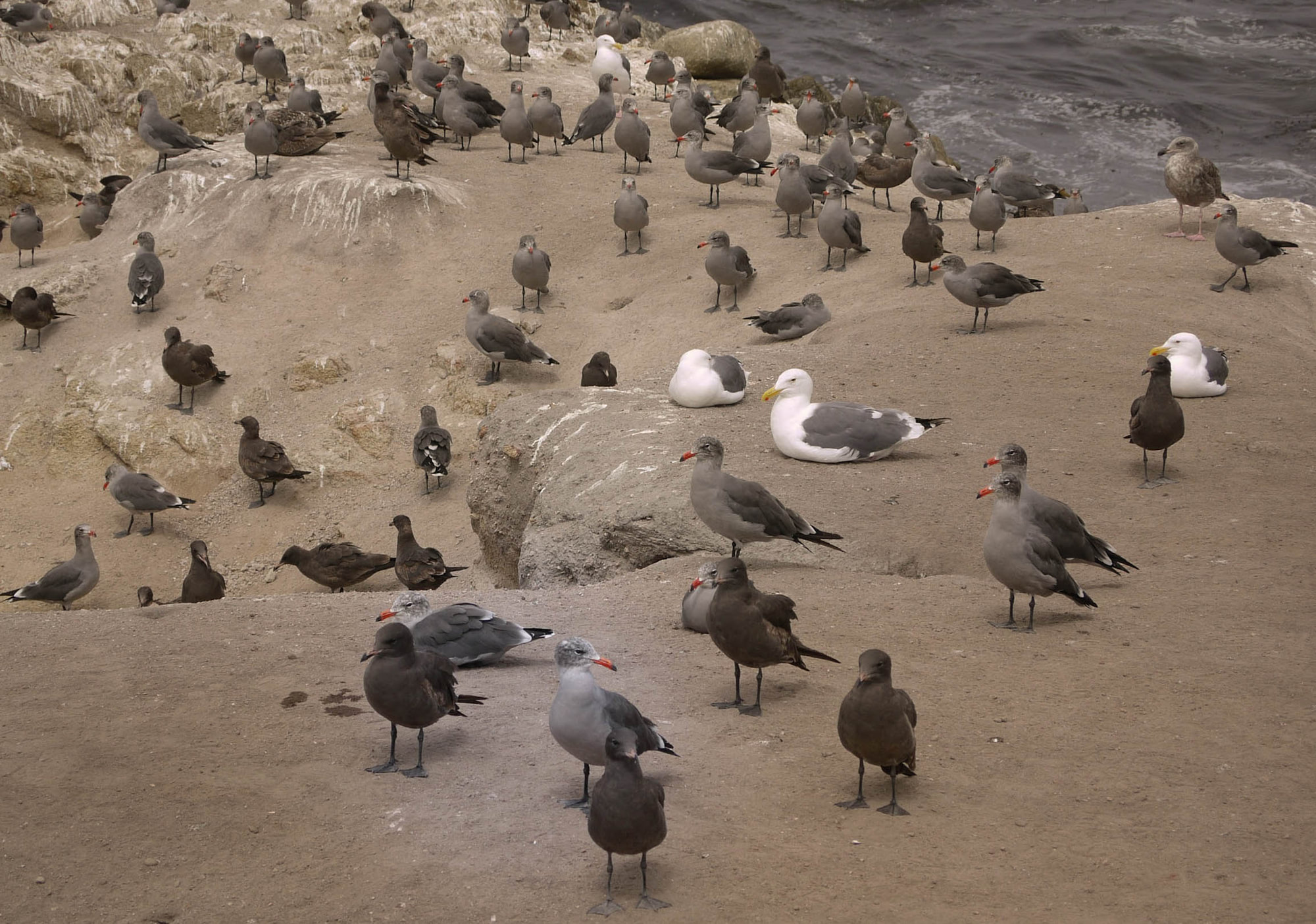
California Gulls Surveys – California Gulls are the most abundant nesting waterbird in the South San Francisco Bay and SFBBO has been monitoring the growth of the breeding population since 1980. In 2017, from May 8 to May 13, biologists and community scientists surveyed ten colony locations in Palo Alto, Alviso, and Fremont and documented 43,570 nesting California Gulls in the South Bay during several all-day walk-through surveys and re-sighted 31 banded gulls. Thirty of these birds were banded at the A6 colony at the Don Edwards San Francisco Bay National Wildlife Refuge near Sunnyvale from 2008 – 2010. Band resighting data from this project provides useful information regarding gull lifespan, dispersal, and the potential impact of encroachment into breeding areas for other sensitive species.
Landfill Surveys – SFBBO staff have surveyed gulls at a local landfill since 2007, and expanded this project to include a local recyclery and the survey of corvids in 2014. Gull counts in 2017 pointed to the effectiveness of the multi-approach abatement. In 2017, the abatement program, continued by Wingmaster Falconry, appears to have maintained a dramatic decrease in the number of gulls using the Landfill and Recyclery since their initiation in February 2012. Reducing landfill use by nuisance species limits population growth and their potential to negatively affect other local ground-nesting waterbirds.
Managed Pond Surveys – Since 2005, SFBBO biologists have conducted surveys of the waterbirds that use managed ponds around the Bay (as well as water quality) that are associated with the South Bay Salt Pond Restoration Project. For the past three years, these surveys covered 82 ponds extending across the Alviso, Newark, Mowry, Ravenswood, and Hayward Eden Landing Ecological Reserve complexes. In 2017, Waterbird Director Max Tarjan, as well as biologists Anqi Chen, Cole Jower, Victoria Heyse, Alex Rinkert, Josh Scullen, Yiwei Wang, Dan Wenny, and interns Rock Delliquanti, Wray Gabel, Anjou Kato, and Emma Stevens,, surveyed over 20,000 acres of managed ponds in the South Bay and counted more than one million birds over the course of the year. These data guide the restoration efforts of the project and enable our partners to maintain ponds that support the needs of multiple local species. SFBBO reported the pond survey data regularly to managers at the U.S. Fish and Wildlife Service (who funded the project) and the California Department of Fish and Wildlife. They used the data to maintain target numbers for particular waterbird guilds, like Eared Grebes and phalarope.
Colonial Waterbird Program – The Colonial Waterbird Program (CWB) is one of SFBBO’s long-standing community science programs, initiated in 1982 to monitor waterbird nesting colonies in the San Francisco Bay. For 35 years, teams of biologists and community scientists have monitored herons, egrets, terns, and other colony nesting waterbirds through our Colonial Waterbird Program. The program has engaged hundreds of community scientists in waterbird nest-monitoring activities and introduced hundreds of local community members to the presence of these birds and their needs for protection and management. Trained community scientists work independently to collect observational data on nesting status, timing of breeding, waterbird behavior, and evidence of disturbance at selected colonies each year. The CWB emphasizes community engagement and community science in order to: 1) increase monitoring capacity across a large geographic area, and 2) generate public interest in protecting waterbirds and their habitats. Many of the colonies monitored by SFBBO community scientists would not otherwise be tracked. The 2017 team, led by Waterbird Program Director Max Tarjan and Outreach and Communications Director Kristin Butler, monitored 82 colonies across 57 sites, 52 of which became active breeding colonies, throughout the Bay Area from February to August using observational methods. Community scientists recorded the number of adults, chicks, and nests they saw and also noted conservation threats such as predation and human disturbance. Thank you to these community scientists for donating more than 739 hours monitoring colonies.
However, our monitoring of nest success and chick survival also showed that controlling predators is required to realize the breeding success needed to reach plover recovery goals in the Bay Area.
Our South Bay salt ponds support nearly 10% of the rangewide Snowy Plover population, likely more plovers than were historically found here. These sensitive birds face substantial threats across the Pacific Coast—habitat loss, predation, human disturbance, and imminent sea level rise—making the South Bay an important breeding and wintering refuge for these birds.
In 2017 our team monitored 343 plover nests, the largest amount of nests monitored since our program began in 2003. We counted 246 plover adults during the breeding window survey, the highest total since 2011 and third highest overall. In addition, we banded 55 plover chicks, down from 66 chicks banded in 2016; and we observed a fledge rate of 44%, an increase from the 2016 fledge rate of 27%.
In addition, we monitored 21 Least Tern nests and observed that five nests hatched at least one chick, eight nests were presumed to have hatched at least one chick, and estimated that 20-28 fledglings were produced from the colony. This is the first time we’ve seen this tern species nest at Eden Landing since 2009! The team was led by Plover Program Director Karine Tokatlian, and included Lead Biologist Ben Pearl, Biologists Cole Jower and Alex Rinkert, and Intern Lani Renshaw. We maintained our valuable partnerships with local agencies and projects, like the U.S. Fish and Wildlife Service and the South Bay Salt Pond Restoration Project, to achieve species recovery while plover resource needs continue to change in the South Bay. This work was funded by the Don Edwards San Francisco Bay National Wildlife Refuge, U.S. Fish and Wildlife Service Bay Delta Field Office, and the Alameda County Fish and Game Commission.
In 2017 we conserved local genetic diversity by searching for and collecting 10 species of plants that are important to the estuary margin. We looked for ways to minimize costs and strengthen partnerships among vegetation managers throughout the region. We increased the geographic scope of the Decision Support System (DSS) we created that lets people use models to decide where to do restoration. And we increased the number of people who use our DSS by holding a webinar and getting it published on Conservation Biology International’s Data Basin interactive website, which allows non-GIS users to visualize and query data.
Habitats Program Director David Thomson led the team, which also included Ecologists Miranda Melen and Eric Lynch, Biologists Cole Jower and Alex Rinkert, partner Brian Fulfrost, and many interns and volunteers. The work was possible through Climate Ready Round 3 grant funding from the California Coastal Conservancy, and Santa Clara Valley Water Districts Safe and Clean Creeks and Natural Flood Protection Program partnership with us.
Coyote Creek Field Station – Like much of the Bay Area, our Coyote Creek Field Station was hit by major rainstorms and flooding in 2017 which broke our equipment and temporarily delayed our banding station operations. But thanks to our generous donors and dedicated team, we still captured an impressive number of birds and created an innovative outreach program that will inspire a new generation of bird conservationists. For over 35 years, we have banded birds at our Coyote Creek Field Station (CCFS) on restored riparian habitat in north San Jose. In 2017, 49 community scientists spent over 4,000 hours collecting, entering, and proofing bird banding data on landbirds that live and pass through the area. This data is important because we and our academic partners use it to track avian responses to climate change, restoration and urbanization, and to document long-term demographic trends.
In 2017, Landbird Program Director Josh Scullen ran the station with support from biologists Anqi Chen, Alex Rinkert, and Dan Wenny. Interns Rock Delliquanti, Wray Gabel, Sharon Huerta, Amaya McKenna, Nicole Tomes-Orlale, and Joleen Tseng also contributed to this program. Together, we captured 3,959 birds of 64 species—just above our annual average of 3,900 birds captured per year. This accomplishment was especially impressive considering we lost over 10% of our total operating hours due to the historic rain storms and flooding that hit San Jose in January and February. Because of the weather we had to close the station for nearly a month while flood waters receded, returned, and then receded again. Nearly a quarter of our nets and other equipment were destroyed or damaged, but with amazing support from our volunteers, donors, and a generous grant from the William H. and Mattie Wattis Harris Foundation, we were able to get back up and running as soon conditions allowed.
Burrowing Owl Program – In 2017, SFBBO continued a five-year project funded by the Santa Clara Valley Habitat Agency to monitor Western Burrowing Owls and enhance, maintain, and restore nesting habitat at Warm Springs Unit, a vernal pool alkaline grassland that is part of the Don Edwards San Francisco Bay National Wildlife Refuge. With the help of our community science volunteers, Landbird Biologist Dan Wenny conducted two line transect breeding season surveys, focal burrow monitoring and camera trapping to estimate the population and breeding success of the Burrowing Owls at the 719-acre unit. Through this effort, we recorded two successful nests from 5 nesting attempts. The two successful nests fledged 3 and 4 chicks. In addition to many volunteers, Executive Director Yiwei Wang, Landbird Program Director Josh Scullen, Plover Program Director Karine Tokatlian, Biologists Cole Jower, Alex Rinkert, Ben Pearl, and Ecologist Eric Lynch helped with the surveys. We also continued working with the Santa Clara Audubon Society on Burrowing Owl habitat management and monitoring in Alviso.
2017 Board of Directors
Jan Hintermeister – Board Chair
Shannon McMahon – Board Secretary
Anne Hepburn – Board Treasurer
Lynne Trulio – Board Member
Gina Barton – Board Member
Brian Fulfrost – Board Member
Denise Mohsenin – Board Member
Leah Russin – Board Member
Thomas Stewart – Board Member
Anna Zivian – Board Member


