
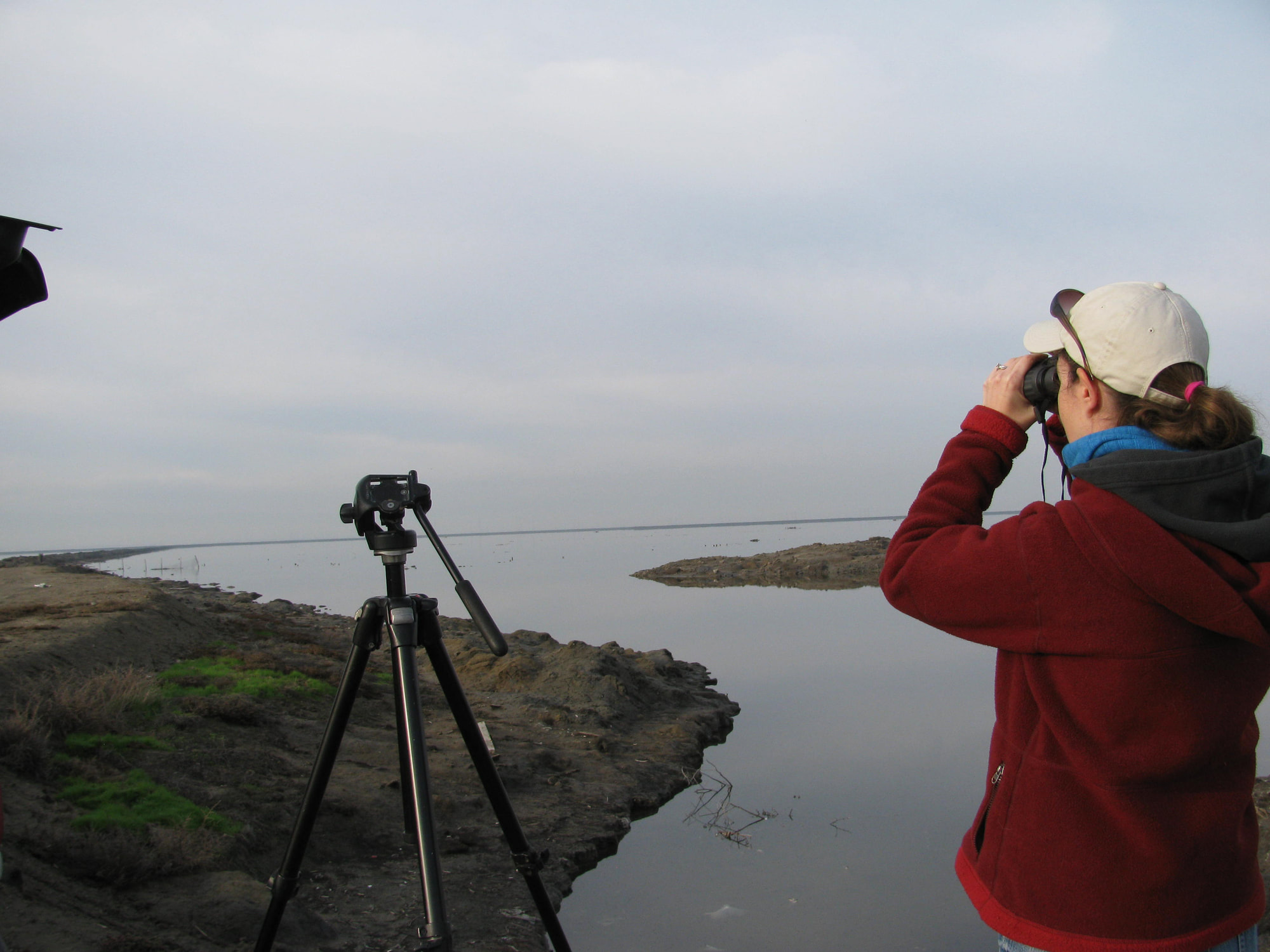

Since 2005, Donna Nicoletti has been an active and dedicated member of our volunteer community, contributing her time to a wide range of science programs at SFBBO. Her first volunteer experience involved conducting power line surveys in Coyote Creek and she quickly became a key participant in colonial waterbird surveys, covering HEP and GUTE colonies across the Bay. In addition to these efforts, her work on the Pacific Flyway Shorebird Surveys and Western Snowy Plover conservation at Eden Landing has made a lasting impact on our mission. We are truly grateful for Donna’s unwavering commitment to our avian science programs and we wish her many great years of birding ahead in her new home beyond the bay area. Below is an interview, where she reflects on her time as a volunteer.
I started volunteering in about 2005 when I moved to Redwood Shores. The very first survey was the Power Line Surveys in Coyote Creek. After that, I primarily volunteered for CWB surveys. I covered various GUTE and HEP colonies in San Francisco, PA Baylands, Mountain View and Redwood Shores. I also did the annual Pacific Flyway Shorebird Survey in PA Baylands, ponds G20 and G21. One year, I think it was 2006, I did a Gull survey in the south bay salt ponds with Cheryl Strong. That was wild. I also volunteered for a few years for oyster shell duty in Eden Landing for Western Snowy Plovers with Caitlyn Nilsen.
I don’t have a science background but my grandmother, who was an Italian immigrant, was fond of backyard birds and piqued my interest in local birds. What initially drew me to volunteer for SFBBO was a typical “lifer” experience. I love to hike and on a hike one day along a levy in Belmont Slough, I came across a breeding colony of FOTE on an island in a seasonal pond. The birds were raucous and wild, and several adults tried to attack me. I was hooked! I wanted to learn about those birds, so as soon as I got back home, I looked up bird organizations in the South Bay and that’s how I found SFBBO.
Many stories! Here are a few:
- My first CWB colony was a CATE colony in Agua Vista Park in San Francisco. A large colony of CATE used an old, abandoned wooden boat dock in Mission Bay for their breeding substrate. The dock was originally built in the early 1900s for the shipbuilding industry, so the platform was, by that point, very dilapidated. I couldn’t believe the birds found and used such an unlikely nesting location. I counted the colony for about four years. Each successive year when I arrived for the first survey in March, I found more sections of the dock had fallen into the water over the winter. The CATE colony continued using it for nesting even in its fragile state. I brought the dock to the attention of both Golden Gate Audubon and SFBBO. The last few years of the survey, I assisted both organizations to try to persuade the San Francisco Port Authority to repair the dock or provide another nearby substrate for them. Unfortunately, the Port Authority determined that it wasn’t feasible for them to make any changes, but the process provided me with an education in California and U.S. migratory bird protection laws and the intricacies of working with government agencies in conservation efforts. Eventually the dock completely collapsed in the water, and the colony must have dispersed elsewhere.
- The first survey I was involved with was part of the PG&E Power Line Program in Coyote Creek. The survey was very important as the biologists were tracking bird collisions with power lines and monitoring the effectiveness of marked vs. unmarked lines. The surveys were done at sunset and sunrise. I was on sunset duty. The groups would sit out in fields in camping chairs and keep watch with night vision goggles. That was the first (and last) time I used them! It was fun and fascinating for a first-time volunteer. The SFBBO biologists were terrific and took time to explain the details of the survey to me. I learned a lot about science-based data collection, and it was a wonderful introduction to bird surveys.
- For the Pacific Flyway Survey, one year, 2014, my partner and I counted 1184 birds. It was like a bonanza of shorebirds; we had never counted that many birds previously on the fall survey.
Most people are stumped when I tell them I volunteer to count birds. This is definitely not your typical volunteer activity! I usually get questions about how the counting process is done. I’ve found that generally people are unfamiliar with local bird species even though they may pass bird habitats every day. When I’m out in the field on a survey and people stop and ask me what I’m looking at, I always advocate for SFBBO and the work we are doing in the South Bay. I think those of us who perform the surveys are pretty unique. You must love the outdoors, be patient and thoughtful, work independently and truly care about birds.
So many ways. Seeing birds through my spotting scope has given me such an intimate connection to individual birds and the fragile lives they live. I am still in awe of how they manage to come back every year to breed in the same place, seemingly against all odds. I also think the breeding season is a microcosm of a human family in a time lapse of a few months. Each stage, from nest building, egg laying, hatching and feeding hungry chicks is a mirror of our lives. I especially love it when I see juveniles take their first steps toward independence; they look and act just like human teenagers!
And I’m quite sure the years of keeping track of the details of colony stages has trained my brain to think in more science-based ways.
After over 40 years of living in the Bay Area, I now live in the Sacramento Valley, and want to continue volunteering with conservation organizations here. I live close to the American River and Sacramento County has several refuge areas for Pacific Flyway birds. I am excited to learn about different species that live or migrate here.
I just want to add that I have enormous respect for the biologists, support team and board of directors at SFBBO. SFBBO has been steadfast in their mission while facing the economic pressures of sustaining a nonprofit. I truly appreciate the work and dedication of everyone at SFBBO and I am very grateful for the opportunity this organization has given me to have a small impact on San Francisco Bay birds.