
Colonial Waterbird Nest Monitoring Research
Quick Links:
How to Become a Volunteer • Visit the Colonial Waterbird Volunteer Website • 2023-2026 Strategic Plan

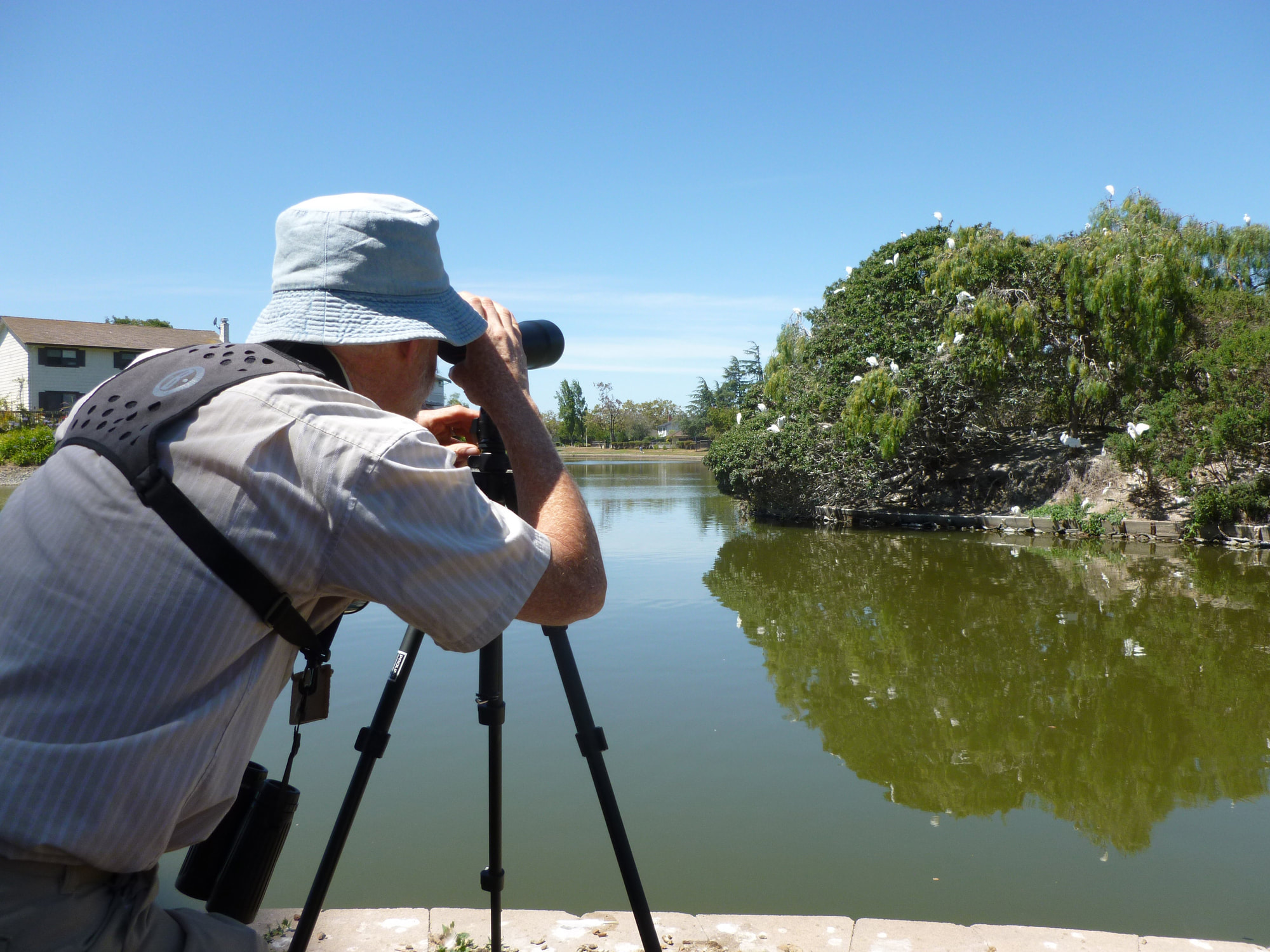
Since 1982, our biologists and volunteer community scientists have monitored colonial waterbirds in the Bay Area. Beginning in early February and continuing through early August, we track numbers of breeding herons, egrets, terns, gulls and other birds that nest in colonies around the Bay Area.
These numbers are added to a database that extends for nearly 40 years, allowing us to document colony location population trends. We also monitor the timing of nesting and evidence of disturbance and predation. These colonies are found on preserves as well as urban landscapes, including the Google Complex campus!
Through our new Strategic Plan, we aim to expand the use of our data and research, and engage with other scientific communities and resource-management agencies, to address climate change, habitat loss, and other environmental issues. We hope you will join our community of scientists, resource managers, and environmental organizations by using our data and analysis to better understand how birds are doing and find ways to promote sustainability in your community.
Jump to the following sections below:
Impact of Our Work, View Our Data, Colonial Waterbirds in the Media, Get Involved, and Thanks to Our Supporters.
The Impact of Our Work
Share Data Nationally – We share our long-term data set with the U.S. Fish and Wildlife Service through our partnership with the Don Edwards San Francisco Bay National Wildlife Refuge.
Collaborate With Other Projects – We contribute our research findings to other projects, including the “Annotated Atlas and Implications for the Conservation of Heron and Egret Nesting Colonies in the San Francisco Bay Area,” a collaboration between SFBBO and Audubon Canyon Ranch. In addition, one of our long-term volunteers founded a nonprofit in San Francisco, San Francisco Nature Education, in 2000 as a result of volunteering in our Colonial Waterbird project and monitoring Great Blue Herons in Golden Gate Park for SFBBO since 1993.

Inform Conservation Efforts – We share research with Bay Area land managers and organizations such as the Audubon Society to help the public make resource management decisions that protect birds.
Serve Local Universities And Organizations – We share our data with universities and other groups that are doing region-wide research projects to help them understand localized bird population trends.
View Our Protocols, Data, and Findings
Click on the links below to view our data and reports. Mini Reports of specific colonies are available upon request, please contact Science Director Nathan Van Schmidt at nvanschmidt@sfbbo.org.
Videos
- Our Nature Stories: Vasona Lake Herons by Community Scientist Christine Zack – 2021
- Almaden Lake: Evolution of the Environment and How Birds Adapt Science Talk by Community Scientist Larry Manning – 2021
- Virtual Waterbird Colony Tour at Lake Cunningham with Community Scientist Christine Zack – 2020
- Waterbird Program Annual Report by Waterbird Program Director Max Tarjan – 2017
- Egrets Breeding at the Google Campus in Mountain View – 2016
- The State of the Birds San Francisco Bay – 2011
Data and Reports
- Breeding Activity of Colonial Waterbirds in the San Francisco Bay Region: a Summary of 2025 Community Science Monitoring Efforts
- Ornamental Tree Species Drive the Selection of Nesting Colony Sites by Black-crowned Night Herons in an Urban Habitat
- Habitat Use by Breeding Waterbirds in Relation to Tidal Marsh Restoration in the San Francisco Bay Estuary – 2023
- Teen Volunteer Program Report: Effects of Flora on Bay Area Bird Populations – 2023
- SFBBO Colonial Waterbird Program Website (for protocols, colony maps, and information about how to request specific data) – 2022
- Breeding Waterbird Populations Have Declined in South San Francisco Bay: An Assessment Over Two Decades – 2021
- Establishing Forster’s Tern (Sterna forsteri) Nesting Sites at Pond A16 Using Social Attraction for the South bay Salt Pond restoration Project – 2020
- Colonial Waterbird Nesting Summary Annual for the U.S. Fish and Wildlife Services Reports – 2005-2020
- Bay Area Colony Maps and 2020 Season Highlights – 2020
- Ask a Scientist Social Media Campaign – 2020
- Colonial Waterbird Analysis -1980-2016
- Annotated Heron and Egret Atlas – 2006
Colonial Waterbirds in the Media
- Where Birds Count and Fish Sell, Climate Online Redwood City, May 2021
- Is Oakland Failing its Official Bird?, The Oaklandside, August 4, 2020
- Lending Nature a Hand: Rescued Water Birds Return to Their Habitat, San Jose Mercury News, August 10, 2018
- John Kelly on Conservation Science, Point Reyes Light, July 5, 2018
- The Bird Counter at Shadow Cliffs, Pleasanton Weekly, May 17, 2018
- Oakland’s Black-crowned Night Herons Just About at Their Peak, Says Wildlife Expert, Hoodline, March 4, 2017
- Hard to Swallow: Great Blue Herons Eating Gophers in Golden Gate Park, Hoodline, June 23, 2016
- Learn a Lesson in Compassion About the Bay Farm Island Egrets, Alameda Magazine, June 17, 2015
- Local Egret and Heron Reseach Aids Land Conservation Efforts and Encourages Public Participation, Tideline, Summer 2015
- Mountain View Egrets Return to Googleplex, San Jose Mercury News, April 10, 2015
- Effort Underway to Protect Egrets at Google, San Jose Mercury News, July 3, 2014
- Egrets Are in Town and They’re Pretty Handy with Tools, KQED Science, May 4, 2013
Get Involved
Volunteer – Receive training about our field protocols and help our biologists monitor nests around the Bay Area or teach the community about colonial waterbirds by becoming a volunteer. Current volunteers can access trainings, protocols, and other information on our on our colonial waterbird volunteer website.
Donate – Make a positive impact for birds and habitats by giving generously to SFBBO. Every donation we receive is wisely invested in our mission.
Report – If you like to kayak in Bay Area sloughs, please keep your eye out for colony nesting waterbirds and let SFBBO know if you find one so we can monitor it. Check out our flyer to learn how!
Learn – Visit a colony near you by joining a “Birds in Your Neighborhood” event. Contact outreach@sfbbo.org to learn more.
Share – Share our story by covering our work in your publication. Please contact Outreach and Communications Director Kristin Butler at kbutler@sfbbo.org to learn more.
Thanks to Our Supporters and Volunteers
We could not do this work without the dedication of around 50 community science volunteers each year and the support of our donors who contribute to our annual appeals and membership program to fund staff time to manage the program, analyze our data, and share it with our partners and the public. Check out former Science Director Max Tarjan’s thank you message to donors.