The most recent stories about our science and outreach work
SFBBO Biologists Release Four Juvenile Snowy Plovers
By Education and Outreach Specialist Sirena Lao
This year has been eventful so far for Snowy Plovers and our biologists who study them here in the South San Francisco Bay. Western Snowy Plovers are small, pale shorebirds that breed along the Pacific Coast from Southern Washington to Baja California, as well as inland at alkali lakes. The Pacific Coast population of Western Snowy Plovers is federally listed as a threatened distinct population segment, with about 2,500 individuals. These birds typically breed on coastal sandy beaches, but with human development and disturbance, some birds have taken advantage of former salt evaporation ponds here in the Bay, a rather stark landscape that mimics salt panne habitat found in isolated areas of the coast and interior. These salt ponds now regularly support about 10% of the Pacific Coast population.
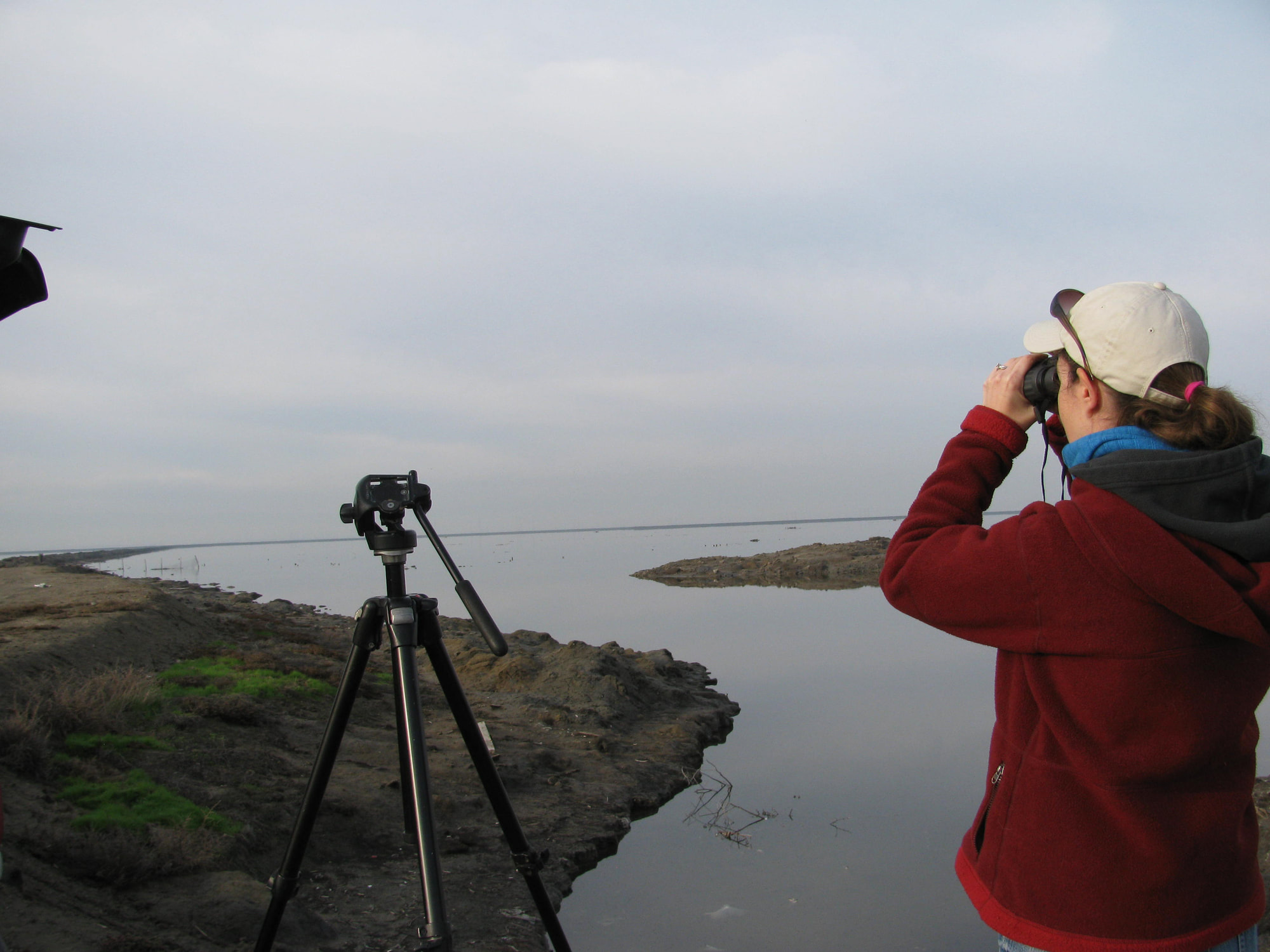
SFBBO biologists have been studying and conserving Snowy Plovers since 2003. Biologists spend long days in the field each spring and summer in conditions with no shade, sometimes strong winds, and plenty of dust and salt that coats their hands, clothes, and virtually all surfaces of our work vehicles. The biologists start by driving slowly on the levees surrounding the salt ponds, using spotting scopes to look for plover nests. Because plover nests consist of lightly decorated scrapes on the ground, spotting nests means looking for incubating plovers sitting on the ground. This is no easy feat given how well camouflaged these small shorebirds are against the landscape, aided by the many oyster shells we’ve placed to help the birds further blend in and hide from predators.
A Harrowing Season
This year’s plover season got off to an early start. Each year, we begin surveying for breeding plovers in March. Our biologists did not expect to find the first chicks hatching already before the end of the month! This is the earliest hatching nest we’ve ever encountered. Only time will tell if earlier hatching will become a trend, as it has with other bird species due to climate change.
April brought challenges for nesting plovers, as we found more abandoned nests than usual. A nest is considered abandoned when the adult plover does not return to the nest to incubate their eggs or brood their chicks. At Eden Landing Ecological Reserve in Hayward, our biologists found two freshly hatched chicks abandoned shortly after an unseasonably late rain storm. In addition to these two chicks, we found one abandoned egg close to hatching at Eden Landing and another at the Warm Springs Unit of the Don Edwards SF Bay National Wildlife Refuge in Fremont. While we don’t always know why plovers sometimes abandon their nests, we strongly suspect that the frequent storms this spring have caused higher than usual nest abandonment. With climate change expected to continue altering the timing and severity of weather events, we may see even more cases of nest abandonment in the future.
When we find abandoned eggs or chicks, we bring them to our partners at International Bird Rescue (IBR). In the last year, IBR has successfully incubated several abandoned Snowy Plover eggs and raised chicks until they’re ready to feed themselves and fly. Our biologists then return to IBR, band the juvenile birds, and release them back into the wild. After nearly two months of caring for the two chicks and two eggs we brought to them in April, IBR sent word to our biologists that these four plovers were ready to be picked up and released.
Release Day
On the morning of Friday, June 17th, I accompanied biologists Jessica González and Josh Scullen to International Bird Rescue’s facility in Fairfield. The plan for the day was to band the four juvenile Snowy Plovers, transport the birds back down to the South Bay, and release them at the Ravenswood Unit of Don Edwards in Menlo Park, one of their primary breeding locations in the bay.
The IBR staff welcomed us and led us into a room with a bench where we could band the plovers. They brought the four plovers in a single cardboard pet carrier. One at a time, Jessica and Josh reached into the carrier to pull out a bird, being careful not to create too wide of an opening lest the plovers fly out. Jessica and Josh carefully placed the four bands on each bird and recorded their measurements. All the while, it was also a busy morning for IBR; while we banded the plovers, we were accompanied by the squawks and squeals of fuzzy Double-crested Cormorant chicks recently rescued from the South Bay being cared for at the bench behind us.
After the birds received their new jewelry and were secured in our cardboard carrier, the plovers began a new journey. Riding in the backseat of our vehicle for about an hour, the plovers occasionally called or scratched the bottom of the carrier. Peeking through one of the air holes in the carrier, I saw that at least one of the plovers seemed to settle in, preening and fluffing itself during the road trip.
When we arrived at the Ravenswood pond where we planned to release the birds, we met up with biologist Parker Kaye, who had been conducting plover surveys earlier that morning, and science director Ben Pearl, who manages our plover recovery program.
After deciding on a good spot to release the birds, we brought the carrier down the side of the levee to the dry edge of the pond bottom. Josh gently tipped the carrier to lay it flat on its side and opened it up. The four young plovers all began to take their first steps into their new life. Two of them took to the skies almost immediately, disappearing among the salt ponds. The remaining two plovers spent more time wandering and exploring, as if they were unsure of this new and foreign setting. Eventually, one of them took off while the other decided to take a short trip to the other side of the levee. This last plover found itself standing on some barnacle-encrusted rocks on the side of the levee, an unusual setting for a Snowy Plover. It finally made its way down to the bottom of the salt pond, where it began foraging and seemed to feel much more at home.
As the Snowy Plover breeding season continues through the summer, our biologists will continue to eagerly look through scopes to read color bands of any plovers spotted, hoping to see these four lucky birds again. Our team is grateful to have played a part in giving these plovers a second chance at life.
If you’d like to support SFBBO’s Snowy Plover recovery program and our other bird conservation efforts, we hope you’ll consider becoming a member to join our community of bird supporters.
Update: 12/30/2022
We are happy to report that all four of the released juvenile Snowy Plovers have been resighted since they were released! In the summer, two were seen at Ravenswood, one was observed at Eden Landing, and the last one pictured on the left below moved from Eden Landing to Frank’s Dump in Hayward Shoreline.
Just before Thanksgiving, we received a report of one the Snowy Plovers on Monarch Beach in Dana Point pictured on the right below! We’re happy to see that it made it all the way to Southern California. As of December 30, 2022, the plover has continued to winter at the beach along with about 40 other plovers.
Thank you to Susan Teefy and Nancee Wells for sharing photos of these birds. If you ever see a banded Snowy Plover, you can send photos and report your sighting to snpl_bandreporting@googlegroups.com. Include the location, date, number of plovers observed, and number of plovers checked for bands. Your message will go to all Snowy Plover banders across the Pacific Coast, and someone will respond within a few days to let you know the history of the observed bird!