
By Guest Blogger Stephanie Klein

This spring and summer I have been on a mission to find Swainson’s Hawks in the Bay Area. While I have always enjoyed watching birds, especially water birds and passerines, I only recently became acquainted with hawk species in a raptor class offered at De Anza College. It was in that class that I learned about and first observed a Swainson’s Hawk.
When our class went out to look at raptors in Coyote Valley, we found a male Swainson’s Hawk perched atop a tall cedar tree. Our instructor, Ryan Phillips, said he was likely guarding a nest nearby. While we were there, a Cooper’s Hawk ventured into the nesting area. Sure enough, the Swainson’s Hawk immediately launched …
off his perch, screaming, and took out after the intruder.
That time, the male’s quick response was enough to drive away the threat, but sometimes, if the offending individual doesn’t get the hint, the female will come off the nest and join the pursuit. Some Swainson’s Hawks will even swoop and dive at people who come too close. I was amazed to see how vigilant both the male and female were in defending their nest, and at their steadfast adherence to a seasonal cycle.
I continue to be amazed at these hawks. They are obligate migrators and spend the winter months in places as far away as Argentina. When it’s time to make the journey south, they amass in enormous flocks and begin binging on food. If you go out to the Central Valley near Davis or Tracy in late August or September you can see hundreds of them hovering, sitting and chasing each other around farm and grass fields. On the way south (and north in the spring) their pattern of migration funnels them through Veracruz, Mexico, in the tens of thousands. By the time they’ve made a round-trip between their breeding and wintering grounds, they may have traveled more than 6000 kilometers!
That time, the male’s quick response was enough to drive away the threat, but sometimes, if the offending individual doesn’t get the hint, the female will come off the nest and join the pursuit. Some Swainson’s Hawks will even swoop and dive at people who come too close. I was amazed to see how vigilant both the male and female were in defending their nest, and at their steadfast adherence to a seasonal cycle.
I continue to be amazed at these hawks. They are obligate migrators and spend the winter months in places as far away as Argentina. When it’s time to make the journey south, they amass in enormous flocks and begin binging on food. If you go out to the Central Valley near Davis or Tracy in late August or September you can see hundreds of them hovering, sitting and chasing each other around farm and grass fields. On the way south (and north in the spring) their pattern of migration funnels them through Veracruz, Mexico, in the tens of thousands. By the time they’ve made a round-trip between their breeding and wintering grounds, they may have traveled more than 6000 kilometers!
While it’s pretty easy to find Swainson’s Hawks in the Central Valley during the spring and summer, it’s more difficult in the Bay Area. There are few records of Swainson’s Hawks nesting in the valleys of the Bay Area. In fact, the two that we observed in class were the first confirmed nesting pair in Santa Clara County since the late 19th century. Another pair was also discovered in 2013 in northern San Benito County near Hollister, and then another three years later in Gilroy. Does this mean that Swainson’s Hawks are expanding their range?
Could be. But, as is the case with many other raptors, Swainson’s Hawk populations have declined from their historical numbers. In California, the drop was so drastic that the species was listed as threatened in the state in 1983. One of the major reasons for their decline has been loss of habitat, so the appearance of Swainson’s Hawks in the Bay Area could mean that they are being pushed out of their Central Valley nesting grounds by housing and infrastructure development there. It seemed important to me to keep track of the nesting pairs in the Bay Area to see if their numbers increased, so in 2016 I began monitoring the Coyote Valley pair as a volunteer with Talon Ecological Research Group.
Could be. But, as is the case with many other raptors, Swainson’s Hawk populations have declined from their historical numbers. In California, the drop was so drastic that the species was listed as threatened in the state in 1983. One of the major reasons for their decline has been loss of habitat, so the appearance of Swainson’s Hawks in the Bay Area could mean that they are being pushed out of their Central Valley nesting grounds by housing and infrastructure development there. It seemed important to me to keep track of the nesting pairs in the Bay Area to see if their numbers increased, so in 2016 I began monitoring the Coyote Valley pair as a volunteer with Talon Ecological Research Group.

2016 was a great year for “our” pair. In early July of that year, my husband and I made our first observation of the nest with a scope borrowed from SFBBO. The wind was high that day and the leaves of the Sycamore were swaying vigorously back and forth making it difficult to see the nest. Suddenly the leaves parted in the wind and we got a glimpse of a nestling, bobbing up and down with the wind.
After that we made weekly trips to observe the nest. The following Saturday we discovered a second and a third nestling. A few weeks later we spotted all three, perched on the top of the adult hawks’ lookout tree. One of the adults glided overhead calling plaintively. I imagined that it was sending some message to its brood. “It’s time to fly away,” perhaps, or “pay no attention to those two pests who keep watching us.”
After that we made weekly trips to observe the nest. The following Saturday we discovered a second and a third nestling. A few weeks later we spotted all three, perched on the top of the adult hawks’ lookout tree. One of the adults glided overhead calling plaintively. I imagined that it was sending some message to its brood. “It’s time to fly away,” perhaps, or “pay no attention to those two pests who keep watching us.”

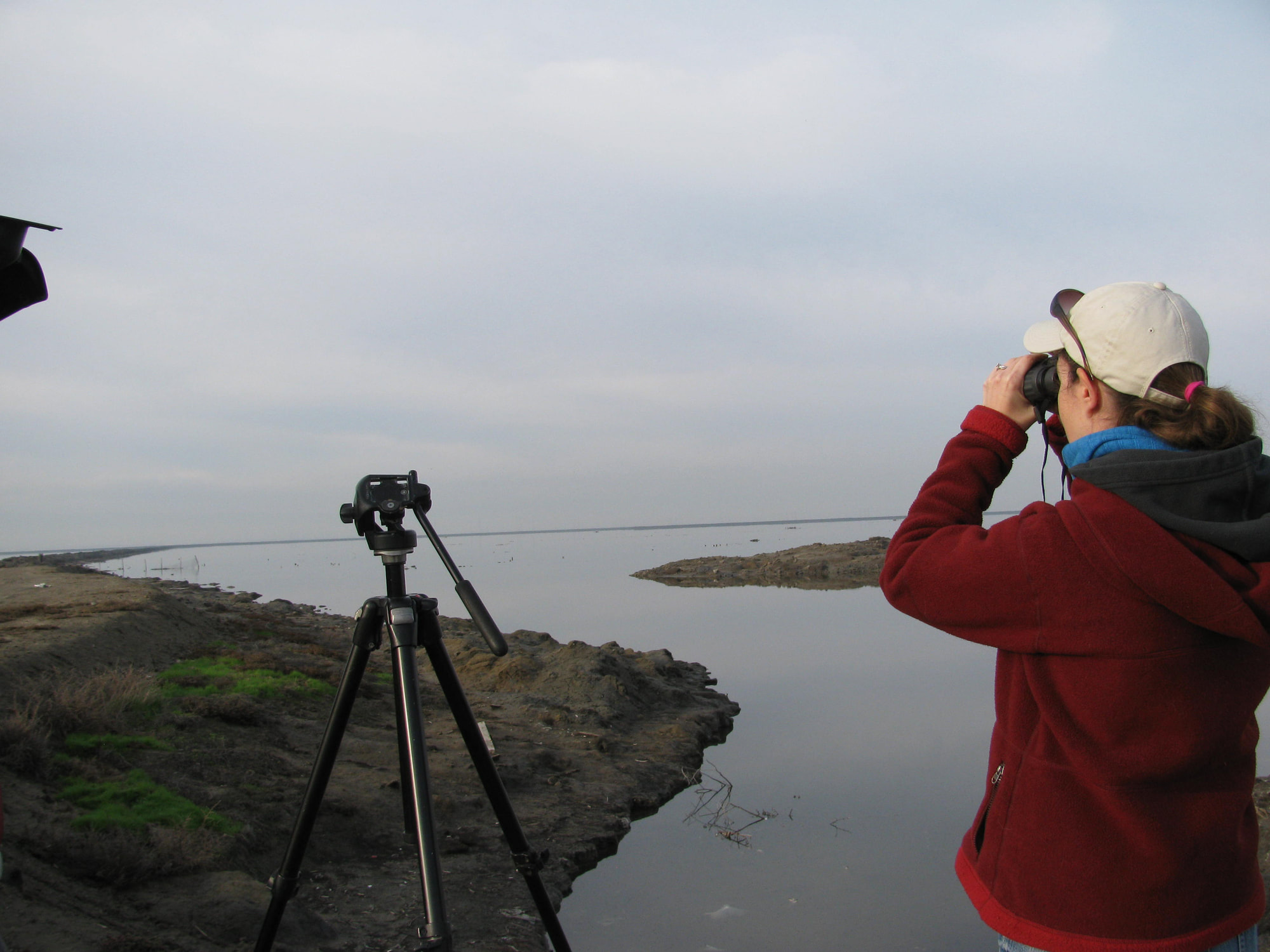
Whatever it may have meant, we were both hooked on monitoring the Swainson’s Hawks in the valley. We invested in a scope and have continued monitoring the Coyote Valley pair every year since then. We’ve even branched out to include the two other known pairs nesting near Gilroy and Hollister. In all, the pairs have fledged at least three more young, and since Swainson’s Hawks generally return to their natal area, we expect and hope to see more nesters in the future.
This season, as a project for a program in wildlife management at Oregon State University, we have been searching other areas with suitable habitat to get an estimate of Swainson’s Hawk occupancy in the area. The days of searching can be long and tiring. More often than not, we don’t see any Swainson’s Hawks on these outings, but sometimes we do! And that possibility keeps us looking.
Stephanie Klein volunteers with SFBBO as a librarian and colonial waterbird monitor. She also enjoys monitoring cavity nesters of all kinds for the Audubon Society and, of course, looking for Swainson’s Hawks with Talon Ecological Research Group. She recently completed an Associates Degree in Wildlife Science at De Anza College.
This season, as a project for a program in wildlife management at Oregon State University, we have been searching other areas with suitable habitat to get an estimate of Swainson’s Hawk occupancy in the area. The days of searching can be long and tiring. More often than not, we don’t see any Swainson’s Hawks on these outings, but sometimes we do! And that possibility keeps us looking.
Stephanie Klein volunteers with SFBBO as a librarian and colonial waterbird monitor. She also enjoys monitoring cavity nesters of all kinds for the Audubon Society and, of course, looking for Swainson’s Hawks with Talon Ecological Research Group. She recently completed an Associates Degree in Wildlife Science at De Anza College.