
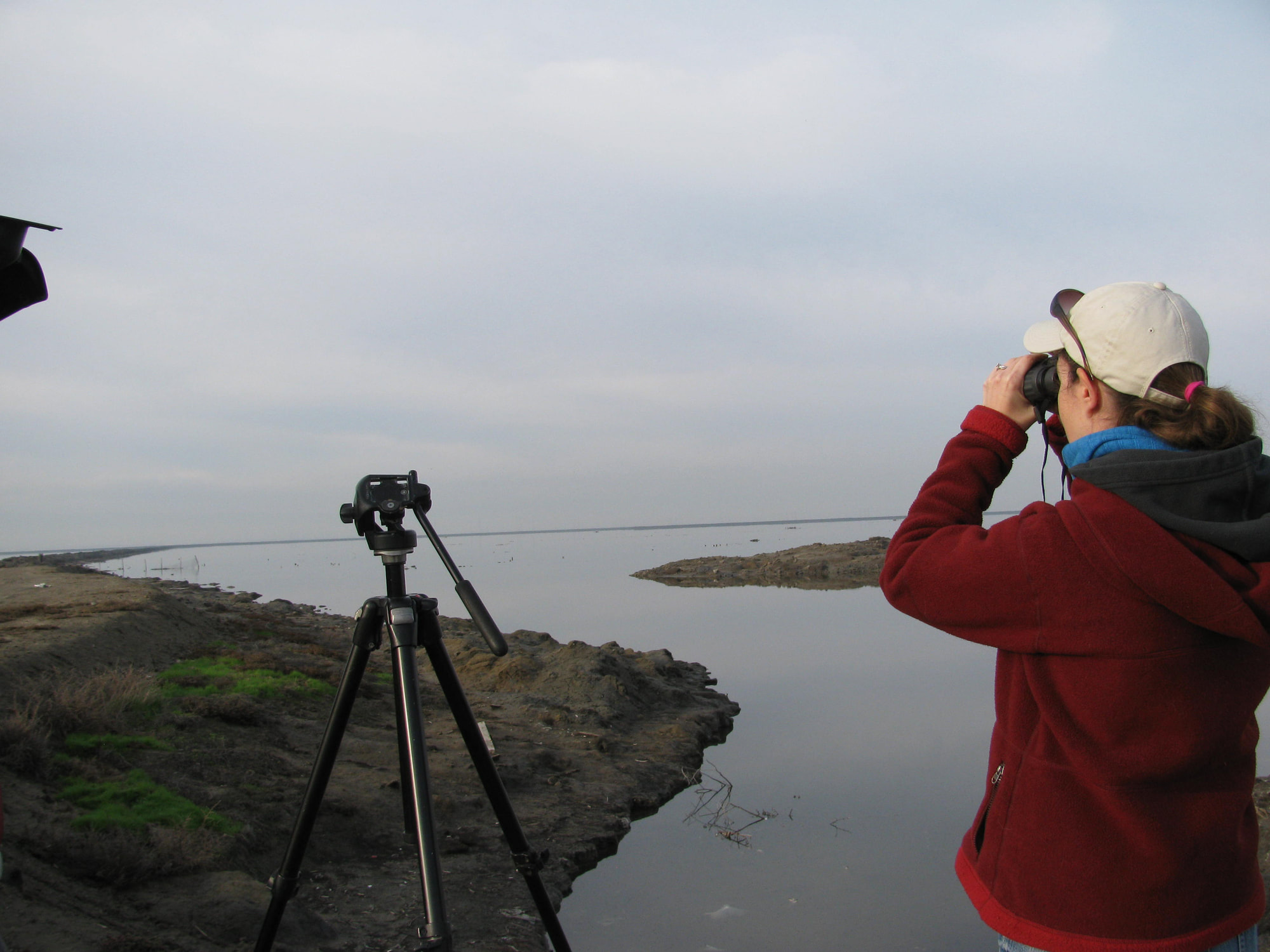
SFBBO Science Director Maddy Schwarz

For 20 years, SFBBO has surveyed the Western Snowy Plover, a federally listed species that usually lives on beaches but has found a home on the dry salt pond beds along our Bay. Because of it’s protected status, the U.S. Fish and Wildlife Service has set goals to restore plover numbers throughout the region. In addition, the South Bay Salt Pond Restoration Project, a 50-year effort to return half of the Bay’s salt ponds back to tidal marsh, has also established goals to increase plover numbers in the Bay Area. SFBBO is a part of a range-wide effort to study and help these birds by improving their habitat and banding and re-sighting them to learn where they go. As part of our 2023 California Fall Challenge (CFC), for the next four …
weeks SFBBO Science Director Maddy Schwarz and her team will share the latest banded plover re-sightings and a little about these adorable birds.
This week, SFBBO staff biologists began conducting Western Snowy Plover color-band resight surveys. These surveys are a vital step in assessing annual plover breeding success. Throughout the nesting season, SFBBO biologists banded 242 Snowy Plover chicks with a unique four-color band combination for each chick. After banding, the chicks were released and with any luck, fledged approximately 28 days later. Birds are at their most vulnerable when they are chicks, so a fledged bird represents successful recruitment into the population. Fledge rate is one of the key recovery metrics USFWS tracks to assess the health of the Western Snowy Plover population. Of the 242 chicks banded by SFBBO in 2023, so far we have confirmed that 49 birds have fledged by resighting their unique color-band combination in the field. This represents a 21 percent fledge rate, which is unfortunately a less successful year. In 2022 we observed a 34 percent fledge rate and in 2021 we observed a 32 percent fledge rate.
This week, SFBBO staff biologists began conducting Western Snowy Plover color-band resight surveys. These surveys are a vital step in assessing annual plover breeding success. Throughout the nesting season, SFBBO biologists banded 242 Snowy Plover chicks with a unique four-color band combination for each chick. After banding, the chicks were released and with any luck, fledged approximately 28 days later. Birds are at their most vulnerable when they are chicks, so a fledged bird represents successful recruitment into the population. Fledge rate is one of the key recovery metrics USFWS tracks to assess the health of the Western Snowy Plover population. Of the 242 chicks banded by SFBBO in 2023, so far we have confirmed that 49 birds have fledged by resighting their unique color-band combination in the field. This represents a 21 percent fledge rate, which is unfortunately a less successful year. In 2022 we observed a 34 percent fledge rate and in 2021 we observed a 32 percent fledge rate.

However, there is still time for that number to increase since SFBBO staff will be performing another week of resight surveys. Hopefully we will be able to confirm additional fledges like this bird we confirmed on August 22nd: violet over orange, yellow over blue, or VO:YB! This bird was one of the last chicks banded this season on July 19th at Eden Landing. It was seen again and photographed on September 19th on the same pond where it hatched. The first photo was taken right after it was banded when it was just a couple hours old. The second photo was taken on September 19th, all grown up and fully fledged!
The bonus photo below is of another bird that isn’t a fledge from this year, but who doesn’t want to see more plover photos! For more information about our plover research or to get involved, please visit our website.
The bonus photo below is of another bird that isn’t a fledge from this year, but who doesn’t want to see more plover photos! For more information about our plover research or to get involved, please visit our website.
