
Western Snowy Plover and Least Tern Research
Quick Links:
How To Become a Volunteer • Read About a Snowy Plover Rescue • 2023-2026 Strategic Plan

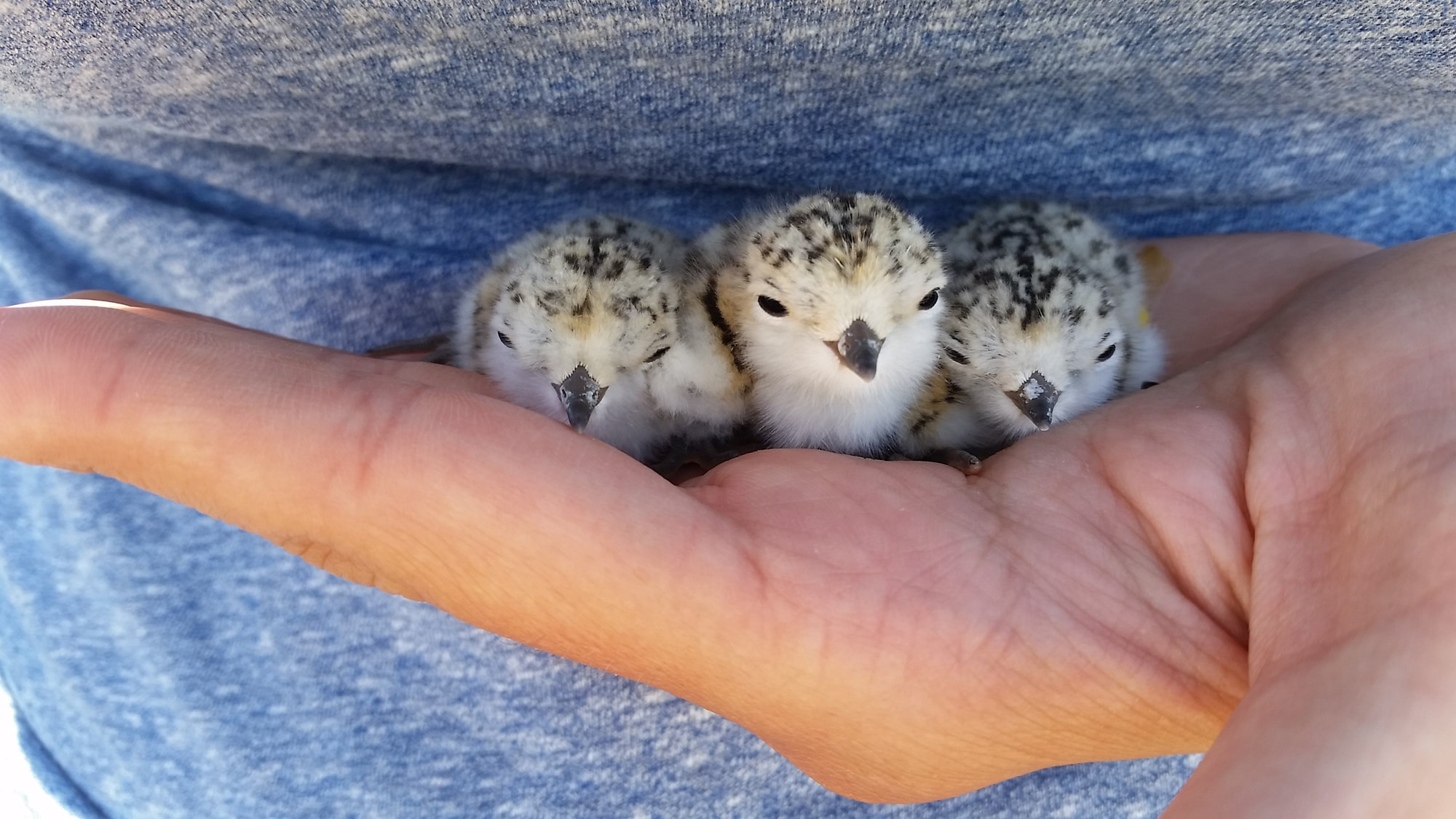
The Western Snowy Plover is a threatened shorebird that breeds along the west coast of the U.S. Because of this status, the U.S. Fish and Wildlife Service has set goals to restore plover numbers throughout the region. In addition, the South Bay Salt Pond Restoration Project, a 50-year effort to return half of the Bay’s salt ponds back to tidal marsh, has also established goals to increase plover numbers in the Bay Area. Since 2003, SFBBO has worked with both of these efforts to study and conserve local plovers. We recently expanded our work beyond the San Francisco Bay to monitor plovers in Monterey. Check out a video about our spring 2020 plover work.
We survey salt ponds to locate breeding habitat and monitor plovers to determine nest and fledging success. Each spring our biologists band plover chicks to track their movements and survival, and use remote trail cameras to identify predators such as corvids, gulls, and foxes. In addition, a few community scientists help us conduct winter surveys so we know how plovers use the Bay outside the breeding season, and we enhance plover habitat.
The California Least Tern is an endangered species that breeds along the California Coast in sparsely vegetated and flat areas located next to the Pacific Ocean. Although their natural habitat is sandy beaches and lagoons, in the San Francisco Bay they have adapted to breed in former salt production ponds, which provide the habitat features California Least Terns need to breed. SFBBO first began working with California Least Terns between 2007-2009, and again in 2017 when they were attracted to habitat enhanced for Snowy Plovers with oyster shells. We also enlist the help of community science volunteers to monitor Least Terns in the area during the breeding season.
In addition, we removed posts and other objects that predators like to perch on as well as vegetation that was encroaching on nesting habitat. We also spread oyster shells on the pond bottoms that camouflage plovers during the breeding season, and during the late winter we hold a Mud Stomp when volunteers stomp in the mud to create depressions and texture that allow plovers to blend in better with their surroundings.
Although historically the Bay Area likely only supported a small Snowy Plover Population and few (if any) Least Terns, today the South Bay salt ponds support nearly 10% of the rangewide Snowy Plover population, and one of only six Least Tern colonies in the San Francisco Bay Area. These two sensitive species face substantial threats across the Pacific Coast—habitat loss, predation, human disturbance, and imminent sea level rise—making the South Bay a critical habitat for these sensitive birds.
Your message will go to all Snowy Plover banders across the Pacific Coast, and someone will respond within a few days to let you know the history of the observed bird!
Through our 2023-2026 Strategic Plan we aim to expand the use of our data and research, and engage with other scientific communities and resource-management agencies, to address climate change, habitat loss, and other environmental issues. We hope you will join our community of scientists, resource managers, and environmental organizations by using our data and analysis to better understand how birds are doing and find ways to promote sustainability in your community.
Jump to the following sections below: Impact of Our Work, View Our Data, Western Snowy Plovers and Least Terns in the Media, Get Involved, and Thanks to Our Supporters.
Impact of Our Work
Share Data Nationally and Regionally – We share our research results with the U.S. Fish and Wildlife Service and the California Department of Fish and Wildlife.
Collaborate Regionally – We are part of a region-wide effort – Recovery Unit 3 working group that works together to survey Snowy Plovers in our region.
Present Our Research – In addition to presenting our data at annual plover recovery conferences, we give presentations at universities and to other groups, such as the Audubon Society.
Inform Local Conservation Efforts – We share our data and partner with others in the South Bay Salt Pond Restoration Project, a 50-year project to restore tidal marsh and manage salt ponds that ring the Bay.

View Our Protocols, Data, and Findings
Click on the links below to view our data and reports. For information about our plover and tern research or to discuss collaborations involving our data, please contact Science Director Maddy Schwarz at mschwarz@sfbbo.org.
Videos
- Science Talk – Snowy Plover Monitoring in the San Francisco Bay Estuary by Science Director Ben Pearl – 2022
- SFBBO Biologists Release Four Rescued Snowy Plovers – 2022
- Science Talk – Snowy Plover Conservation in the Bay Area: Successes and Challenges in a Shifting Landscape by Science Director Ben Pearl – 2021
- Science Talk – Wild Napa: Snowy Plovers and Least Terns in the Bay Area by Science Director Ben Pearl – 2020
- Science Talk – Snowy Plovers, the Cutest Birds on the Beach by Biologist Jessica Gonzalez – 2020
- Snowy Plover Field Work – 2020
- Plover Program 2017 Annual Report by Science Director Ben Pearl – 2017
- Science Talk – Factors Affecting Wintering Foraging Habitat Selection of Western Snowy Plovers in South San Francisco Bay by Science Director Ben Pearl – 2015
Data and Reports
- Western Snowy Plover and California Least Tern Monitoring in the San Francisco Bay Annual Report – 2025
- Habitat Enhancement, Community Engagement, and Use of Motus to Support Western Snowy Plover and California Least Tern Recovery at Eden Landing Ecological Reserve, Hayward, California, Final Report – December 31, 2025
- SFBBO Snowy Plover Annual Reports for the U.S. Fish and Wildlife Service – 2004-2020
- Ask a Scientist Social Media Campaign – 2020
- 5-Year Review, Western Snowy Plover [Pacific Coast population Distinct Population Segment] – 2019
- South Bay Salt Pond Restoration Project Report – Snowy Plovers Doing More with Less – 2017
- Oyster Shell Habitat Enhancement for Breeding Snowy Plovers in Pond A14, Eden Landing Ecological Reserve – 2016
- Managed Pond Waterbird Surveys – 2015
- Establishing baseline Conditions to Inform Adaptive Management or South San Francisco Bay Salt Ponds – 2013
- Monitoring Western Snowy Plover Nests with Remote Surveillance Systems in San Francisco Bay, California – 2012
- Determining the Effects of Habitat Enhancements and Predators on Western Snowy Plovers – 2004-2010
Plovers and Terns in the Media
Click on the links below to read the latest news about our Plover and Tern Research and Recover Work
- Salty Dave’s Wetland Weblog: I Need a Plover, South Bay Salt Pond Restoration Project, August 19, 2022
- SFBBO Biologists Release Four Juvenile Snowy Plovers, Wingbeat, July 1, 2022
- Global CSR Report: Facebook Journeying into a Zero Carbon Economy, The CFR Journal, October 19, 2021
- Plover Rescue Kicks Off SFBBO’s 40th Anniversary, Wingbeat, September 2, 2021
- Helping Snowy Plover Hatchlings Out of Their Shell, Every Bird Matters, August 18, 2021
- An Interview with Snowy Plover Biologist Jessica Gonzalez, Andytown Coffee Roasters Blog, September 13, 2021
- A Chain Reaction Brought Gulls to the Bay … Now They Are Eating Other Birds, KALW Crosscurrents, August 15, 2019
- Salt Ponds to Pickleweed, Landscape Architecture Magazine, September 9, 2017
- Protecting Bay Area Western Snowy Plovers, Albatross, March/April 2017
- Banding Plover Chicks, Sebastian Kennerknecht Nature and Conservation Photography, February 9, 2017
- Help SFBBO Protect the Western Snowy Plover, Eco-Logic, February 2017
- Help San Francisco Bay Bird Observatory Raise Funds for its ‘Protect Our Plovers’ Campaign, Tideline, December 2016
- Searching for Western Snowy Plovers, Wild Expectations, November 3, 2015
- A Glimpse into the Life of a Snowy Plover, Save the Bay, July 29, 2014
- Protecting Snowy Plovers Wintering on Urban Beaches, KQED Science, January 31, 2014
Get Involved
Volunteer – Assist with plover or tern habitat restoration by becoming a volunteer.
Donate – Make a positive impact for birds and habitats by giving generously to SFBBO. Every donation we receive is wisely invested in our mission.
Report – If you spot a plover with bands on its legs, please report the band colors, location, and date to Science Director Maddy Schwarz at mschwarz@sfbbo.org.
Learn – If you would like to schedule a science talk, bird walk, or kids activity focused on plovers or terns, please contact outreach@sfbbo.org.
Share – Share our story by covering our work in your publication. Please contact Outreach and Communications Director Kristin Butler at kbutler@sfbbo.org to learn more.
Thanks to Our Supporters and Volunteers
Thanks to the individuals volunteers and groups for donating their time to help us survey plover populations, enter data into our databases, and enhance plover and tern habitats.
Thanks to our partners with the U.S. Fish and Wildlife Service, California Department of Fish and Wildlife, and Eden Landing Ecological Reserve for managing the lands our plovers and terns live on, and the South Bay Salt Pond Restoration Project.
This work is funded by the Alameda County Fish and Game Commission, California Coastal Commission, California Environmental Law Project, California Wildlife Foundation/California Coastal Conservancy, Cargill, Facebook, Santa Clara County Fish and Game Commission, Sierra Foothills Audubon Society, Sonoma County Fish and Wildlife Commission, U.S. Fish and Wildlife Service, and our SFBBO donors.