
Coyote Creek Field Station Landbird Banding Research
Quick links:
Scientific Papers Using CCFS Data • “Notes From The Station” blog • 2023-2026 Strategic Plan

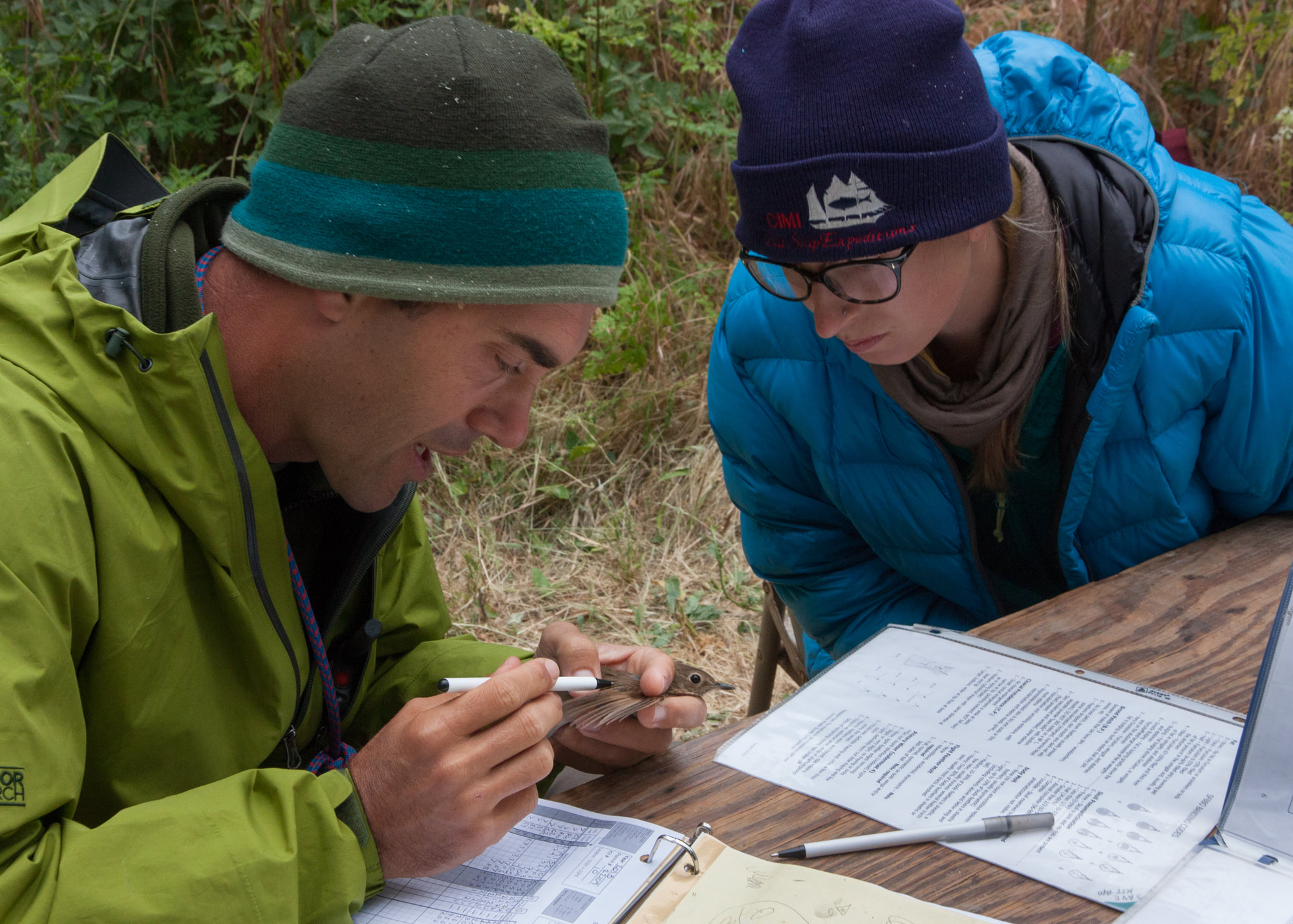
For 40 years, our scientists and community scientists have conducted bird banding research on passerines at the Coyote Creek Field Station (CCFS) in Milpitas, CA. Bird banding provides valuable information that helps us study bird dispersal, migration, behavior, social structure, life span, survival rate, reproductive success, and population growth. It also allows us to understand seasonal and long term population patterns of migratory, wintering and year-round resident birds; and track individual birds, which is important in factoring survival, migratory turnover rates, and longevity. Additionally, it allows us to examine bird responses to the riparian restoration at CCFS.
For example, by knowing the age of individual birds, we have discovered the immature and adult Song Sparrow use the restored habitats differently. Furthermore, we have discovered strong species preference to habitat characteristics associated with the restored habitats. As more and more of our Bay Area creeks are restored, these data are important for land managers and those designing future riparian restorations to create habitats that can support healthy, vibrant bird populations.
Through our Strategic Plan we aim to expand the use of our data and research, and engage with other scientific communities and resource-management agencies, to address climate change, habitat loss, and other environmental issues. We hope you will join our community of scientists, resource managers, and environmental organizations by using our data and analysis to better understand how birds are doing and find ways to promote sustainability in your community.
Jump to the following sections below: Impact of Our Work, View Our Station and Data, Get Involved, and Thanks to Our Supporters.
Impact of Our Work

Share Data Internationally – We, along with most other banding facilities in North America, send our banding data to the Bird Banding Laboratory (of USGS), which stores all of this information that can be used by scientists internationally. This collected information tells us how far a bird may travel during migration and which path it chooses to take. We have banded birds recaptured as far away as Alaska, British Columbia, Washington, and Newport Beach, California, and have also recaptured birds from as far as Alaska and Oregon.
Present Our Research – Our landbird scientists are members of the Western Bird Banding Association and present papers at WBBA conferences about our work, and contribute our data to others’ research projects.
Collaborate With Other Projects -We also contribute our data and analysis to other research projects, including the Bird Genoscape Project.
Serve Local Universities – We also open our field station to college students and other scientists who use bird banding and bird banding data in their research and collaborate with local educators who use our data in their curricula to prepare the next generation of scientists. University partners include Santa Clara University, Cal State East Bay, San Francisco State, Stanford, and others.
New NSF Grant – In 2020, SFBBO and our partners at Jasper Ridge Biological Preserve, Santa Clara University, San Jose State University and West Valley Community College received an incubator grant from the National Science Foundation (NSF) to plan the San Francisco Bay Research Coordination Network for Student Opportunities in Avian Research (SOAR) to Enhance STEM Education. The collaboration of SOAR among Bay Area institutions will connect students in field research and community-building. SOAR will be designed especially to appeal to those from underserved communities and engaging all participants in the field and lab-based STEM activities through the lens of ornithology. The program intends to set up and support long-term bird-banding stations at Jasper Ridge, Stanford lands, and the Coyote Creek Field Station. Participants will learn how to collect and analyze data to better understand the San Francisco Bay Area’s bird populations’ dynamics. The project also provides opportunities for hands-on field research and follow-up lab activities for students who do not presently have access to such experiential learning in outdoor settings.
View Our Protocols, Data and Findings
Click on the links below to view our data and reports. For information about our Coyote Creek Field Station research or to discuss collaborations involving our data, please contact Science Director Katie LaBarbera at klabarbera@sfbbo.org.
Videos
- Panel Speaker – Climate Change and Ecosystems – Peninsula-South Bay Watershed Forum with Science Director Katie LaBarbera – 2022
- Panel Speaker – Shining a Spotlight on the Coyote Creek Watershed Peninsula-South Bay Watershed Forum with Science Director Katie LaBarbera – 2021
- Video Experience – Bird Banding from the Point of View of a Bird Banding Biologist – 2021
- Science Talk – A Bird in the Hand is Worth … What We Can Learn by Catching Birds by Landbird Science Director Katie LaBarbera – 2020
- Science Talk – Bird Banding at the Coyote Creek Field Station by Landbird Program Director Josh Scullen – 2020
- Jasper Ridge Bird Banding Science Talk by Stanford University’s Julian Tattoni – 2019
- Video Experience – Virtual Tour with Landbird Program Director Josh Scullen Shared by Jay Goble – 2013

Data and Reports
- Jasper Ridge Biological Preserve Annual Report for 2020-2021: Changes Underway
- Peer Reviewed Articles with Summaries
- Our data lives and is accessible for free online at the Bird Banding Laboratory of US Geological Survey.
- Coyote Creek Field Station Wildlife Checklist (PDF)
Get to Know Our Station
- Check out our CCFS blog “Notes from the Station” for updates about the birds we are capturing
- Slide Show – Click here to see how we band birds
- Check out our 2020 Ask a Scientist social media campaign on CCFS
- For Educators – Free Middle School Curriculum
Coyote Creek Field Station in the Media
Click on the links below to read the latest news on our Coyote Creek Field Station
- Keeping Up With the Flyers: Wildlife Tracking Breakthroughs, Bay Nature Magazine, Sept. 1, 2022
- Learning More About Injured Birds Could Improve Their Welfare, Earth.com, May 16, 2022
- Songbirds Have a Story to Tell About Climate Change, KQED News, March 16, 2018
- Mist Nets and Feather Quest, Native Birds of San Francisco Bay, Tri-City Voice, Jan. 23, 2018
- Timing of Migration is Changing for Songbirds on the Pacific Coast, Science Daily, Dec. 7, 2017
- Bird Banding with SFBBO, video by Bay Nature Magazine, Oct. 10, 2017
- The (Citizen) Science of Bird Banding, Discover’s Citizen Science Salon, Sept. 14, 2015
- Bird Banding with the San Francisco Bay Bird Observatory, video by Bay Nature Institute, July 4, 2012
- Studying the Mysteries of Migration, KQED Science Climate Watch, May 4, 2012
- Are Birds Getting Bigger Because of Global Climate Change, Los Angeles Times, Nov. 7, 2011
- Bigger Birds in California Courtesy of Climate Change, Science Daily, October 31, 2011
Get Involved
Volunteer – Attend trainings about field protocols and help our biologists collect bird banding data by becoming a volunteer.
Donate – Make a positive impact for birds and habitats by giving generously to SFBBO. Every donation we receive is wisely invested in our mission.
Report – If you come across a dead bird with a band on it, please visit the Bird Banding Lab’s band reporting website with the band number and information about when and where the bird or band was found. This will provide important information about bird movements and lifespan.
Learn – Bring our science to your classroom! Download our free middle school curriculum designed to teach students about birds and bird banding science. See a video of students enjoying a field trip to the station. You can read about the experience on our blog. You can also bring your students, group, or family to visit the station from April 15-Oct. 15 by contacting outreach@sfbbo.org.
Partner – Collaborate with us on an event or project, such as the youth education program we are doing with Marshmallow Minds and a panel hosted by Grassroots Ecology where our Landbird Science Director Katie LaBarbera spoke about the importance of the Coyote Creek watershed for birds.
Share – Share our story by covering our work in your publication. Please contact Outreach and Communications Director Kristin Butler at kbutler@sfbbo.org to learn more.
Thanks to Our Supporters and Volunteers

Thanks to Our Volunteer and Donors – We could not do this work without the dedication of more than 30 community science volunteers each year and the support of our donors who contribute to our annual appeals and membership program to fund staff time to manage the program, analyze our data, and share it woth our partners and the public.
New NSF Incubator Grant – Thank you also to the National Science Foundation for awarding us and our partners an incubator grant to plan the San Francisco Bay Research Coordination Network for Student Opportunities in Avian Research (SOAR) to Enhance STEM Education. The program intends to set up and support long-term bird-banding stations at Jasper Ridge, Stanford lands, and the Coyote Creek Field Station. Participants will learn how to collect and analyze data to better understand the San Francisco Bay Area’s bird populations’ dynamics. The project also provides opportunities for hands-on field research and follow-up lab activities for students who do not presently have access to such experiential learning in outdoor settings.
New Facilities Grant – In addition, thank you to the Open Space Authority’s Urban Grants Program for a 2021 $40k grant to plan a major renovation and upgrade to replace our 30-year-old banding trailer. Planning for the project will involve extensive consultation with local educators and outreach leaders to make sure the new station design will facilitate our education and outreach efforts, allowing us to introduce more people to the wonders of scientific research and up-close avian encounters.