
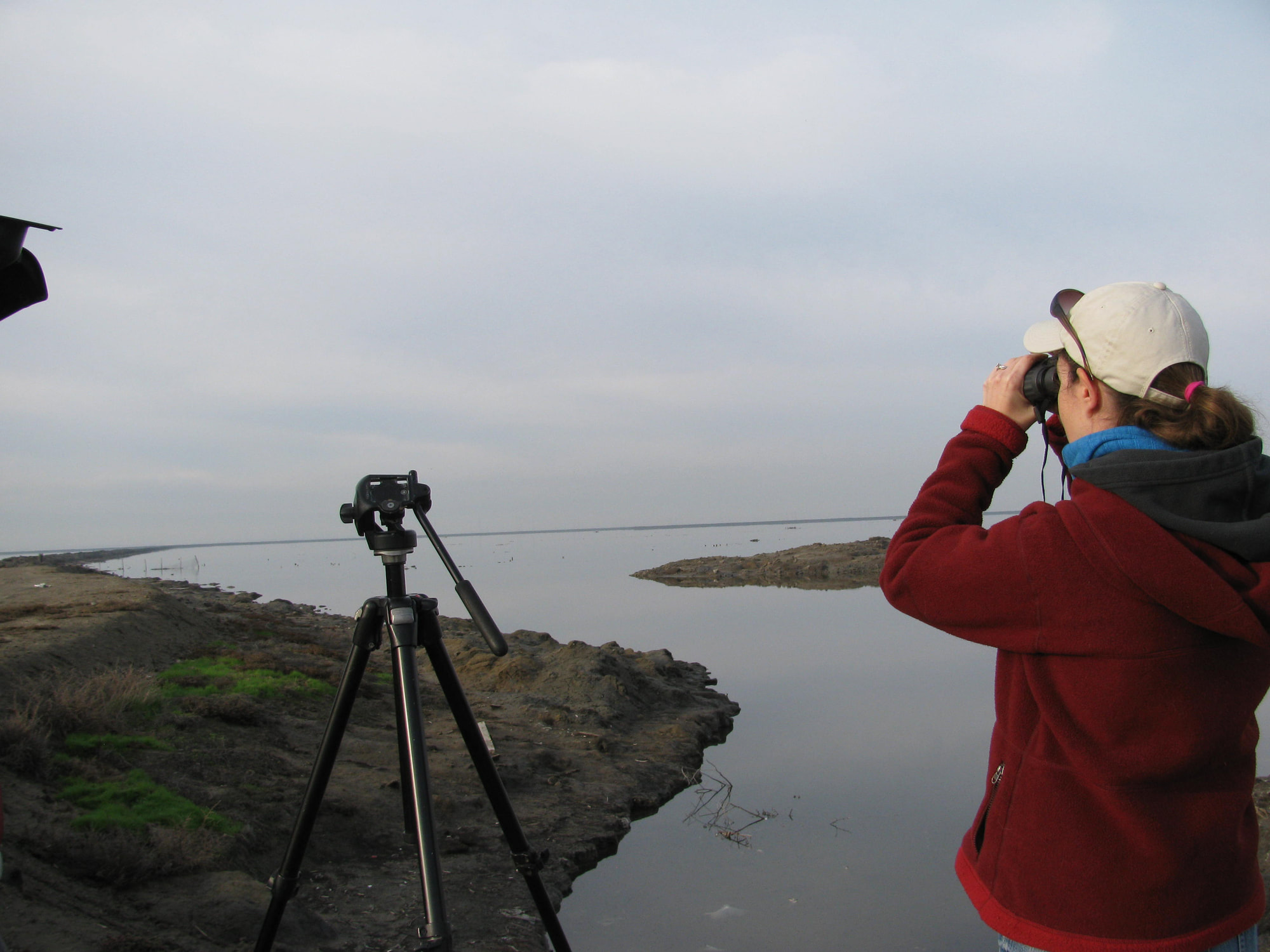

Back in the days of the global shelter-in-place, Nani Welsh, a Science Outreach Intern at SFBBO, created a program bringing together the teenage volunteers at the organization. The idea was to foster a community for teens interested in bird science and conservation and provide mentorship and opportunities to work together through research and outreach projects. Nani reached out to us teens directly, inviting us to be a part of this new program. Virtually gathering together nine of SFBBO’s teen volunteers, we became the first members of the Teen Volunteer Program.
OUR QUESTION
We all had a great interest in human impacts on birds. After much discussion, we chose to investigate the relationship between colonial waterbirds and native vs. nonnative plants out of our interest in the effect of invasive species. Many species of colonial waterbirds build their nests in vegetation such as trees and bushes that includes both native and non-native plant taxa. Therefore, we wanted to investigate whether colonial waterbirds tended to nest in non-native or native plants to shed light on the importance of these plants to different bird colonies. Many considerations should go into the decision to remove or retain non-native plant taxa, particularly those considered to be invasive, and one of these is how native bird species rely on them for nesting.

We studied 26 well-established colonies of various shorebirds and other waterbirds (interactive map). For each of these sites, we collected data on which plants the birds nested on. We tried to identify the plants by collecting photographs and notes from Colonial Waterbird Program volunteers while also using various outside identification resources such as iNaturalist. From here, we were able to observe certain trends between the birds and their nesting tree species.
We found that there was no significant difference between the preferred tree for each studied bird species. However, we did notice a high percentage of colonies using Eucalyptus trees (which are nonnative) for nesting sites. For other plants, the usage was roughly evenly split between native and nonnative plant genera.

WHY DO THESE RESULTS MATTER?
Our results find relevance in the environmental debate over whether Eucalyptus in the Bay Area should be removed. Currently, the debate for and against the removal centers around two issues: the potential fire hazard that trees of the genus Eucalyptus present, and the threat it poses to native mixed-woodland biodiversity. Since our study shows that these trees are widely used by native waterbird populations, it might be worth considering retaining certain swaths of Eucalyptus intact to sustain healthy riparian communities. More investigation is needed to determine the best practices for conserving our native biodiversity and ensuring public safety. It would also be interesting to compare the data of bird-tree pairings with the local tree distribution to find a baseline of the relative local abundance of each tree species. This can give us a clearer picture of trends that might exist between bird species or across regions.
When conducting this study, we encountered challenges that could impact the results. First, identifying the plant species was difficult in many cases due to unavailability of photos or poor quality of photos. When we could not identify the plant species, we excluded the site from our study, which could bias the results. The Colonial Waterbird Program also relies on volunteers to record colonies present at different sites throughout the Bay Area, and lack of volunteer availability can affect the consistency of the data. For example, COVID-19 restrictions impacted the ability of volunteers to assess all the sites. Due to these challenges, we ended up with a small sample size, so our results might not be representative of overall trends in the Bay Area. Nonetheless, our study provides an example of how long-term data collection by scientists and community members can be used to explore questions relevant to avian conservation.
OUR MESSAGE TO YOU
As with many other organisms during this time of rapidly changing environments, colonially nesting waterbirds need our support if they are to remain healthy and thriving. In order to effectively give this support, we all need to spend more of our time and resources on research to help guide more successful conservation efforts. If you’re interested in helping waterbirds in the Bay Area or wherever you live, we encourage you to get involved with SFBBO or with your local bird conservation organization. Make your home and community more friendly to native birds by planting and protecting native plants, help to support local research projects or volunteer as a citizen scientist, and share your enthusiasm for helping birds with those around you!

Peter Covert is a senior at Palo Alto High School, planning to study Chemical Engineering at Stanford University. He has been passionate about ornithology for much of his life – he built and has monitored nesting boxes for chickadees and titmice for about five years, has participated in the ornithology event for his school’s Science Olympiad team, and enjoys spending free mornings hiking and birdwatching. For SFBBO, he has monitored Snowy Plovers and participated in the Teen Volunteer Program.


Lara Tseng is a 16-year-old junior who entered Cal State LA through the Early Entrance Program. She is majoring in biology, focusing on ecology, evolution, and the environment and is also minoring in bioinformatics. Lara is also a 2023 Goldwater Scholar. She hopes to obtain a Ph.D. in ornithology and dedicate her career to pursuing avian evolutionary research. Lara has published a peer-reviewed study on Western Bluebird calcium consumption. Watch her Birdy Hour talk about the study here, and check out her talk on shorebird identification with Jon Dunn here.
Yunjiao Xiao is a junior at Mission San Jose HS, and she also goes by Grace. She is passionate about STEM and plans to major in mechanical engineering. She has been a long-time pet owner, and her animal buddies over the years have included turtles, a pair of parrots, two rabbits that had eight babies, and currently a tuxedo cat named Joy. Grace’s hobbies include painting, camping, and reading web novels. At SFBBO, she has participated in the Teen Volunteer Program and the Avian Disease Prevention Program, working with local biologists in field surveys and identifying (and capturing) dead, sick, or injured waterfowl to prevent the spread of diseases.
