• SFBBO’s Colonial Waterbird Report Relaunches Bigger Than Ever!

    SFBBO’s Colonial Waterbird Report Relaunches Bigger Than Ever!
    By Science Director Dr. Nathan Van Schmidt
    Picture

    ​For over four decades, SFBBO’s Colonial Waterbird Program has sent trained volunteers into the field each spring and summer to watch over the Bay Area’s nesting herons, egrets, cormorants, terns, and gulls. Our annual monitoring report has long been a cornerstone of that effort, combining all the data gathered by our hard-working volunteers on how these majestic birds are faring across the region. In 2020, we undertook a major overhaul of our monitoring protocols to streamline the monitoring protocol. That broke all our old analysis code, and the report went kaput. But that was well worth it for the on-the-ground tradeoff: new volunteers could be onboarded more easily, and more people than ever could participate in avian science! ​And did it ever grow substantially. In 2024, Audubon Canyon Ranch ended their long-running sister monitoring program in the North Bay, and we were able to step in and take the 44 colonies in Marin, Sonoma, Napa, and northern Contra Costa counties under our wing (pardon the pun). That scientific rescue effort required another two years of building relationships, training volunteers, and figuring out logistics before we were ready to publish again. But I’m thrilled to say: the report is back!

    ​Spearheaded by Amy Parsons, SFBBO’s Lead Waterbird Biologist, the new 2025 Colonial Waterbird Monitoring Report summarizes what our community scientists found across 76 active nesting colonies across 82 sites spanning from northern Napa Valley to Santa Cruz. Our monitors documented 2,741 heron, egret, and cormorant nests and 747 tern and shorebird nests—with Double-crested Cormorants as the most abundant nesting species. Some of these rookeries were impressively huge: Dover Park hosted over 250 nests of Snowy Egrets and Black-crowned Night-Herons, and the Alviso pond complex continued to support large concentrations of cormorants, terns, and shorebirds. 
    ​Behind the scenes, we also developed a new mathematical algorithm to estimate fledgling production from our simplified field protocols. For the first time, we can say that the huge Great Egret colony at Gold Hill produced an estimated 284 fledglings! Because our volunteers can’t follow individual nests through their entire lifecycle, we needed a way to correct for double-counting slow-developing chicks on consecutive visits and account for nests hidden by foliage that we know are there but can’t always see. The result is a more rigorous estimate of breeding success that we can apply consistently across all our sites going forward, strengthening the scientific value of the dataset even as we’ve made fieldwork more accessible. Those key measures are going out to both federal agencies like the U.S. Fish and Wildlife Service and local ones like Santa Clara County Parks to help guide their conservation of these keystone birds and their habitats.
    ​One of the report’s most significant stories is about California Gulls, a species that has a reputation of being a management headache in the South Bay for their tendency to predate nests of threatened birds like Snowy Plovers. But here’s where it gets complicated: did you know California Gulls were once also listed by the state as a bird of conservation concern? Their native breeding grounds are at Mono Lake, a salt lake with specialized habitat that they need, and which has long been threatened by unsustainable water withdrawals to Los Angeles. It wasn’t until a few decades back when they were delisted because of the explosive growth of the San Francisco Bay population and an apparent stabilization of Mono Lake’s water levels. But with Mono Lake plagued by continuing water overdraft that has driven collapses in invertebrate prey, our partner scientists there reported 2024 had the lowest-ever count (just 20,258 birds) with chick production collapsing by 97%. Back here in the Bay, our walkthrough surveys found 36,820 breeding adults across 9 colonies in 2025, a 9% decline from the previous year and part of a broader years-long plateau.
    ​Our local population may represent over 60% of the entire state’s breeding birds and roughly 10% of the global population. With South Bay now supporting more breeding California Gulls than Mono Lake, it is a potentially important refugia for California Gulls, even as they pose a risk to the nests of Forster’s Tern, American Avocet, and other sensitive waterbirds. Land managers face the genuinely difficult task of protecting rare shorebirds from gull predation while recognizing that the Bay Area may be this species’ most stable breeding ground in all of California. There are no easy answers, but in May we will get in our kayaks to head back out to the gull colonies to continue gathering the long-term data needed to navigate this tricky situation. 
    ​None of this would be possible without our extraordinary community scientists. In 2025, 118 volunteers contributed over 1,000 hours. That’s equivalent to more than $40,000 in donated labor! They spent their weekends peering through spotting scopes, counting nests, recording disturbances, and building the kind of long-term dataset that no single research team could maintain alone. To every one of you: thank you!!
    And now we’re gearing up for what promises to be our biggest season yet. The 2026 nesting season launches in earnest, with over 100 volunteers trained and ready to head into the field. It’s the largest monitoring effort in the program’s history. That said, we still have a few colony sites in the North Bay that need dedicated monitors. If you or a birder you know in Marin, Sonoma, or Napa County would like to contribute to real conservation science while getting to know your local waterbirds intimately (or if you’re in South Bay and want to join us for California Gull Walkthroughs in May) just email Amy to get involved!
  • SFBBO Wraps Up Massive Levee Planting Effort

    SFBBO Wraps Up Massive Levee Planting Effort
    By Science Director Eric Lynch
    Picture

    SFBBO’s Habitats Team is wrapping up its initial planting of the roughly 2 miles of new levee just constructed at Don Edwards NWR in Alviso. The new levee, which is actually an old levee that was raised about 9 vertical feet, comprises Reaches 1-3 of the South San Francisco Bay Shoreline Project’s Flood Risk Management levee. This levee is designed to protect low-lying South Bay shoreline communities like Alviso from the increasing flood risk brought on by sea level rise. Once additional reaches of the levee are complete, it will also help facilitate the restoration of thousands of acres of former salt ponds to tidal marsh.

    With generous funding from the State Coastal Conservancy, and help from wonderful partners like the U.S. Fish & Wildlife Service, Valley Water, and H. T. Harvey, SFBBO spent the last 3 years rebuilding a native plant nursery at Don Edwards NWR in Fremont, and then grew over 35,000 plants for the new levee. Most of these plants were installed at the “toe” of the levee to help prevent erosion from wind waves and facilitate the rapid establishment of native plant communities that will benefit local wildlife. 
    Salt-tolerant stands of pickleweed, salt grass, alkali heath, marsh gumplant, and salty susan will provide habitat for a variety of species at the toe of the levee, and large patches of salt grass placed along the mid-slopes of the levee will provide low, invasion-resistant grassland for foraging birds. A few tidal and tidal-adjacent areas were planted with a greater diversity of plants often found in upland areas adjacent to marshes. The hard-working members of the San Jose Conservation Corps helped the hard-working members of the Habitats team complete the planting over a period of about 2 months. The rest of the levee was treated with a mix of native seeds and goldfields, tidy tips, red maids, and fiddlenecks are currently blooming in great abundance.
    The levee is currently open to visitors after 3 long years of closure for construction work. Reach 1 can be accessed from Alviso Marina County Park, and Reaches 2-3 can be accessed from the Don Edwards Alviso Environmental Education Center. Visitors can connect the two levee sections by taking a long detour north to cross the Union Pacific Rail Road tracks which bisect the levee. SFFBO’s work is not done out there – we have 3 years of managing vegetation, surveying results, replanting, and reseeding the levee to help usher it through its early years. We hope you’ll come out and visit the levee to enjoy some spring flowers, birding, and wide open views. If you see our staff working out there, please stop and say hello!
  • Closing Out 2025 with a Bang – Plover and Tern Report

    Closing Out 2025 with a Bang – Plover and Tern Report
    By Science Director Maddy Schwarz
    Picture

    ‘Twas the day before New Year’s and all through the house, biologists were typing and rereading paragraphs aloud…
     
    It’s a cruel fact that projects are often due on the last day of the month, meaning that if it was a year-long project, it’s due on the last day of the year. Therefore, before you head out to your New Year’s Eve festivities, you must first cobble together whatever brainpower survived the onslaught of holiday cookies and poor sleep decisions during the week between Christmas and New Year’s and submit! that! final! report! While generally not anyone’s preferred New Year’s Eve activity, if you’re lucky, the project you’re finishing is interesting and worthwhile. The kind of project that makes you reflect on what you accomplished during the year, appreciate how much you learned, who you worked with, and how your efforts illuminated a new corner of the world you hadn’t considered before.

    ​Happily, this was the case for the project I was finishing on New Year’s Eve 2025. The Plover and Tern Program at SFBBO received a Section 6 grant from the US Fish and Wildlife Service and the California Department of Fish and Wildlife in August 2024 that provided funding for our biologists to deploy Motus tags on western snowy plovers at Eden Landing Ecological Reserve in Hayward. Although Motus tags have been used on snowy plovers in the Great Salt Lake and Mexico, our project is the first one to deploy them on the federally listed population. We were also testing an aspect of the technology that would allow us to track finescale movement within individual ponds. We partnered with two additional snowy plover biologists in the Bay, Ben Pearl, who longtime readers may recognize as the former Plover and Tern Program Director at SFBBO, and Carleton Eyster, a renowned plover biologist who has been studying the species since the 1990s.
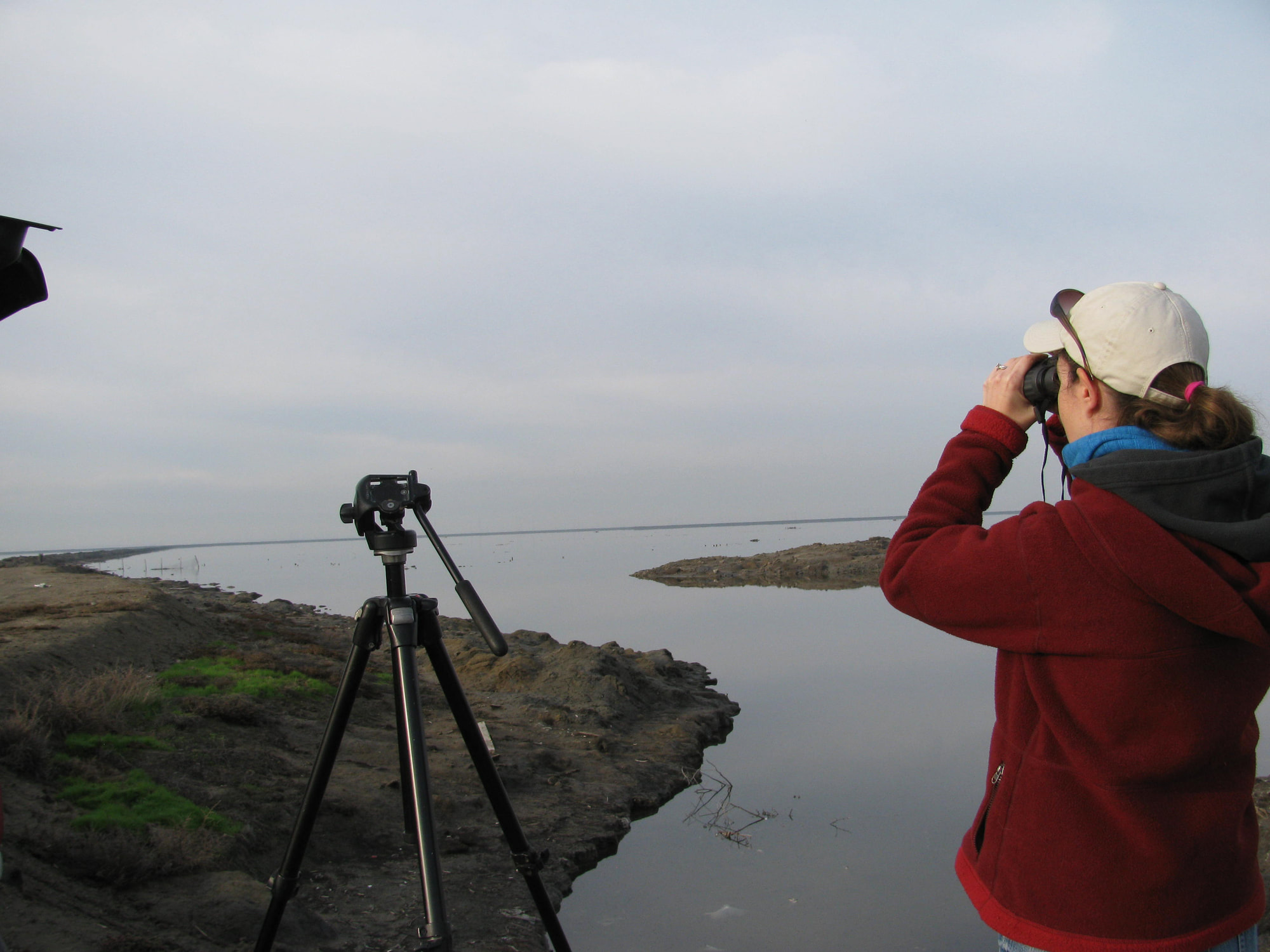
    ​After a year of hard work that involved 12-hour build days, walking 40 grams of raw chicken on the end of a tripod across Eden Landing, waiting at nests until 1am to capture adult male plovers, and sorting through 5 million lines of data, we had arrived at the finish line. What did we have to show? ​Many interesting things!
    ​Incubating plovers spend a lot of time at their nest. On first glance, this seems obvious. Of course they’re spending a lot of time at their nest, where else would they be? But plover pairs typically divide their incubation duties into shifts. The males are supposed to incubate at night and the females are supposed to incubate during the day. This allows the other sex to leave and forage or roost for half the day. During our regular daytime surveys, we usually observe the female on the nest by herself and the male is nowhere to be found. However, the Motus data showed that while the other adult did leave and forage when they weren’t incubating, they still spent a lot of their “free time” near the nest. This also allowed them to sneak in short incubation stints even when they weren’t “supposed” to be incubating. This shows that the day/night split between females and males is not so straightforward and is likely unique to each pair.
    Picture
    Figure 1: Flight path of the banded snowy plover female, Ka:wr, showing her journey from Eden Landing in Hayward, California to Bolinas, California.
    ​Plovers really love water! A trend we noticed immediately is that when birds weren’t at their nests, they were finding a wet area of a pond to forage along. This makes sense when you consider that plovers are shorebirds. They’re adapted to eat small invertebrates that occur along the tideline. It makes perfect sense that they would seek out the water’s edge on salt ponds as well. SFBBO has always understood that good foraging habitat includes water, but this project really helped us visualize just how much time plovers spend foraging. The plover program is primarily focused on ensuring plovers have adequate breeding habitat in the Bay Area, and while that is definitely still important, this project has inspired us to think about foraging habitat more intently as well.
    ​And finally, some of the birds we tagged went to many different places! The Motus tags that we used don’t just tell us information about where individuals are in Eden Landing, they can also ping any other Motus tower in the world. From pings we received from towers outside Eden Landing, we know that our birds have gone to Point Reyes, China Camp State Park, Don Edwards National Wildlife Refuge, Milpitas, Napa-Sonoma Marshes Wildlife Area, and the Channel Islands! We have always known that plovers disperse to a variety of areas in the winter, but it was so exciting to see just how many different places they went.
    Picture
    Figure 2: Series of heat maps showing the locations of a banded, incubating pair (male Gk:og, female Ka:wr) split into daytime and nighttime. The maps show that both adults spend the majority of their time at the nest during a 24-hour cycle, but that the female will forage in additional areas during the night and the male will forage in additional areas during the day.
    As a biologist, I spend so much time staring through a scope, hoping to get a quick peek into a plover’s life, knowing that it is only a tiny snapshot, and accepting that I will never get to see the vast majority of their life. It’s not that typical survey methods don’t work or are inadequate: I am consistently amazed by how much information we’re able to acquire from a weekly survey alone. But when the opportunity comes along to crack open the puzzle a little wider and peer into the vast network of interactions we call ecology, it’s impossible not to feel the excitement. The maps that we generated from the Motus data and included in the final report for this project took an astronomical quantity of information and condensed it into a representation that our human brains can easily interpret. When I look at one of these maps and understand the habits of a tiny bird that I may have never seen with my own eyes, it feels like magic. 
  • The Story of the Marsh: The Marsh We Share

    The Story of the Marsh: The Marsh We Share
    ​By Guest Blogger Jesse Amital
    Picture

     As part of our ongoing work to connect people with the Bay’s natural landscapes, we’re sharing a series that explores the story of San Francisco Bay’s tidal marshes — their history, science, and the community efforts that keep them thriving.

    San Francisco Bay’s tidal marshes do more than shape the shoreline. They filter water, buffer nearby communities from storms, and store carbon that would otherwise contribute to a warming climate. These wetlands are also home to wildlife found nowhere else, including species specially adapted to life in the tides.

    Critically, many of these marshes are public lands — protected within the San Francisco Bay National Wildlife Refuge Complex, and open for people to explore, learn, and connect with the Bay. These places endure because people choose to care for them. Every act of stewardship, every visit, and every voice raised for conservation helps keep these wetlands thriving. When we show up for the marsh, we help ensure it remains open, healthy, and vibrant for generations to come.
    Picture
    Photo by Amanda Newlove
    Learn more about our ongoing tidal marsh restoration work at sfbbo.org/tidalmarsh.
  • The Story of the Marsh: Shelter for Vulnerable Species

    The Story of the Marsh: Shelter for Vulnerable Species
    ​By Guest Blogger Jesse Amital
    Picture

    As part of our ongoing work to connect people with the Bay’s natural landscapes, we’re sharing a series that explores the story of San Francisco Bay’s tidal marshes — their history, science, and the community efforts that keep them thriving.

    The Bay’s tidal marshes are humming with song and motion — and we’re working to help keep them that way. At Eden Landing Ecological Reserve, SFBBO’s restoration teams and partners are rebuilding habitat that endangered species depend on, including the Ridgway’s Rail, Salt Marsh Harvest Mouse, and Western Snowy Plover.

    Years of restoration and monitoring have helped create safer places for these species to nest, feed, and recover. Every acre we restore offers another opportunity for survival, and shows what steady, long-term conservation can achieve.

    Learn more about our ongoing tidal marsh restoration work at sfbbo.org/tidalmarsh.
  • The Story of the Marsh: Data, Dirt and Discovery

    The Story of the Marsh: Data, Dirt and Discovery
    By Guest Blogger Jesse Amital
    Picture

    As part of our ongoing work to connect people with the Bay’s natural landscapes, we’re sharing a series that explores the story of San Francisco Bay’s tidal marshes — their history, science, and the community efforts that keep them thriving.

    The marsh’s recovery is unfolding through a combination of science and stewardship, as recent projects show.

    At Pond A17, our team has been studying how different soil treatments and seeding techniques support native marsh vegetation.

    By testing and monitoring these methods over time, we’re learning what makes tidal wetlands more resilient in the face of changing environmental conditions. Volunteers — including students from San José State University — support these efforts by collecting data and tracking plant growth, turning each field season into applied restoration science.

    ​That spirit of hands-on involvement extends to Alviso Marina County Park, where more than 1,000 local 5th and 6th graders from Title I schools have helped plant native species and restore marsh habitat through our partnership with educational nonprofit Marshmallow Minds.
    Through these experiences, students discover that they can play an active role in conserving their local environment.
    Picture
    Photo by Amanda Newlove
    Every seed sown, dataset collected, and young person inspired helps shape the marsh’s future.

    Learn more about our ongoing tidal marsh restoration work at sfbbo.org/tidalmarsh.
  • The Story of the Marsh: From Seeds to Roots

    The Story of the Marsh: From Seeds to Roots
    By Guest Blogger Jesse Amital
    Picture

    As part of our ongoing work to connect people with the Bay’s natural landscapes, we’re sharing a series that explores the story of San Francisco Bay’s tidal marshes — their history, science, and the community efforts that keep them thriving.

    Our story with the marsh began at Pond A6. In 2010, we helped restore 330 acres of a former salt-production pond to tidal action, reopening the area to the natural ebb and flow of the Bay. We scattered native seeds across the newly restored marsh in an aerial seeding effort that helped jump-start plant growth and stabilize the soil. It worked: today, Pond A6 teems with life, from song sparrows trilling in the reeds to herons and rails hunting along the channels.

    A few years later, our work expanded to Bair Island, another vital piece of the Bay’s wetland puzzle. In 2015, we partnered with local organizations and volunteers to till and weed levees, spread seed by hand and via hydro-seeding, and plant nursery-grown species across 15 acres in three fall phases. Since then, we’ve continued to monitor and care for the site, tracking the marsh’s recovery through a community-powered photo monitoring project — a living time-lapse of resilience in motion.
    In 2024, Bair Island’s story reached the national stage when Secretary of the Interior Deb Haaland visited to celebrate federal investments in natural infrastructure. Her visit underscored what we’ve known all along: when communities, scientists, and leaders work together, restoration can not only succeed — but inspire others across the country.

    Together, these projects reflect a simple truth: restoring the Bay’s tidal marshes takes persistence, partnership, and hope.

    Learn more about our ongoing tidal marsh restoration work at sfbbo.org/tidalmarsh
  • The Story of the Marsh: From Salt to Sanctuary

    The Story of the Marsh: From Salt to Sanctuary
    By Guest Blogger Jesse Amital
    Picture

    As part of our ongoing work to connect people with the Bay’s natural landscapes, we’re sharing a series that explores the story of San Francisco Bay’s tidal marshes — their history, science, and the community efforts that keep them thriving.

    Once salt flats — now a living marsh.

    For decades, the South Bay Salt Pond Restoration Project has been transforming former industrial salt ponds across the Bay into thriving tidal wetlands. These restorations turn salty, barren landscapes into dynamic ecosystems alive with water, vegetation, and the calls of nesting shorebirds.

    Through this ongoing effort — the largest wetland restoration project on the West Coast — scientists, land managers, and volunteers are helping nature reclaim its rhythm. Each restored pond becomes a new refuge for wildlife and a buffer that protects nearby communities from rising tides.
    Ravenswood salt flats prior to restoration in 2008
    Restored habitat at Ravenswood Pond SF2 with nesting islands, 2015
    To see more of this incredible transformation, visit southbayrestore.org — and learn more about SFBBO’s tidal marsh restoration and monitoring work at sfbbo.org/tidalmarsh.
  • The Story Of The Marsh: The Beginning

    The Story Of The Marsh: The Beginning
    By Guest Blogger Jesse Amital
    Picture

    As part of our ongoing work to connect people with the Bay’s natural landscapes, we’re sharing a series that explores the story of San Francisco Bay’s tidal marshes — their history, science, and the community efforts that keep them thriving.

    Tidal marshes are the beating heart of San Francisco Bay — a Ramsar Wetland of International Importance that supports over a thousand animal species and protects our communities from floods and rising seas.

    Once diked and drained for salt production, these wetlands are now the focus of one of the largest restoration efforts on the West Coast. Through projects that blend science, stewardship, and collaboration, we’re helping return the tides — and life — to the Bay’s marshes.

    ​From aerial seeding and community planting to long-term monitoring and education, each restoration site tells a story of resilience and renewal. Together, these efforts reveal what’s possible when people and nature collaborate.


    Learn more about our tidal marsh restoration work and explore current projects at sfbbo.org/tidalmarsh.
  • Spring Community Outreach for Birds

    Spring Community Outreach for Birds
    By Communications and Marketing Director Kristin Butler
    Picture

    This spring our staff and community outreach volunteers have been busy teaching about conservation science and advocating for birds at our Coyote Creek Field Station and at events in the wider community.

    ​This is part of our mission to engage communities in avian science, habitat restoration, and education. 

    ​We brought science to life at the Wildlife Society’s Earth Month Kickoff and engaged 118 visitors through interactive education about bird migration, sparking curiosity and dialogue about the importance of conservation. 

    SFBBO’s Landbird Banding Team welcomed students and community members into the field for hands-on bird science experiences. 
    Fourth Graders from Russo McEntee Academy visited CCFS for their second annual bird banding experience, exploring different habitats and learning about scientific data collection.
    Picture
    We brought bird conservation education to students at Santa Clara’s Earth Day and Arbor Day event where we taught young visitors and their families about birds.
    Members from Golden Gate Bird Alliance joined us at CCFS for bird banding demonstrations, expanding our network of engaged bird conservation advocates.