• Corporate Volunteers Banding Together to Save Tidal Marshes

    Corporate Volunteers Banding Together to Save Tidal Marshes
    ​By Habitats Seasonal Ecologist Emily Cech
    Picture

    ​One of my favorite aspects of working with SFBBO has been community involvement. Over the past six months, I have had the opportunity to help lead corporate volunteer events with Intuitive SurgicalCisco, and Electronic Arts.

    ​It is truly powerful having people from different backgrounds and professions coming together to make a difference. With the continuing rise in sea level, it is now more important than ever to protect 
    tidal marshes. Tidal marshes not only provide habitat for wildlife, but also act as refuge for sensitive species at high tide and protect …

    neighboring communities from flooding.

    In December 2017, Intuitive Surgical planted native species, such as California rose (Rosa californica), saltgrass (Distichlis spicata), and poverty weed (Iva axillaris) at one of SFBBO’s restoration sites, Pond A17, in Alviso, CA. Planting these natives not only promotes a more diverse plant community, but also provides critical habitat for sensitive wildlife.
     
    In this same month, Cisco came out to our nursery located at the Don Edwards San Francisco Bay National Wildlife Refuge Environmental Education Center in Alviso, CA. They seeded about 200 alkali mallow (Malvella leprosa) into plug flats. We will continue to care for these natives in our nursery until they have grown to a point where they are ready for planting out at Pond A17.
     
    In May and June 2018, Electronic Arts volunteered with us at another one of SFBBO’s restoration sites, Inner Bair Island, in Redwood City, CA. They participated in the removal of highly invasive species: crown daisy (Glebionis coronaria) and mustard (Brassica sp.). These species have the capability to overtake habitats and outcompete beneficial native plants.
    The effort put in from these volunteers is crucial. Clearing out these invasive plants will give natives a more optimal chance to establish and create a more suitable habitat for fauna. Electronic Arts also collected salt marsh sand spurry (Spergularia marina) seeds onsite. To continue our efforts in establishing a more stable community of native plants, these collected seeds will eventually be spread across the site.
     
    My experiences working with corporate volunteers has been truly priceless. Each person brought such a sense of interest and enthusiasm. It was very inspiring to witness such a willingness to learn about tidal marshes. We owe so much to the hard work of all of our wonderful volunteers! Thank you for your help!

    You can reach Emily at [email protected]. You can learn more about volunteering your corporate group by visiting our website. 
  • Local Students Experience Bird Banding at CCFS

    Local Students Experience Bird Banding at CCFS
    By Education Specialist Tonya Anderson
    Picture

    “I’m officially a bird now!” a 6th grader said, pointing to the new “bird band” made of pipe cleaner and numbered beads on her ankle.
     
    Another middle schooler laughed, “I’m trying to measure him, but he won’t stop dabbing!”
     
    They and around 60 of their classmates were visiting SFBBO’s Coyote Creek Field Station in May. They’d arrived in a yellow bus at 8:00 a.m., early enough to see bird species they had learned about in class. The kids were separated into three groups. I led the station where …

    students, including the girl who dubbed herself “Official Bird,” collected data on each other as if their partners were banded birds.
     
    Later, my first group of newly “banded” students watched Landbird Biologist Dan Wenny extract passerines from mist nets, and observed Landbird Program Director Josh Scullen band and collect data on the birds.
     
    Sixty students can be rambunctious, but handling birds is quiet work and the kids became hushed as they got to see 13 tiny birds face-to-face. As each bird emerged from a net or a bird bag, the students jostled to take pictures with their smartphones—capturing the rarity of seeing such delicate wildlife up close.
     
    The unique experience was possible thanks to a Measure Q Urban Open Space Grant SFBBO received from the Santa Clara Valley Open Space Authority, which aims to advance environmental literacy for children through science-based programs.
    Around 500 6th and 7th grade students from two Santa Clara County schools, Windmill Springs Elementary School and Sheppard Middle School, involved in the project visited CCFS in May. The fieldtrips were the final component of a two-part education curriculum module developed by SFBBO with the grant funding.
     
    In the first module, students learned about migratory bird patterns in class. I think what was most special about this module was that youth got access to real, meaningful bird data lovingly collected by CCFS volunteers and staff over more than 35 years. What was most meaningful to me about the second module was getting to see the data I helped collect as a volunteer bird bander come alive in the eyes of young scientists.
     
    May’s activities were a pilot, and feedback indicates that the kids enjoyed their morning immersed in nature, got to apply scientific ideas where real-world science happens, and successfully recalled the IDs of several bird species in the field. SFBBO is making updates to the curriculum and it will soon be available online for free.

    You can reach Tonya at [email protected]. You can learn more about our outreach program on our website.
  • Support Bird Conservation Outreach Through Our 2018 Spring Appeal

    Support Bird Conservation Outreach Through Our 2018 Spring Appeal

    By Executive Director Yiwei Wang 

    ​Last month, we had over 250 6th grade students from Windmill Springs Elementary School and Sheppard Middle School visit our banding station near Coyote Creek.

    If you watch this video, you can sense and hear the excitement as students see bushtits for the first time or learn about the science behind bird banding, only miles away from where they go to school. These field trips for local students are some of our newest educational initiatives, and SFBBO is excited to continue bringing our science to local communities, but we need your help to …
    Picture

    ​Last month, we had over 250 6th grade students from Windmill Springs Elementary School and Sheppard Middle School visit our banding station near Coyote Creek.

    If you watch this video, you can sense and hear the excitement as students see bushtits for the first time or learn about the science behind bird banding, only miles away from where they go to school. These field trips for local students are some of our newest educational initiatives, and SFBBO is excited to continue bringing our science to local communities, but we need your help to …

     make it happen!  

    We are entering the last two days of our Spring Fundraising Drive, with $2000 needed to reach our goal. Money we receive during this period is dedicated towards our outreach and environmental education efforts throughout the year.

    With your support, we have trained hundreds of people to be citizen science volunteers, brought our science lessons to local libraries and Boys and Girls Clubs, and engaged with underserved groups at local Veterans Health Administrations.

    ​Donors like you also provide matching funds, which helped us secure a grant from the Open Space Authority for our banding station field trips. Please help us continue our important outreach programs by making a donation today!

    You can reach Yiwei at [email protected]. You can learn more about our Outreach program on our website.

  • From Drought to Floods, Great Blue Heron Colony on the Rise

    From Drought to Floods, Great Blue Heron Colony on the Rise

    By Guest Blogger Jackie Vargo

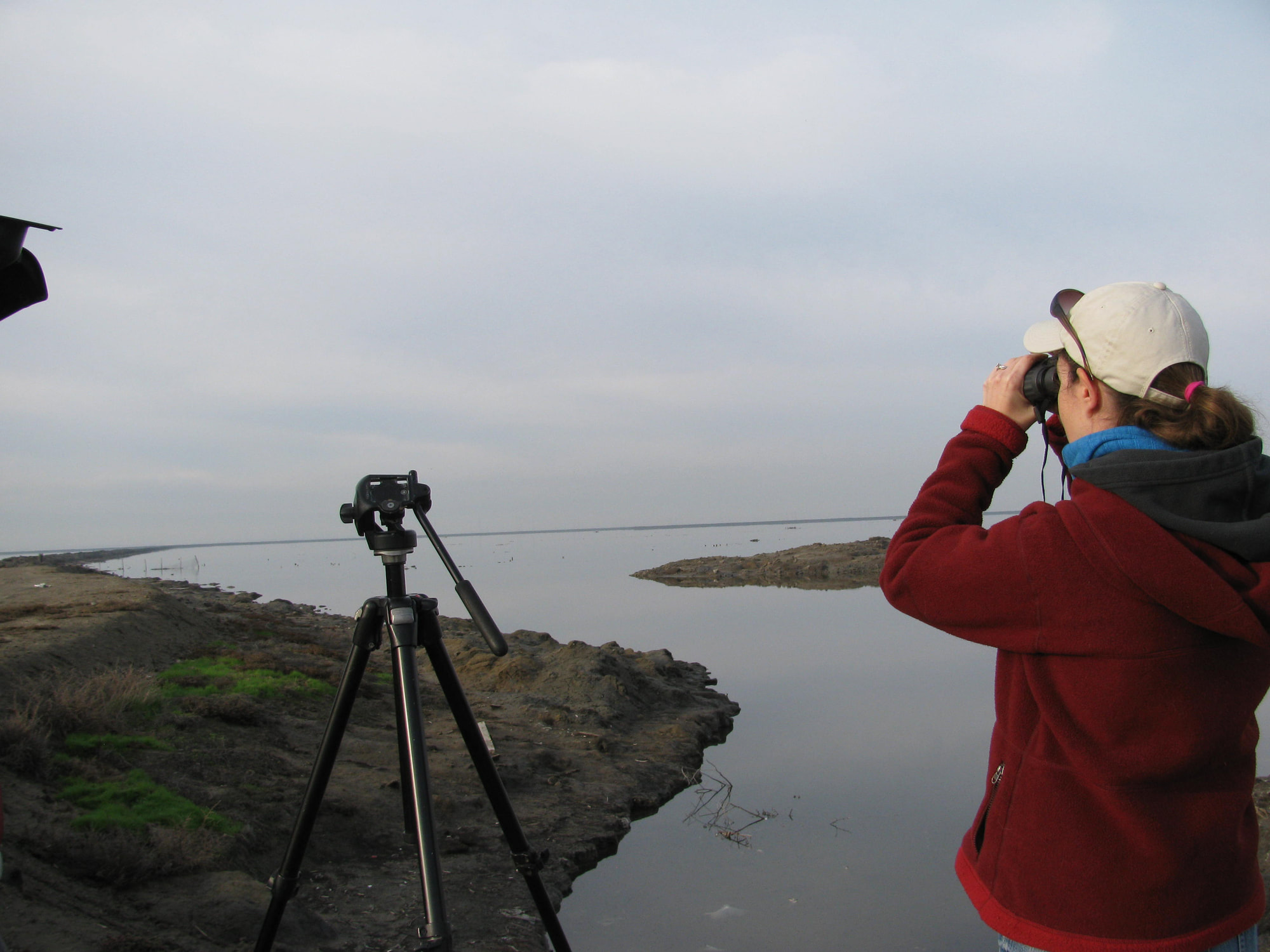
    I’ve been a citizen scientist for SFBBO’s Colonial Waterbird Program since 2014 and monitor a colony of Great Blue Herons that nest at Coyote Ranch Road in San Jose. Over the past four years I’ve noticed that weather has impacted my colony, but I am happy to report that this year my Great Blues are on the rise!

    In 2013, there had only been  4 nests, 3 adults, and 3 young in the Fremont Cottonwoods where they liked to nest. The year I started volunteering I observed that the small canyon below the land where Fremont Cottonwoods stood was mostly dry, ​as was much of the …
    Picture

    I’ve been a citizen scientist for SFBBO’s Colonial Waterbird Program since 2014 and monitor a colony of Great Blue Herons that nest at Coyote Ranch Road in San Jose. Over the past four years I’ve noticed that weather has impacted my colony, but I am happy to report that this year my Great Blues are on the rise!

    In 2013, there had only been  4 nests, 3 adults, and 3 young in the Fremont Cottonwoods where they liked to nest. The year I started volunteering I observed that the small canyon below the land where Fremont Cottonwoods stood was mostly dry, ​as was much of the …

    nearby Coyote Creek, with the exception of a small pond. At that point the San Jose drought was in full swing, so having any water there was a blessing!

    Over the next couple years my colony’s population had its highs and lows, but the low point was reached in 2016, when there was only a maximum of 3 nests and 2 young seen at one time.  While it is possible that nests and birds were hidden in the dense Fremont Cottonwood foliage, there was minimal chick “cackling” or flying adults. It almost seemed as if my colony was not going to last another year.  


    Miraculously, though, the torrential rains in 2017 helped the colony survive and the two Fremont Cottonwoods near Coyote Ranch Road and the Coyote Creek Trail slowly started to be the “place to be” for Great Blue Herons. I even saw a Great Egret nest with 3 egrets, although it didn’t last very long.
    This year the canyon below the Fremont Cottonwoods is completely filled with water, and at some points the Coyote Creek trail was even flooded. On June 1st the colony boasted 14 nests, with 12 young and 14 adults, the highest number of nests and birds since before 2012!   

    Monitoring so many nests is fun because I get to watch the Great Blue Herons’ behavior. There is plenty of time to watch in awe as the parents fly up to the cackling juveniles and just stand there and take it as the kids fight over who gets to bug them for food first. The parents are so admirably patient! And as I wait with my scope pointed at the nest to see if there is actually another chick hiding low, I have to be patient too. It’s definitely worth the wait. 

    You can learn more about our Colonial Waterbird Program on our website.    ​​
  • Exploring Ulistac with the “Steph Curry” of Birders

    Exploring Ulistac with the “Steph Curry” of Birders
    By Guest Blogger Karan Gathani
    Picture

    ​I’ve always had a penchant for spotting birds in the wild. But for years the number of times I’d spotted a “life bird” (a fancy way of saying a new bird species sighting I can’t wait to boast about) were few and far between. So I started to piggyback with other hobbyist birders to learn more about the birds around us and with their help I got better at striking more birds from my “lifers” list.

    I’d thought I’d seen it all until I joined an SFBBO bird walk led by birder Chris Johnson on a Sunday morning earlier this month ​at Ulistac Natural Area in Santa Clara. Interestingly, Chris’s …

    walk didn’t start with a bird sighting but instead with the sighting of a gray fox! Following that brief cameo, Chris led us to different parts of Ulistac and showed us various birding stations around the park.

    Now if you’ve never been on a walk with Chris before, I would highly recommend it! Watching Chris identify birds is like watching Steph Curry from the sidelines! To my eyes and ears it was really hard to distinguish birds apart. But Chris was able to identify a bird with the same ease that Steph uses to snatch those three point shots!

    During the walk, Chris taught us how to tell the males apart from the females by their distinctive markings and their plumage differences, and also how to pinpoint a bird’s species just by its sounds or shape alone. 
    By the end of the 90 minute walk we had spotted 26 species, including several California Scrub-Jays, Northern Rough-winged Swallows, Song Sparrows, Hooded Orioles and a White-breasted Nuthatch, just to name a few.
     
    Towards the end of the walk we came across the same fox, which had been joined by a friend, and nether of them were a tad bit shy of humans. I thought perhaps they were there to pose for a photo, and hoped they’d regain their natural wariness toward humans for their own protection.

    The walk made me realize there is so much wildlife coexisting with humans in urban areas even though you may not observe it. This is why I think supporting SFBBO’s programs, such as habitat restoration and environmental education, is so crucial if we want to pass on this incredible beauty to future generations. 

    Karan Gathani is a citizen science and outreach volunteer for SFBBO. Chris Johnson is a volunteer bird walk leader with SFBBO. His next SFBBO walk will be in September (date and location TBD). You can learn more about our Outreach program on our website
  • Family Science for Conserving Birds

    Family Science for Conserving Birds

    By Science Outreach Intern Kyle Wong

    ​During my time interning at SFFBO so far, our Family Science Nights have rapidly become one my favorite programs! Last month, we had a blast at the Family Science Night at Forest Hill Elementary in San Jose.

    We brought three interactive stations to the multi-purpose room on May 21st that challenged both the kids’ and their parents’ analytical and artistic skills.

    ​At the event one of our volunteers, former SFBBO biologist Emily Moffitt, and I facilitated the 
    Snowy Plover activity table. First, we united the …
    Picture

    ​During my time interning at SFFBO so far, our Family Science Nights have rapidly become one my favorite programs! Last month, we had a blast at the Family Science Night at Forest Hill Elementary in San Jose.

    We brought three interactive stations to the multi-purpose room on May 21st that challenged both the kids’ and their parents’ analytical and artistic skills.

    ​At the event one of our volunteers, former SFBBO biologist Emily Moffitt, and I facilitated the 
    Snowy Plover activity table. First, we united the …

    brains of parents and children in an activity where participants used real plover population data to create graphs. After they constructed their graphs and investigated the causes of plover population decline, the kids were challenged to create posters that teach other people the Snowy Plover’s plight.

    Throughout the night, the kids consistently asked great questions and demonstrated beautiful artistic ability. One girl even spent half of the event working on her poster! Some of our other activity themes at the event included banding landbirds and observing waterbirds in the field.
    Seeing both kids and their parents leave the event with smiles on their faces was extremely gratifying. One of the parents repeatedly thanked us and encouraged us to come back next year. One of my favorite aspects of this program is that it is free. It also helps us to stay true to our mission to conserve birds through both science AND outreach.

    We currently run these family events at Bay Area schools, libraries, and Boys and Girls Clubs, and most recently offered one at the Milpitas Library on June 11.

    You can contact Kyle at [email protected]​. You can learn more about our Outreach program on our website​​
  • Welcome to SFBBO’s New Blog, Wingbeat!

    Welcome to SFBBO’s New Blog, Wingbeat!
    By Outreach and Communications Director Kristin Butler
    Picture

    ​​In our new blog you will find interesting and inspiring stories about our work to conserve birds and their habitats through science and outreach.

    Whether it’s information about our latest scientific discovery, a story about our wonderful volunteers, an invitation to an upcoming event, or a call to action for bird conservation, Wingbeat will engage readers in our mission. Many of our blog articles will be penned by our science and …

    outreach staff, but we also invite our volunteers, donors, partners, and other people from the science and conservation community to write guest posts for us. Articles should be 200-400 words and we especially love when they include a photo, map, or graphic!

    If you are interested in contributing to our blog, please contact Outreach and Communications Director Kristin Butler at [email protected]​​