
By Waterbird Lead Biologist Victoria Heyse

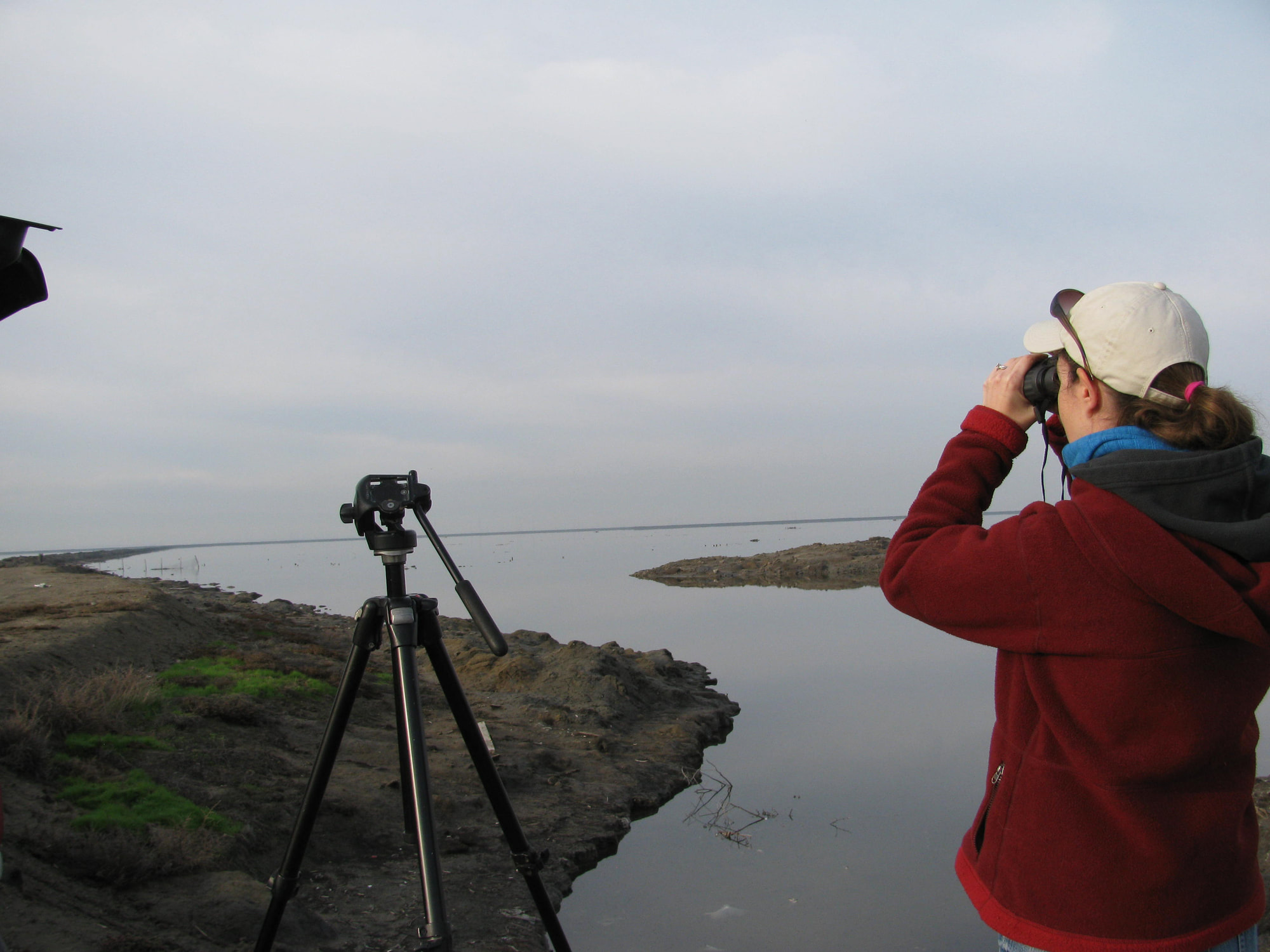
Every May, our volunteers and biologists walk through all California Gull colonies in the South Bay to estimate the breeding population. This volunteer experience isn’t for the faint of heart! It can be hard to hear yourself think, let alone stay focused enough to tally nests, as thousands of screaming gull parents fly towards your helmet, occasionally making contact with a kick or beak strike. You’ll escape the colony unscathed by gull poop only if you’re lucky.
We have monitored the South Bay gull population for almost 40 years. In the early 1980’s there were only 24 breeding California Gulls, and …
in 2013 that number peaked at over 50,000! One of the reasons why gulls are successful in our urban environment is due to their ability to take advantage of human food sources, such as garbage. You can see past years’ numbers in our Colonial Waterbird reports.
This year 19 volunteers helped us count 46,766 adults, up from 43,570 in 2017. The Palo Alto Flood Control Basin was the largest colony for the 4th year in a row, clocking in at a whopping 19,350 breeding adults (the largest it’s ever been, up over 3000 birds from last year). You can check out more photos on my Flickr page.
We also documented a lot of movement between colonies this year. This is interesting because it shows that gulls have a lot of options when it comes to nesting space in the bay. We notify land managers of gull colony changes so that they can implement methods (such as hazing) to discourage gull colony growth and decrease the risk of gull predation on the eggs and chicks of other nesting waterbirds such as stilts, avocets, terns, and plovers. The gull population in the South Bay is no longer showing exponential increase which begs the question of what is influencing carrying capacity if it isn’t nesting space; perhaps it is food availability or nest predators.
This year 19 volunteers helped us count 46,766 adults, up from 43,570 in 2017. The Palo Alto Flood Control Basin was the largest colony for the 4th year in a row, clocking in at a whopping 19,350 breeding adults (the largest it’s ever been, up over 3000 birds from last year). You can check out more photos on my Flickr page.
We also documented a lot of movement between colonies this year. This is interesting because it shows that gulls have a lot of options when it comes to nesting space in the bay. We notify land managers of gull colony changes so that they can implement methods (such as hazing) to discourage gull colony growth and decrease the risk of gull predation on the eggs and chicks of other nesting waterbirds such as stilts, avocets, terns, and plovers. The gull population in the South Bay is no longer showing exponential increase which begs the question of what is influencing carrying capacity if it isn’t nesting space; perhaps it is food availability or nest predators.


SFBBO also looks to resight banded gulls during these walkthrough surveys in order to track their movements over time. SFBBO has banded over 10,000 gulls since 1983. Thanks to this banding effort, when salt pond A6 was restored to tidal action in 2010 as part of Phase 1 actions of the South Bay Salt Pond Restoration Project, we could track where some of the 23,000+ displaced birds went. Even though the last bands were deployed nearly a decade ago, we re-sighted over 30 gulls this year! The most interesting re-sight was a 33 year old gull, banded as a hatch year at a colony in Fremont on May 31st 1985!
California Gull population growth remains a pressing concern for management of the San Francisco Bay estuary. Information on what drives gull population growth and how gulls respond to landscape changes will help predict the ecological impact of future tidal marsh restoration activities in San Francisco Bay. This research was supported by the Santa Clara Valley Water District and donations from the community.
You can reach Waterbird Lead Biologist Victoria Heyse at [email protected]. You can learn more about our gull surveys and how to volunteer on our website.
California Gull population growth remains a pressing concern for management of the San Francisco Bay estuary. Information on what drives gull population growth and how gulls respond to landscape changes will help predict the ecological impact of future tidal marsh restoration activities in San Francisco Bay. This research was supported by the Santa Clara Valley Water District and donations from the community.
You can reach Waterbird Lead Biologist Victoria Heyse at [email protected]. You can learn more about our gull surveys and how to volunteer on our website.