
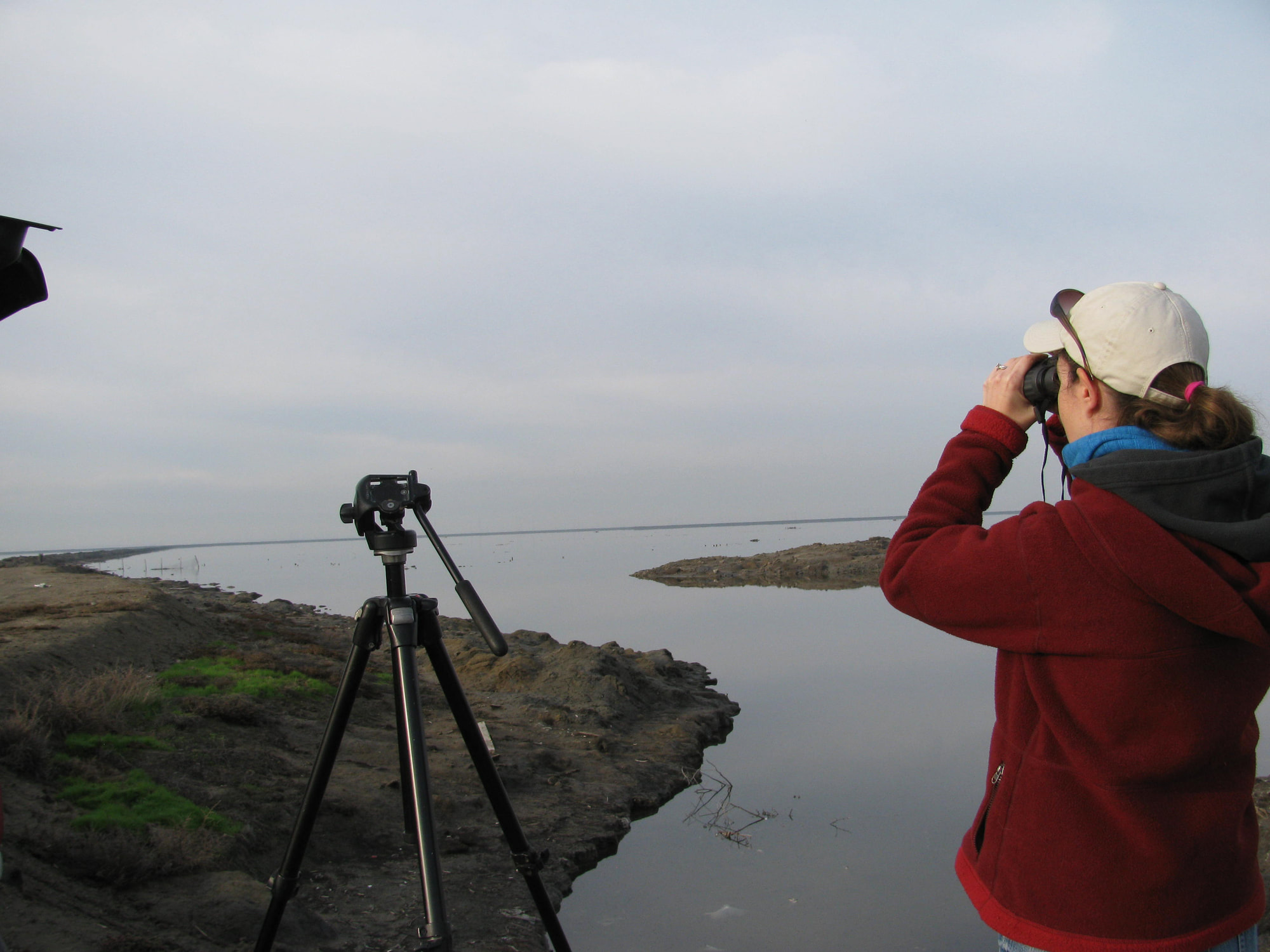

This week Perry encounters vast tracts of orchards and farmland. At first, he doesn’t understand what he’s seeing: acres upon acres of the same plants and men spraying the fields. These are common agricultural practices, monocultures and the use of pesticides, but what’s good for us humans is not so great for birds. There are ways to balance the needs of both though, as Perry discovered when he found a flooded field turned bird oasis.
Click on “Read More” below to check out Episode Five and learn about the challenges Perry faces at the fifth leg of his journey and how you can help. Click here to read Episode 4. Click here to read Episode 6.

Once again, human agricultural practices have a lot to do with habitat loss, but there are many more issues associated with our food production, the two main ones being monocultures and pesticide use. There are ways to balance our needs and the needs of wildlife and it’s worth investing resources into promoting those types of projects. The two primary aspects of agriculture that affect birds go hand and hand usually: the practice of monoculture crops and pesticide/herbicidal use. (photo left by Markus Winkler)

A monoculture simply means an entire crop of the same plant, which is what we most commonly see in America. When farmers plant all of the same crops, it puts the crops at risk for multiple issues: pest problems, pesticide resistance, soil degradation, high use of fertilizers, and more.
A great article that goes more in depth can be found at Pros and Cons of Monoculture Farming | Greentumble, and it’s not entirely one sided, as it goes into the pros as well as cons. Monocultures can affect birds in many ways but the greatest impact in general is on the biodiversity of that area. Biodiversity refers to the variety of plants and animals, and basically all the organisms within an area. When an ecosystem is low in biodiversity it can be more susceptible to disease and destruction.

Farmers can also be part of the solution, though. Perry found a rice farmer that participates in the BirdReturns program which “pairs birding and farmland management with innovations in big data, crowd-sourcing and online auctioneering.” It’s for programs like these that citizens and scientists collect data, and this is one reason why bird science matters so much. Without years of data from places like SFBBO, programs like these would not be possible. This is such a great example of human and bird needs coming together to do the best we can for both.
What can we do personally? Support small farms that do healthy agricultural projects and farm organic! Sometimes the farmers market produce can be a little expensive, but here in California, at least in the Bay, we are super lucky to have hundreds of farmstands from Humboldt to Gilroy. Also, think about abandoning your use of pesticides, herbicides, insecticides, all the -cides. There are multiple natural alternatives for all kinds of pests, some are as simple as a little dish soap or vinegar and water. Sometimes it might just be easiest to plant some sacrificial plants and let the aphids and slugs have those instead of your precious tomatoes.
It’s important we understand that just because birds can fly over it all, doesn’t mean they aren’t affected by what’s going on down here on the ground. The population of North American birds has dropped by nearly 30% since the 1970s, that is a total of almost 3 billion birds. Gone.
Birds are incredibly important to the balance of our ecosystems: they are essential as pollinators and for seed dispersal, particularly for native plants, and they feed on and help control a variety of critters we consider pests like insects and rodents. Bird studies teach us about climate and the environment, and the birds themselves are key indicators of environmental change. And, most simply, birds are beautiful, and they provide us with music and joy.
The protagonist of this story, Perry, is doing his part as a bird, migrating to his northern breeding location to hopefully pass on his little brown bird genes. It’s all he can do. Perry’s Journey illustrates the important journey of birds like him across the globe, who are doing their parts to help.
Migrating birds are disproportionately affected because they need not just one habitat, but multiple habitats that can serve as stopping points along their journeys. We call these migration corridors and it’s important that they are protected: for the birds’ sakes as well as our own. Birds like Perry can’t control what happens on the ground, or in the water and air, but we can. During Perry’s journey over the couse of ten posts, we will go into some of the main issues facing not just migrating birds, but all birds, and what you can do to help. To support SFBBO’s work to conserve birds and their habitats through science and outreach, please make a donation to our Spring Appeal!

Katrina McCollough is from the Bay Area and is a science outreach intern with SFBBO and the creator of Perry’s Journey. Her interest in birds stemmed from an internship she had at SFBBO’s Coyote Creek Field Station where she got firsthand experience working with the banders and volunteers at the station. That was the first time she ever held or released a bird, and she’s fallen in love with them since, and her favorite bird is the Bushtit. Previously, her interests were directed toward the ground, instead of the sky, hunting for mushrooms or insects. Katrina is currently a college student with a major in Biological Sciences, and she hopes to continue her schooling in mycology and bioremediation.