• Une visiteuse de France passe son été à aider les oiseaux de la région de la Baie

    Une visiteuse de France passe son été à aider les oiseaux de la région de la Baie
    Par la blogueuse invitée Clara Millecamps
    Picture

    ​Cette année, pour l’été, j’ai décidé de faire quelque chose de complètement différent. C’est alors que j’ai pris mon courage à deux mains et que je me suis envolée pour les Etats-Unis toute seule. J’avais pour principal objectif d’améliorer mon anglais mais étant passionnée depuis toujours par tout ce qui a un  rapport avec la nature, je me suis vite mise à la recherche d’une association ou d’un organisme dans lequel je pouvais être bénévole. Trouver cet organisme me tenait vraiment à cœur car c’était un moyen pour moi d’approfondir mes connaissances en biologie mais aussi de faire quelque chose que j’aimais vraiment tout en pratiquant mon anglais.

    Grâce à l’intermédiaire du Dr. Ainley, j’ai eu l’extraordinaire chance d’être bénévole à la San Francisco Bay Bird Observatory (SFBBO). J’ai ainsi eu l’occasion de travailler sur différents projets tels que Snowy Plovers avec Ben Pearl et Landbird …

    program avec Josh Scullen.​ Mon travail consistait en un premier temps à entrer toutes les données informatiques que les scientifiques (et bénévoles) pouvaient récolter sur le terrain. J’avais alors pour mission de tout répertorier dans des programmes Excel (dans des tableurs), de tout traiter. Ce travail fût intéressant car il m’a permis de voir les différents aspects de la recherche,  car oui tout ne se passe pas uniquement sur le terrain, il faut également travailler par moments dans un bureau afin de répertorier toutes les informations et pouvoir en tirer des conclusions ou de nouveaux questionnements qui amèneront à de futures recherches.

    Cependant, je pense que la partie que j’ai le plus aimée dans mon travail a été le terrain. C’est un endroit extraordinaire où l’on peut apprendre tellement de choses, où il y a tellement de vie, de diversité. J’ai eu l’occasion d’aller deux fois sur le terrain durant mon bénévolat. Ma première mission sur le terrain a été avec Anjou Kato et avait pour but d’observer s’il y avait des oiseaux malades dans la baie de San Francisco. En effet, durant les années 1980, une bactérie pathogène, Clostridium botulinum est apparue dans les eaux de la baie et a ainsi rendu les oiseaux malades, entrainant une forte mortalité.  Pour effectuer ce suivi, nous avons fait le tour de la baie en voiture et nous avons observé les oiseaux à l’aide de jumelles. Ce jour-là, nous n’avons trouvé aucun oiseau malade. Le fait de n’avoir aucune donnée a été au début un peu frustrant car quand on part sur le terrain, on s’attend toujours à trouver quelque chose, à avoir des informations. Mais si nous réfléchissons bien, c’est une très bonne nouvelle de n’avoir aucune donnée car cela prouve que tous les oiseaux vont bien et qu’ils ne sont pas contaminés par la bactérie. Il faut donc parfois accepter, qu’en tant que scientifique, le fait de ne pas avoir de donnée n’est pas un mauvais signe mais au contraire que c’est une bonne chose.
    La deuxième fois que je suis allée sur le terrain, c’était avec Josh Scullen. J’ai eu la chance de voir comment on pouvait faire du suivi d’oiseaux lors de migrations ou non. Ceci se fait grâce à de très grands filets (aussi long que haut). En effet, les filets étant très imposants mais à la fois très discrets, les oiseaux ne peuvent les voir et volent donc directement dedans. Une fois dans le filet, il faut  détacher délicatement les oiseaux en faisant très attention à ne pas les blesser ni de leurs casser une aile ou une patte. Après avoir détaché l’oiseau, il nous faut déterminer son espèce, voir s’il est bagué ou non puis nous devons le placer délicatement dans un petit sac en tissu afin de pouvoir le transporter vers le bureau/ laboratoire qui se trouve sur le terrain. Une fois au bureau, nous pouvons « examiner » l’oiseau. 

    Pour pouvoir faire du suivi, nous avons besoin de différentes informations à propos des oiseaux comme la taille, le poids, le sexe, l’âge. C’est donc ce que nous allons faire au bureau/ laboratoire. En général, il est facile de distinguer un mâle d’une femelle grâce à la couleur des plumes ou la taille. Quant à savoir si c’est un adulte ou un juvénile il suffit de regarder au niveau des os du crâne, au niveau des plumes mais aussi au niveau du bec (les oisillons porteront des marques oranges autour du bec). Une fois toutes les informations recueillies, il ne nous reste plus qu’à relâcher l’oiseau dans un endroit sûr. Lors de cette journée, nous avons pu capturer 14 oiseaux dont des Bruants chanteurs et des Parulines masquées. Ce n’est pas énorme mais c’est un nombre correct qui nous permet un bon suivi. 

    Travailler en tant que bénévole à la SFBBO a été pour moi une expérience très enrichissante qui m’a permis d’apprendre tellement de choses autant sur le terrain qu’au bureau. Je tiens à remercier toutes les personnes travaillant à la SFBBO pour leur gentillesse (ainsi que pour m’avoir aidé à améliorer mon anglais) et plus particulièrement Josh et Ben qui m’ont permis de travailler sur leurs projets et m’ont montré à quoi ressemble le métier de scientifique : un métier extraordinaire qui peut être tellement différent d’un jour à l’autre.

    Clara Millecamps est étudiante en biologie avec spécialisation en écologie à l’Université de Lille en France. Elle a fait du bénévolat à la SFBBO cet été lors de sa visite dans la région de la Baie.
  • A Visitor from France Spends Her Summer Helping Bay Area Birds

    A Visitor from France Spends Her Summer Helping Bay Area Birds
    By Guest Blogger Clara Millecamps
    Picture

    This summer, I gathered my courage to do something completely different and flew to the United States. My main goal was to improve my English, but because I have always been passionate about nature, I also looked for an association or organization where I could volunteer so I could deepen my knowledge in biology while practicing my English.

    Thanks to the advice of Dr. David Ainley, I had the amazing opportunity to volunteer at the San Francisco Bay Bird Observatory (SFBBO). While there this summer, I worked on ​different projects such as Snowy Plovers with Plover Program Director Ben Pearl and bird banding with Landbird Program … 

    Director Josh Scullen. My job was initially to enter the data that scientists (and volunteers) collected in the field into a spreadsheet for further analysis. This was important work that allowed me to see the different aspects of several research projects and help scientists gather the information they need to draw conclusions or ask new questions that might lead to future research.

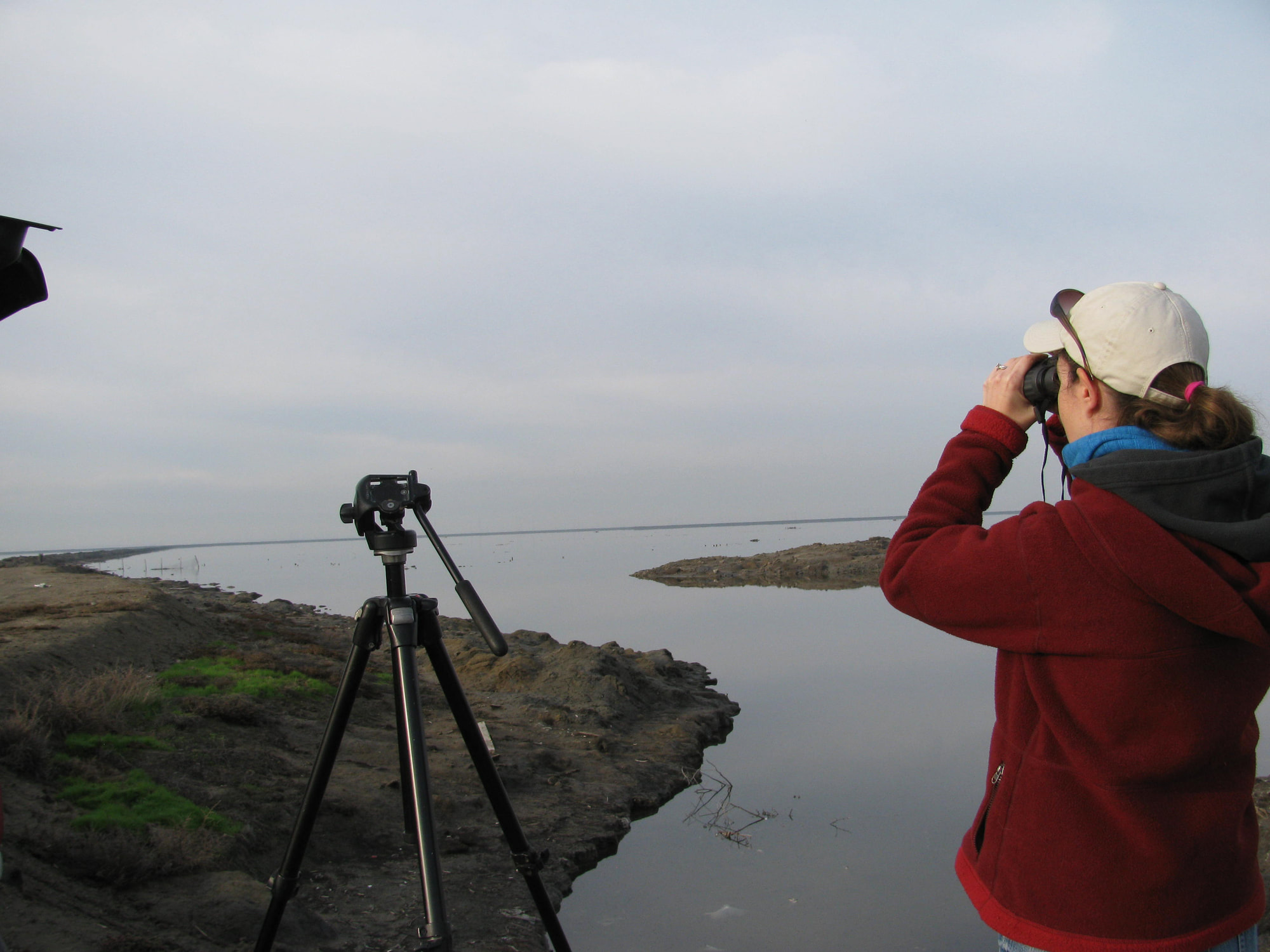
    However, the part I loved most was working in the field. The Bay Area is an amazing place filled with life and diversity where you can learn so much. My first field mission was with SFBBO Biologist Anjou Kato helping her search for sick or injured birds in South Bay sloughs. During the 1980s, a pathogenic bacterium, Clostridium botulinum, appeared in the waters of the Bay, causing many birds to become sick or die. Since then, SFBBO has searched South Bay sloughs to prevent the spread of such diseases. Ajou and I searched for birds by car and watched them with binoculars. We did not find any sick birds. The lack of new data was initially a little frustrating because when we go on the field we always expect to find something. But if you think about it, it was very good news because it proved that all birds are healthy and not contaminated by bacteria. It is sometimes necessary to accept that, as a scientist, the fact of not having data is not a bad sign but on the contrary that it is a good thing.
    The second time I went in the field was with Landbird Program Director Josh Scullen to see how SFBBO tracks birds throughout the year. This was done through very large mist nets. While the nets are large, they are made of fine mesh that is hard for the birds to see so they flew directly into it. Once in the net, scientists extracted the birds carefully, being very sure not to hurt them or break a wing or a leg. After detaching the bird, we determined its species, saw if it was banded or not, then placed it gently in a small cloth bag in order to transport it to the laboratory located in the field. Once there, we could “examine” the bird.

    We looked at different information about the birds such as height, weight, sex, and age. In general, it was easy to distinguish a male from a female because of the color of the feathers or the size. As for whether it was an adult or a juvenile, we looked at the bones of the skull, at the state of the feathers, and at markings on the beak (chicks have orange markings around the beak). Once all the information was collected, all that remained was to release the bird in a safe place. That day, we were able to capture 14 birds, including Song Sparrows and Common Yellowthroats. 

    Working as a volunteer at the SFBBO was a very rewarding experience that allowed me to learn so much in the field as well as in the office. I would like to thank all the people working at SFBBO for their kindness (as well as for helping me improve my English) and especially Josh and Ben who allowed me to work on their projects and helped me learn what scientists do: an extraordinary job that can be so different from one day to the next.

    Clara Millecamps is a student pursuing  a bachelor’s degree in biology, with a specialty ecology, at the University of Lille in France. She volunteered at SFBBO this summer during her visit to the Bay Area.
  • The Wonder of the Swainson’s Hawk

    The Wonder of the Swainson’s Hawk
    By Guest Blogger Stephanie Klein
    Picture

    ​This spring and summer I have been on a mission to find Swainson’s Hawks in the Bay Area. While I have always enjoyed watching birds, especially water birds and passerines, I only recently became acquainted with hawk species in a raptor class offered at De Anza College. It was in that class that I learned about and first observed a Swainson’s Hawk.

    When our class went out to look at raptors in Coyote Valley, we found a male Swainson’s Hawk perched atop a tall cedar tree. Our instructor, Ryan Phillips, said he was likely guarding a nest nearby. While we were there, a Cooper’s Hawk ventured into the nesting area. Sure enough, the Swainson’s Hawk immediately launched …

    off his perch, screaming, and took out after the intruder.
     
    ​That time, the male’s quick response was enough to drive away the threat, but sometimes, if the offending individual doesn’t get the hint, the female will come off the nest and join the pursuit. Some Swainson’s Hawks will even swoop and dive at people who come too close. I was amazed to see how vigilant both the male and female were in defending their nest, and at their steadfast adherence to a seasonal cycle.
     
    I continue to be amazed at these hawks. They are obligate migrators and spend the winter months in places as far away as Argentina. When it’s time to make the journey south, they amass in enormous flocks and begin binging on food. If you go out to the Central Valley near Davis or Tracy in late August or September you can see hundreds of them hovering, sitting and chasing each other around farm and grass fields. On the way south (and north in the spring) their pattern of migration funnels them through Veracruz, Mexico, in the tens of thousands. By the time they’ve made a round-trip between their breeding and wintering grounds, they may have traveled more than 6000 kilometers!
    While it’s pretty easy to find Swainson’s Hawks in the Central Valley during the spring and summer, it’s more difficult in the Bay Area. There are few records of Swainson’s Hawks nesting in the valleys of the Bay Area. In fact, the two that we observed in class were the first confirmed nesting pair in Santa Clara County since the late 19th century. Another pair was also discovered in 2013 in northern San Benito County near Hollister, and then another three years later in Gilroy. Does this mean that Swainson’s Hawks are expanding their range?

    Could be. But, as is the case with many other raptors, Swainson’s Hawk populations have declined from their historical numbers. In California, the drop was so drastic that the species was listed as threatened in the state in 1983. One of the major reasons for their decline has been loss of habitat, so the appearance of Swainson’s Hawks in the Bay Area could mean that they are being pushed out of their Central Valley nesting grounds by housing and infrastructure development there. It seemed important to me to keep track of the nesting pairs in the Bay Area to see if their numbers increased, so in 2016 I began monitoring the Coyote Valley pair as a volunteer with Talon Ecological Research Group.

    2016 was a great year for “our” pair. In early July of that year, my husband and I made our first observation of the nest with a scope borrowed from SFBBO. The wind was high that day and the leaves of the Sycamore were swaying vigorously back and forth making it difficult to see the nest. Suddenly the leaves parted in the wind and we got a glimpse of a nestling, bobbing up and down with the wind.
     
    After that we made weekly trips to observe the nest. The following Saturday we discovered a second and a third nestling. A few weeks later we spotted all three, perched on the top of the adult hawks’ lookout tree. One of the adults glided overhead calling plaintively. I imagined that it was sending some message to its brood. “It’s time to fly away,” perhaps, or “pay no attention to those two pests who keep watching us.” 
    Whatever it may have meant, we were both hooked on monitoring the Swainson’s Hawks in the valley. We invested in a scope and have continued monitoring the Coyote Valley pair every year since then. We’ve even branched out to include the two other known pairs nesting near Gilroy and Hollister. In all, the pairs have fledged at least three more young, and since Swainson’s Hawks generally return to their natal area, we expect and hope to see more nesters in the future.
     
    This season, as a project for a program in wildlife management at Oregon State University, we have been searching other areas with suitable habitat to get an estimate of Swainson’s Hawk occupancy in the area. The days of searching can be long and tiring. More often than not, we don’t see any Swainson’s Hawks on these outings, but sometimes we do! And that possibility keeps us looking.

    Stephanie Klein volunteers with SFBBO as a librarian and colonial waterbird monitor. She also enjoys monitoring cavity nesters of all kinds for the Audubon Society and, of course, looking for Swainson’s Hawks with Talon Ecological Research Group. She recently completed an Associates Degree in Wildlife Science at De Anza College.
  • Dudley Carlson’s Kids Bird Book Recommendation: Bird Watch

    Dudley Carlson’s Kids Bird Book Recommendation: Bird Watch
    Picture

    ​Anyone who has sat with a child in the lap and a book like Where’s Waldo in hand knows the pleasure of sharing a seek-and-find game. In Bird Watch, Christie Matheson brings this pleasure to birders, with the addition of a ten-to-one countdown. Gentle, elegant illustrations in watercolor and collage provide a game of “find the bird” for the very young. “If you look closely, you just might find eight sparrows hiding near the ground.” Parents may also be challenged to find some of the hidden targets, but there’s plenty to look at and enjoy.  

    Trees, flowers, seeds, insects and spiders surround and help to camouflage the birds and distract the searchers. For the uninitiated, endpapers and back matter add information for further identification.
     
    Play the can-you-find-it game first. Then take your little ones for a walk to see how many birds they can spot. If there are older siblings along, you might even teach them to use iBird to keep track of their sightings. Try it beside the Bay, in the hills, around the block, in the park or at your own feeder. Any way you play it, you’ll all win.

    SFBBO member Dudley Carlson, a biologist’s daughter, grew up in a family of birders and was Manager of Youth Services at Princeton (NJ) Public Library for 25 years. She believes that if children enjoy learning about birds and understand how important they are to our environment, then birds, nature and people will have a better chance at a healthy future.
  • Dudley Carlson’s Kids Bird Book Recommendation – Teaching Kids Thoughtful Consumption Through Books

    Dudley Carlson’s Kids Bird Book Recommendation – Teaching Kids Thoughtful Consumption Through Books
    By Guest Blogger Dudley Carlson
    Picture

    ​Enormous thanks to SFBBO, POST and the Santa Clara Library for their large-screen showing in April of Chris Jordan’s film, “Albatross.”  This amazing film (definitely not for young children) is one of the most beautiful art films and horrifying scientific documentaries I’ve ever seen.  It is available free for viewing online. Anyone who uses plastic, eats fish, loves birds or cares about the environment should see it.

    A year ago, I wrote briefly about Caren Loebel-Fried’s A Perfect Day for an Albatross (Cornell Lab Publishing Group, 2017), a picture book for young children that traces the life cycle of the Laysan …

    Albatross through the eyes of an adult female nesting on Midway Island, where Jordan’s film is set. The film immediately brought to mind another young picture book, Eve Bunting’s Ducky (illustrated by David Wisniewski, New York Clarion Books, 1997), which tells the true story of a plastic toy washed overboard in 1992 when a storm-tossed container ship lost part of its cargo in the Pacific Ocean. Bathtub toys from this shipment, carried by ocean currents, turned up all over the world for many years. Together, these picture books offer a means of introducing very young children to the separate ideas of a bird that lives primarily at sea, the fact that many man-made objects find their way into that same watery world, and that the ocean contains rivers and pathways.

    For children ready to think more deeply, Loree Griffin Burns has written a fine book on the scientists who study ocean currents and what floats on them. Tracking Trash; Flotsam, Jetsam, and the Science of Ocean Motion (Boston, Houghton Mifflin, 2007) explores the history and science of oceanography through the eyes of scientist Curt Ebbesmeyer, who first coined the phrase “great garbage patch,” and others who study currents, gyres, and their impact on life, both in the sea and on land. That includes citizen scientists, some of them children, who belong to the beachcombers’ network that Ebbesmeyer started to collect reports on current-driven objects washed up on beaches. It also discloses that ocean plastic makes its way up through the food chain, from plankton to jellyfish to fish to humans. Though brief (50 pages), this is a well-illustrated book that combines photographs, maps and charts with well-organized information and resources.
    And for those older readers, be they adults or teens, who are still hungry for information, Ebbesmeyer himself has written a personal account of his work Flotsametrics and the Floating World, by Curtis Ebbesmeyer and Eric Scigliano. New York, HarperCollins, 2009), tracing his career as an oceanographer and the discoveries and experiments leading to an understanding of ocean currents and gyres and how they function. Research in the last few decades has greatly expanded our knowledge of how these movements affect life on earth, even as manufacturing, commerce, and waste disposal have radically altered the life of the oceans and all of us whose lives depend on their health.

    During the question period after the library’s film showing, a member of the audience commented that one way to change the impact of ocean plastic on the albatross would be to show this film to children. While I don’t think it’s suitable for young children (there are disturbing images of albatross carcasses filled with bits of plastic and of chicks dying because of what they’ve been fed by their unknowing parents), it is absolutely one to show to middle and high school students and to adults. And it’s never too early to teach all of our children about thoughtful consumption, wasting less, disposing carefully of what we do use, and reducing our use of plastic.  

    SFBBO member Dudley Carlson, a biologist’s daughter, grew up in a family of birders and was Manager of Youth Services at Princeton (NJ) Public Library for 25 years. She believes that if children enjoy learning about birds and understand how important they are to our environment, then birds, nature and people will have a better chance at a healthy future.
  • Humble Caretaker Upgrades Our Coyote Creek Field Station

    Humble Caretaker Upgrades Our Coyote Creek Field Station
    By Plover Intern Illianna Termuehlen
    Picture

    As the rain stops and it begins to look like spring again, the Coyote Creek Field Station will take advantage of the sunny days and continue banding birds. The Coyote Creek Field Station would not be the same without volunteers like Gerry Ellis. A lifelong birder, Gerry discovered CCFS decades ago through an article in the paper advertising bird banding training. He came for a few classes and stayed for years. Gerry has been an asset to SFBBO, not only as a bird bander but as a humble caretaker of the field station. 

    Gerry says that what kept him at CCFS for so many years were the people, the positive atmosphere and supportive learning environment and being able to witness the families and visitors inspired by the banding demonstrations.

    Recently, with a donation of used deck boards from Gail Richardson and Dave Austin, Gerry rebuild the deck at CCFS. This is only one of many projects Gerry has completed to keep CCFS running and looking it’s best. On your next visit to the field station note the signs: the new stairs, the poles for the nets, and the newly deck, all completed by Gerry.
    There are few people who know as much about CCFS as Gerry, and his love for the place is clear. Just ask him about the ecological history of the area and he will tell you about the indigenous plants and notable wildlife sightings. To many, CCFS is an island of semi-wild in the midst of a city, a place to be treasured and taken care of, just as Gerry and other volunteers have. Thank you so much, Gerry, for all you’ve invested in CCFS, it would not be the same without you!

    Illianna Termuehlen is a plover intern at SFBBO. She grew up in Wisconsin and graduated from Mount Holyoke College with a BA in Environmental Studies in 2018. She previously worked with UCCE and the U.S Forest Service monitoring wild horse populations in Northern California. She also spent a summer monitoring terns with Project Puffin on an island off the coast of Southern Maine. 

  • Can the Number of eBird Check Lists Predict the Number of Species at a Site?

    Can the Number of eBird Check Lists Predict the Number of Species at a Site?
    By Waterbird Intern Alicia Manfroy
    Picture

    Ulistac Natural Area is not as quiet as one would expect on a Saturday morning. The sound of rushing cars is replaced by the twitter of birds as I move farther towards the park’s interior. I made this trip to the meandering park in Santa Clara because I wanted to see one of the eBird birding hotspots mentioned in a recent data analysis by SFBBO volunteer Chris Johnson. The results of his analysis showed that the number of eBird checklists a site has can explain much of the variation in species number between birding locations. 

    Johnson used data from eBird to find the top birding locations …

    around Santa Clara County.  eBird is a very popular bird tracking app created in 2002 by the Cornell Lab of Ornithology. A birder can download the app onto his or her phone (see our article for directions) or access the eBird website. Birders can then select a  location and add the birds they observe to a checklist. New checklists can be created for each birding trip. eBird creates an online platform for birding knowledge, including species observed, hotspots, and sites sorted by number of species. This data is shared among citizen and scientific communities. But this begs the question Chris wanted to answer: Is the number of eBird checklists a good predictor of the number of species found at a location (species richness) and hence a predictor of a “good” birding site?

    Chris was soft spoken, but passionate about this project when I spoke with him on the phone recently.. Chris found birding at a young age and has been performing data science for resource management purposes since college. Chris decided he wanted to combine his two passions, birding and data analysis, to examine the relationship between eBird checklists and species richness at 38 creekside Santa Clara County sites.

    First, Chris downloaded the checklists from eBird and then used a spreadsheet to create graphs to analyze the relationship between the number of eBird checklists at a site and the number of species at the same site. He found the relationship to be logarithmic, meaning there is a fast increase in species observed at first, but that increase slows over time. On average, a birder has a 3% chance of seeing a new species on any give outing once a certain threshold (the linear or flat portion of the log curve in Figure 1) has been hit. Chris found that the number of eBird checklists was a powerful predictor for the number of species a birder can see on a given trip, explaining almost 80% of variation between sites.
    At this point, Chris narrowed his analysis from the original 38 sites spanning four Santa Clara County creeks and rivers to the top 20 “hotspots,” defined as locations with over 150 species recorded. The number of checklists varied widely over all 20 locations. This variation could depend on convenience and accessibility to birders. To combat this variation, Chris extrapolated the data to make all the checklists “even”, essentially eliminating the number of checklists as a factor for the number species found at a site. While some sites showed surprising changes in the number of species, other locations held their rank. The top sites before the extrapolation were the Palo Alto Baylands Preserve, Don Edwards National Wildlife Refuge, and Shoreline Park. The Top sites after the extrapolation were Don Edwards National Wildlife Refuge, Coyote Creek, and the Sunnyvale Baylands. Below is a graph comparing the number of species before and after the extrapolation.  
    While this analysis of eBird data is a great way to find new birding locations based on species richness, Chris does warn that this analysis may not tell the full story. Other factors that might influence the number of species are habitat type, habitat quality, and the way eBird participants enter data.  

    Despite the other variables that may affect species richness, eBird checklists are a great way for the average birder to find new birding locations. If you want to get involved with eBird, join the Cornell Lab on May 4, 2019, during their Global Big Day. Have a great time birding and thank you, Chris, for the interesting data science analyzing ebird checklists as a predictor of good birding sites.


    Alicia Manfroy is a waterbird intern at SFBBO. She graduated from Santa Clara University with a degree in Environmental Science. A South San Jose native, Alicia grew up birding at nearby wetlands, percolation ponds, and reservoirs. She is excited to pursue her passion for waterbirds with SFBBO in the upcoming months.
  • Dudley Carlson’s Kids Bird Book Recommendation: Superlative Birds

    Dudley Carlson’s Kids Bird Book Recommendation: Superlative Birds
    By Guest Blogger Dudley Carlson
    Picture

    ​Are there Guinness Book of World Records collectors in your family? Are there poets, or poetry enthusiasts? Just in time for National Poetry Month, I discovered this highly unusual collection of poems, drawings, and superlatives about the bird world.  Which bird has the longest toes? The most feathers? The most accurate hearing? The most gruesome means of collecting prey? In Superlative Birds, Leslie Bulion as researched them all, creating verses that introduce birds both familiar and strange. 

    Each double-page spread contains a poem and, in smaller …

    type, additional scientific information the older or more interested reader. Meganck’s illustrations are colorful and witty, illustrating the important point of each poem. On each spread, a chickadee adds notes about other kinds of birds or animals that share some of the characteristics being described.

    At the end, the author adds a glossary and a list of “poetry notes,” explaining the wide variety of poetic forms used. These are from all over the world, and from many languages. Not to be outdone, the illustrator shows, on the front end-pages, each of the superlatives described and, on the back ones, identifies the matching bird. There’s also a list of resources for young birders.
     
    Whether you’re a birder, a poet, or a collector of world records, there’s something here to tempt you to explore these superlative birds. Enjoy them!

    SFBBO member Dudley Carlson, a biologist’s daughter, grew up in a family of birders and was Manager of Youth Services at Princeton (NJ) Public Library for 25 years. She believes that if children enjoy learning about birds and understand how important they are to our environment, then birds, nature and people will have a better chance at a healthy future.
  • LA Ecology: Striving for an Equitable, Sustainable Future

    LA Ecology: Striving for an Equitable, Sustainable Future
    By Guest Blogger Jessica Kochick
    Picture

    ​For the past three years, I’ve been teaching an Urban Ecology class at RFK Community Schools in the Koreatown neighborhood of Los Angeles. K-Town has one of the lowest percentages of tree cover in the city, and the school campus, built only nine years ago, is lined with concrete. In spite of these challenges–or maybe because of them–there is so much for students to observe and learn. On our last trip outside, we saw a Western Gull rip apart a discarded sandwich. Near the landscaped entrance to campus, house sparrows were hopping about looking for food. One student shouted, “A hawk!” and sure enough, a red-tailed hawk was soaring overhead. Another student informed the class of ​the location of its nest on the other side of the softball field.

    My students are aware that in our highly urban environment, these are the types of species that manage to thrive. We don’t just study the neighborhood–we look at the whole watershed and the connectivity of the landscape. When I take them to the natural-bottom portion of the L.A. River, they see a much wider variety of wildlife: great blue herons, snowy egrets, mallards, coots, and black phoebes. For some students, this is their first encounter with these animals, and their first visit to a portion of the river that doesn’t look like a concrete ditch.
    Exciting changes are underway, as the city begins to implement the LA River Revitalization Master Plan along portions of its 51-mile stretch. It will bring Angelenos access to revamped natural beauty, while improving wildlife habitat that was destroyed when the river was channelized for flood control. In the process, communities are fighting to ensure that the improvements won’t price them out of their own neighborhoods along the river. Many of these families had been displaced from Chavez Ravine in the 1950’s, when after being promised better housing, the site was sold to the LA Dodgers for a stadium.

    As we strive for a more sustainable future, we do so with a vision of social and racial equity. The public health benefits, and the opportunity to connect with the natural world, belong to everyone. The LA teachers’ union, UTLA, recently went on strike. Among other social justice demands, we reached an agreement to remove asphalt and provide more green space on our campuses. I look forward to seeing my students encounter more wildlife and natural beauty in their daily lives. 

    Jessica Kochick teaches urban ecology at a high school in Los Angeles, and she studies anthrozoology as a part-time graduate student. Last summer, she was an intern at SFBBO where she supported the development of science education materials. 
  • Ecología de Los Ángeles: luchando por un futuro equitativo y sostenible

    Ecología de Los Ángeles: luchando por un futuro equitativo y sostenible
    Por el Blogger Invitado Jessica Kochick
    Picture

    ​Durante los últimos tres años, he enseñado una clase de Ecología Urbana en las Escuelas Comunitarias RFK en el barrio de Koreatown en Los Ángeles. K-Town tiene uno de los porcentajes más bajos de cubierta de árbol en la ciudad, y el campus de la escuela, construido hace solo nueve años, está revestido de concreto. A pesar de estos desafíos, o tal vez debido a ellos, hay tanto que los estudiantes pueden observar y aprender. En nuestro último viaje afuera, vimos a una gaviota occidental comiendo un sándwich desechado. ​Cerca de la entrada ajardinada al campus, los gorriones hacían brincos buscando comida.Un estudiante gritó: “¡Un halcón!” Y, efectivamente, un halcón de cola roja se elevaba por encima. Otro estudiante informó a la clase la ubicación ​de su nido en el otro lado del campo de softball.

    Mis estudiantes son conscientes de que en nuestro ambiente tan urbano, estos son los tipos de especies que logran prosperar. No solo estudiamos el barrio–consideramos toda la cuenca y la conectividad del paisaje. Cuando los llevo a la parte del río de Los Ángeles con fondo natural, ven una variedad mucho más amplia de fauna: grandes garzas azules, garcetas nevadas, patas y fochas. Para algunos estudiantes, este es su primer encuentro con estos animales y su primera visita a una parte del río que no parece una zanja de concreto.
    Se están realizando cambios emocionantes, a medida que la ciudad comienza a implementar el Plan de Revitalización del Río de Los Ángeles a lo largo de partes de su tramo de 51 millas. Traerá a los Angelinos el acceso a la belleza natural renovada, al tiempo que mejorará el hábitat de la vida silvestre que se destruyó cuando el río se canalizó para controlar las inundaciones. En el proceso, las comunidades están luchando para asegurar que los mejoramientos no las desplacen de sus hogares a lo largo del río. Muchas de estas familias habían sido desplazadas de Chavez Ravine en la década de 1950, cuando después de que se les prometiera mejores viviendas, el sitio fue vendido a los Dodgers de Los Ángeles para un estadio.

    A medida que nos esforzamos por un futuro más sostenible, lo hacemos con una visión de justicia social y racial. Los beneficios para la salud pública y la oportunidad de conectarse con el mundo natural pertenecen a todos. El sindicato de maestros de Los Ángeles, UTLA, recientemente se declaró en huelga. Entre otras demandas de justicia social, llegamos a un acuerdo para eliminar el asfalto y proporcionar más espacios verdes en nuestras escuelas. Espero ver a mis estudiantes encontrar más vida silvestre y belleza natural en sus vidas diarias.

    Jessica Kochick enseña ecología urbana en una escuela secundaria en Los Ángeles, y estudia antrozoología como estudiante de posgrado a tiempo parcial. El verano pasado, hizo prácticas en SFBBO donde apoyó el desarrollo de materiales de educación científica.