• A Fond Farewell from Waterbird Biologist Victoria Heyse

    A Fond Farewell from Waterbird Biologist Victoria Heyse
    By Waterbird Lead Biologist Victoria Heyse
    Picture

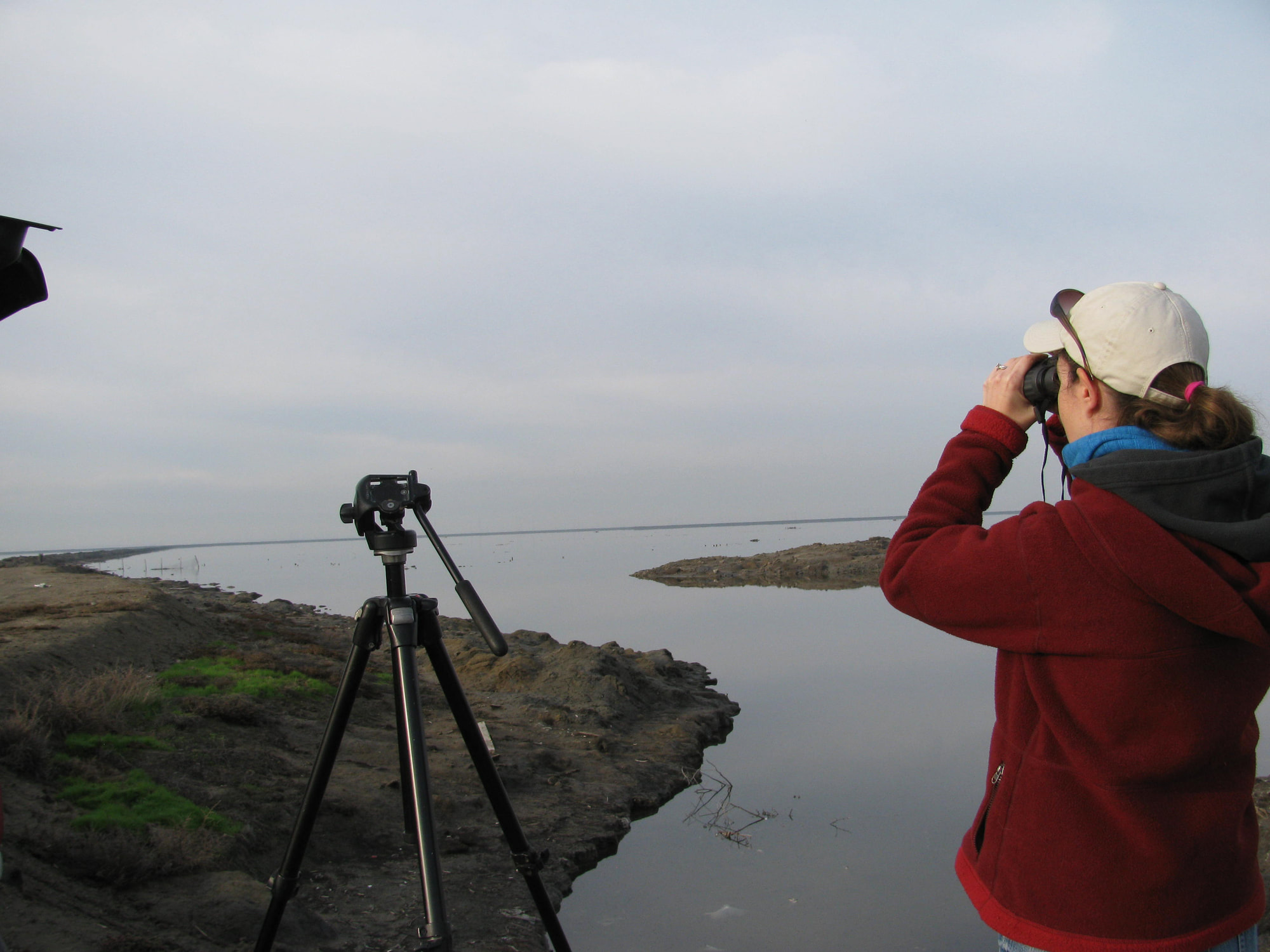
    I first came to SFBBO in the Fall of 2014 to work as a Salt Pond Intern. I was familiar with waterbirds, but as a recent New England transplant, my only experience had been with east coast species. To say that I had a lot to learn those first couple months would have been an understatement, and not only that but I needed to learn fast as the winter migration of shorebirds & waterfowl would soon be in full swing. But after my first salt pond survey not only was I hooked … ​​I was obsessed! I loved familiarizing myself with the diversity of the pond habitats and their corresponding waterbird niches. As my internship was ending, an opportunity arose for me to join the …

    SFBBO staff as a full time Waterbird Biologist and I didn’t hesitate to stick around and learn as much as I could. As I organized salt pond surveys for the next three years, I experienced the migration of birds to and from the bay. It’s a special feeling to have a pulse on those seasonal changes. It creates a feeling of connection to the natural world that is indescribable. 

    ​It wasn’t just working on salt ponds where I felt that connection. Avian Disease Prevention boat surveys probably top my list of favorite job duties. Out of the seven million people that live in the bay area, I bet less than 0.05% have had the opportunity to experience a meandering south bay slough by boat. It is as breathtaking as it is special. Counting 50,000-plus gulls in a week is also special (and another favorite memory of mine), although I must admit, it takes your breath away in a different way (it doesn’t smell the best).  
    After four years (and some change) of incredible work at SFBBO, I am moving on to a job as a Park Interpreter with Santa Clara County Parks. Now more than ever, I feel pulled toward educating the next generation of scientists and helping to facilitate meaningful connections in nature. I’m honored to have been a part of such an awesome and passionate group of biologists, volunteers, and fellow bird nerds. It has been so inspirational to see all of the heart that everyone who is a part of SFBBO pours into the conservation of birds and habitats. I look forward to staying involved and up to date with everything SFBBO as a volunteer and member.

    Victoria Heyse was SFBBO’s Lead Waterbird Biologist. She is now a Park Interpreter with Santa Clara County Parks, where she will continue to impact birds as an SFBBO partner. 
  • 2018 California Fall Challenge a Big Success!

    2018 California Fall Challenge a Big Success!
    By Outreach and Communications Director Kristin Butler
    Picture

    ​Thanks to the hard work of our staff and volunteers, our 2018 California Fall Challenge was a huge success and we surpassed our goal to raise $30,000 for our avian science and outreach programs! Congratulations to Cookie Segelstein for winning the People’s Choice Award in our Click Off bird photo contest with her photo “Cormorant and …

    Needle Fish,” which was the category winner in our Bird Behavior category. Congratulations also to Birds and Humans category winner Judy Duffy and her “Mountain Chickadee;” World Birds category winner Don Dvoarak and his “Gentoos Playing in the Surf;” and Birds and Their Habitats category winner Bibek Ghosh and his “Horned Owl Camouflage.” 
     
    Congratulations to Mike Mammoser, Mike Rogers, Francis Toldi, and Nateri Madavan and their team The Refugees team for winning our Mewaldt Cup bird-a-thon by counting 162 species during their Oct. 13 Big Day!
    ​​
    ​We also congratulate our Kids Bird Art Contest Best in Show category winners Nikita Mylavarapu (ages 3-7) for her drawing “My Little Duck;” Lucya Koftinoff (ages 8-11) for her drawing “Nuttall’s Woodpecker;” and Rachel Tse (ages 12-17) for her drawing “Yellow Warbler.”
     
    Our contest winners were awarded at our Annual Membership Meeting at Jasper Ride Ecological Preserve on Oct. 20th. At the meeting we also said thank you to outgoing Board Member Anne Hepburn, who retired from the Board after serving for two three-year terms as our treasurer. We also thanksed outgoing Board members Denise Mohsenin and Gina Barton for their service and welcomed new Board members Marty Michael, Christine Slocomb Zack, and  Larry Spivak. 
    ​At the meeting we also heard a great presentation from Allen Fish about his Golden Gate Raptor Observatory; thanked the following 10 volunteers for raising $10,000 through peer-to-peer fundraising: Gina Barton, Chuck Coston, Karen De Mello, Jan Hintermeister, Mike Mammoser, Lisa Myers, Mike Rogers, Emilie Strauss, Anna Zivian, and Jing Zhu; and thanked the following volunteers who lead CFC guided trips, designed our t-shirt, and organized our Kids Bird Art contest, Click Off bird photo contest, and online silent auction: Gabbie Burns, Elaine Lea-Chou, Karen DeMello, Julie Ho, Chris Johnson, Lisa Myers, Kay Partelow, Mike Rogers, Christine Slocomb-Zack.
     
    Lastly, we want to thank all of our silent auction and prize donors: Wildside Nature Tours; Camel’s Garden Hotel; Los Gatos Birdwatcher; Rosemont Embroidery; Cheesemans’ Ecology SafarisSorensen’s ResortMystery Series; American Adorn; Better Every RideCuriOdessey; California Academy of Sciences; Oakland Zoo; Touchstone Studio Climbing and Fitness; Vortex Optics; Columbia Sportswear; Patagonia; NUMU (New Museum of Los Gatos); Pacific Locomotive Association; Cornell Lab of Ornithology; Santa Cruz Piano; Family Giving Tree; Zanker Recycling; Martha Castillo; Jacqueline Deely; Anne Hepburn; Elaine Lea-Chou; Steve Madel; Christine Slocomb Zack; Tom Stewart; and Jing Zhu.
  • Dudley Carlson’s Kids Bird Book Recommendation – Books about Turkeys

    Dudley Carlson’s Kids Bird Book Recommendation – Books about Turkeys
    By Guest Blogger Dudley Carlson
    Picture

    ​With Thanksgiving almost upon us, how could we NOT read about turkeys?
     
    “You have to see that PBS show about the turkey guy!” my brother insisted. And he was right. Naturalist Joe Hutto’s documentary When I was a Turkey about raising wild turkeys from rescued eggs to adulthood is a moving story. So I was delighted when it came out as a DVD and then as a book for middle-grade readers, complete with Hutto’s drawings and photographs. From a plowed field, thirty rescued eggs ​hatched into tiny poults that … 

    immediately imprinted on Joe, who became their “mother” for the next year or more. His experience as an anthropologist informs his daily observations as the little turkeys learn how to feed, search for food, fly, and eventually to live on their own as adults. It’s dramatic, it’s informative, and it’s a deep look into the relationship that can exist between humans and animals.
     
    In his book All About TurkeysJim Arnosky presents the wild turkey in large, colorful pictures for very young children, pointing out fine details of anatomy and feathering, feeding and nesting. Large-scale paintings allow him to identify details like leg spurs and the caruncle (described in smaller type, so that they can be skipped for very young listeners).
     
    In Wild Turkey, Tame Turkey, a book for somewhat older readers, Dorothy Hinshaw Patent uses text and photos for a fuller portrait of the turkey, including its North American history of domestication by the Aztecs and transport to Europe by early Spanish explorers, its domestication in Europe and the gradual development of a major industry in the United States.
    For the full Thanksgiving experience, start early. Read Arnosky aloud to the little ones and hand the other two to older siblings to read aloud or to themselves. Or read When I Was a Turkey aloud at bedtime, a chapter a night for a couple of weeks. Then on Turkey Day, after the morning hike, the cooking and feasting, the parade and the football and the family conversation, put the PBS documentary on and watch together as a man quite literally becomes a mother to 23 little turkeys and they become, just as literally, his family. It’s amazing and wonderful – and something else to be thankful for.

    SFBBO member Dudley Carlson, a biologist’s daughter, grew up in a family of birders and was Manager of Youth Services at Princeton (NJ) Public Library for 25 years. She believes that if children enjoy learning about birds and understand how important they are to our environment, then birds, nature and people will have a better chance at a healthy future.
  • Designing the CFC T-Shirt: Tips from the Artist

    Designing the CFC T-Shirt: Tips from the Artist
    By Guest Blogger Julie Ho
    Picture

    Julie Ho is an exhibit and graphic designer at NUMU (New Museum of Los Gatos) and designed the artwork for this year’s California Fall Challenge T-Shirt. Below she shares the steps she took to create this year’s design and gives a little preview of the kinds of things she may be sharing during her “Sketching and Beer: Capturing Nature With Art” CFC workshop on Oct. 6th!

    The Sketch: This year’s t-shirt design is a marsh theme featuring a ​salt marsh harvest mouse (Reithrodontomys raviventris) and a …

    Ridgway’s rail (Rallus obsoletus). I started the design as I would start any illustration, by doing research on my subject. I was primarily interested in learning about the habitat the mouse and rail would be found in to get an idea of the foliage that I would need to depict in my design. The pickleweed (Salicornia pacifica) and cordgrass (Spartina foliosa) stood out to me as some of the more easily identifiable and common flora found in San Francisco salt marshes. I knew when I started my research and from seeing the rail and cordgrass that I wanted my design to be vertical and narrow to emphasize the silhouette of the bird. 

    The Draft: After I received feedback on my sketch I added the gumweed plant (Grindelia stricta and Grindelia camporum) to my design to add a pop of yellow from its flowers and break up the green of the cordgrass and pickleweed. At this time I also planned out the color scheme for the t-shirt, doing my best to narrow down the color choices to as few as I could. While I would normally go into detail at this point and flesh out all the subtle color variations in the rail, mouse, and flora I restricted myself in my color palette and made the decision to simplify the flora to very basic shapes to put further emphasis on the rail and mouse. 
    The Final: In the last version of the design I changed my choice about depicting the shorter gumweed plant in the foreground to a similar yellow flowering shrub, the salty susan (Jaumea carnosa). At this point I also realized I had to further simplify my colors and chose slightly different colors to fit within the requirements from the t-shirt printing company. I ended up going with only 3 colors and really had to push my boundaries to make the most of the limited palette I had. 

    I am quite pleased with the end result, and while I could not render all components in the design as accurately as I would have liked due to the constraints, the final design still holds up to my original concept, and that is more than I hoped for going into it! Click here to learn how you can get your own 2018 CFC T-Shirt!

    An artist from the San Francisco Bay Area, Julie started her undergraduate studies in Biochemistry but rediscovered her love for art in her second year and turned her concentration to creating art for science communication. She completed her BFA degree in Pictorial Arts with a minor in Science from San Jose State University. During her time as an undergrad she taught art classes in Los Altos, CA, where she found her passion for children’s education. Continuing her own education, she attended CSU Monterey Bay’s Science Illustration graduate program in 2016. Influenced by the changing climate and its effect on life within it, Julie hopes to communicate local environmental issues through illustrations for science education. She returned to the Bay for her internship in Fremont at the Children’s Natural History Museum. Currently, Julie is working at New Museum Los Gatos (NUMU) as their exhibit and graphic designer. You can see other examples of her work on her website
  • Learning to Appreciate The Bay’s Margins

    Learning to Appreciate The Bay’s Margins
    By Habitats Seasonal Ecologist Eric Lynch
    Picture

    ​I joined the SFBBO Habitats program as a seasonal (part-time) ecologist in the summer of 2016. At the time, I only had a vague understanding of the tidal marsh wetland-upland transitions the program works to restore. This was partly because most San Francisco Bay area residents overlook the Bay: the hills surrounding the bay are charismatic and relatively unblemished, while the margin of the bay often butts up against major freeways and sometimes smells funny. However, the Habitats Program soon taught me to appreciate this often overlooked resource. The boat trips we took to our different restoration sites …

    ​helped me grasp the sheer vastness of the Bay. While the sounds and sights of human civilization were always present, they were muted and quickly forgotten. There was a profusion of wildlife you won’t see in some of the richest and most remote ecosystems in the world. It was not uncommon to see a gray fox roaming our plant nursery or a Bald Eagle soaring high above former salt ponds.

    Just as impressive was the amount of research and thought our team put into our restoration sites. There are no longer any pristine marsh transition sites remaining between the wetlands of the San Francisco Bay and its well-preserved hills. Steady development has left much of the Bay surrounded by concrete or filled in to create more human real estate. In addition, the creeks and rivers that would have formed vast floodplains around the edge of the Bay had been dammed and set into levee-bound channels, drastically changing the ecology of the bay. As a result, when SFBBO began our habitats work in 2011 our team had no living example of what these restoration areas should look like. 
    ​So the team decided what plants to use in our restoration projects partly by examining historical accounts and museum collections. They did careful surveys of restoration sites to verify whether these plants can survive in a vastly different landscape. My favorite part of our program’s research was searching areas around the Bay for remaining populations of plants we needed, and I learned that a lot of little jewels still remained.

    We found inconspicuous bayside areas in Fremont and Alviso that were painted purple and yellow with carpets of flowers in wet years. Some Bay levees near Hayward were taken over by beautiful orange fiddlenecks in early spring. Every empty field or levee became a potential treasure trove of plant genetics that could have been lost if not for our persistent curiosity.

    After three years of delightful part-time employment with the Habitats Program, I am moving on to pursue a master’s degree . I’ll miss working with the Habitats team dearly, but my perspective on the place I love has been forever changed for the better. I am grateful for the diligent work the program does to help improve our incredible San Francisco Bay ecosystem and for all it taught me.

    To find out how to get involved with our work to create and restore tidal marsh habitat at the Bay’s margins, please visit our website or write to [email protected]. 
  • Please Donate Towels to Support Our ADPP Program

    Please Donate Towels to Support Our ADPP Program
    By Waterbird Lead Biologist Victoria Heyse
    Picture

    ​It’s hard to believe that the Avian Disease Prevention Program season is half over! From June through November, we patrol Artesian and Guadalupe Sloughs by boat for the cities of San Jose and Sunnyvale who are required to monitor for avian botulism in order to release treated fresh water from their facilities. During these weekly boat surveys, I am joined by one or two volunteers, who help me by scooping up all the dead vertebrates and sick or injured birds we come across.

    We began monitoring the South Bay sloughs for avian botulism in 1982. Since then, there have been six large die-offs of waterbirds and …

    ​several smaller outbreaks, with the last outbreak occurring in 2004.The Clostridium botulinum toxin affects birds worldwide and spreads naturally in soils under suitable conditions (warm, brackish, shallow water, with low dissolved oxygen concentrations). It is ingested by birds either directly or indirectly (through invertebrates). By removing decomposing matter from the sloughs, we are helping to prevent a disease outbreak by reducing the “fuel” it needs to move through the system. It is also important to have eyes in the slough so that the appropriate actions can be taken ASAP (notifying USFWS, mobilizing more people, conducting more frequent surveys) if an outbreak is detected. 
    ​So far this year, we’ve removed over twenty Striped Bass and close to ten dead birds. We’ve also captured and transported close to a dozen sick or injured birds to the Wildlife Center of Silicon Valley for care. While nearly all of these sick or injured birds have been immature gulls, some unusual recent captures included a Mallard and an American White Pelican with broken wings.

    When capturing live birds, we make use of towels in order to safely handle the birds. If you’re interested in supporting this project, but can’t come out on a boat survey, we’re currently looking for towel donations. We could use a variety of sizes ranging from large dish towels (approx. 20in x 30in) to any size bath or beach towel. Cotton or microfiber towels are preferred over linen towels. Please bring any towel donations to our office in Milpitas. Used towels are great as long as they’re dropped off clean!
     
    If you have any questions, are interested in volunteering for boat surveys, or would like to donate a towel, please contact Victoria Heyse at [email protected].
  • Cultivating Our Connection to Birds: Bringing Up More Young Birders

    Cultivating Our Connection to Birds: Bringing Up More Young Birders
    By Guest Blogger Jeff Caplan
    Picture

    ​Last month, I lead a very enjoyable walk for SFBBO at Ulistac Natural Area in Santa Clara on Bird Language. As I looked around the circle of twenty students that day, I made an observation I often make on bird walks: we’re all over 50 old! Well, not quite. I noticed a few seeds of change: three parents had brought their teens.  

    “Is this going to be another boring walk just naming the birds we see?” muttered one teen before returning back to her cell phone. 

    Good question! My bird language mentor, Jon Young, charged me with a mission: “To protect birds for generations to come, we need get more diverse families and young birders into the flock!”
     
    Over the past year I have been building a new nest to fledge a bilingual family bird festival. I shared my excitement with the class,“This month SFBBO volunteers will be flapping their way over the hill to Santa Cruz to kick off the inaugural BirdFUNfestival!
     
    I could already see the skeptical curiosity in the teens’ eyes. “What’s a Bird Fun Festival, and why would I want to go,” they asked.
     
    I gave my best pitch about the three-day event, which takes place Sept. 14-16. At the festival, kids and their families will get to: make bird masks; learn to sketch hawks, pelicans and ospreys; build bird feeders from recycled materials; pose for a Pinterest portrait; enjoy hands-on science and art; learn how to establish better bird habitat in their gardens; “fly” with the “mini-migration”; and join a bilingual bird walk on the San Lorenzo River to learn some bird language and make new connections to birds, art and history.
    By the end of our walk, the teens were laughing and sharing their enjoyment of bird language. One said “Thank you for making this so accessible, I didn’t have to memorize the names of the birds to be able to listen and learn about them, and my sister enjoyed the turrent spiders we were watching, too.” That’s a good beginning!
     
    I said, “If you want to have more fun with birds, tell your smart phone to go to BirdFUNfest.org.” The teens and more than a few of the adults dove back into their phones with smiles and curiosity.
     
    Jeff Caplan weaves 30 years as a naturalist and a teacher of communication skills to cultivate a common language for connecting more deeply with nature and birds. He combines storytelling, citizen science and strengthening observation skills to inspire connection and stewardship among his audiences.
  • Dudley Carlson’s Kids Book Recommendation – The Long, Long Journey: The Godwit’s Amazing Migration

    Dudley Carlson’s Kids Book Recommendation – The Long, Long Journey: The Godwit’s Amazing Migration
    By Guest Blogger Dudley Carlson
    Picture

    ​Bird migration is a puzzle for many children.  Why do they leave? Where do they go? How do they know when to do it, and how do they find their way? Only in the past century have scientists begun to understand this process, and only in recent years have tracking devices evolved to such an extent that they can precisely track an individual bird to learn more about … 

    the specifics. Which birds make frequent stops? How on earth do those who don’t stop manage to go such long distances? In The Long, Long Journey: The Godwit’s Amazing Migration author Sandra Markle and illustrator Mia Posada explore these questions by focusing on one species. Their choice, the Bar-tailed Godwit, is an unusual sighting in our area as it generally follows the Asian side of the Pacific on its flights from Alaska to New Zealand and back. But the Marbled Godwits that winter around the Bay are its close relatives and they also migrate, though for much shorter distances.

    Markle explains the importance for migrants of fattening up before departure in order to fly long distances without food; the reasons for changing locations to raise young; and the questions scientists are still asking about what is learned and what is innate. Since parents and young birds don’t travel together, how do the young know where they’re going?
    As arctic migrants begin to return to our area, this is a great book to read before a walk near the bay or the beach. The species you see may be different, but the experience they are having is very similar. And if you’re lucky enough to watch SFBBO staff banding birds, you and your children can ask, “Do we know where this bird has been? How will we know where it goes? What else does banding tell us?”

    SFBBO member Dudley Carlson, a biologist’s daughter, grew up in a family of birders and was Manager of Youth Services at Princeton (NJ) Public Library for 25 years. She believes that if children enjoy learning about birds and understand how important they are to our environment, then birds, nature and people will have a better chance at a healthy future.
  • A Quest for Cow-Resistant Cameras to Study Burrowing Owls

    A Quest for Cow-Resistant Cameras to Study Burrowing Owls
    By Landbird Lead Biologist Dan Wenny
    Picture

    ​Planes fly over Warm Springs heading north every 20 minutes and the cows there are apparently very itchy. Those are two of the unexpected insights we gleaned from the motion sensor cameras we use to record Burrowing Owl activity at Warm Springs in Fremont this year. It turns out that the camera posts, and the cameras themselves, are delightful scratching posts, at least for the cows. For one particular camera placed at Warm Springs last year, it took just a few hours for the cows to bend the post and dislodge the camera, leaving it on the ground facing …

    straight up. In addition to a regular procession of planes to the Oakland airport, the camera captured random gulls and swallows flying overhead. At that burrow the owl was evicted by a brush rabbit so I didn’t miss much in terms of owl activity.

    We observed three pairs of owls this breeding season at the Warm Springs site, with one pair successfully rearing five chicks. In 2017 we had four pairs and two successful nests raising seven chicks overall. In order to make sure we can continue to collect data on their activity in between our visits, I realized that it is essential that I design a cow-resistant camera post.

    First I attached a 1” x 4” pine board to the metal u-post to make it harder to bend the post. But using the straps to hold the camera to the new post clearly wasn’t sufficient – the cows rubbed on the cameras and broke most of the plastic strap loop on the backs of the cameras. For the next attempt I added a steel camera case which I bolted directly to the camera post. This version was better, but the cows could still move the post enough that the camera was no longer aiming towards the burrow resulting in a week’s worth of photos documenting the exciting pace of plant growth. 
    The latest design, and the one I’m still using, includes three 3’ guard posts cut from tree stakes. These guard posts don’t totally prevent the cows from rubbing on the camera, but they take the brunt of the assaults and delay the inevitable demise enough that I can usually straighten and repair things during the weekly battery change and card swap. The main issue that remains is that the ground is so hard that it is difficult to pound the guard posts in far enough to withstand 20 cows with a 7-day itch.

    I’m sure some of our readers have ideas on how to design a better cow-proof camera post. If so, please contact me at [email protected]​. For information about our Burrowing Owl research, please visit our website
  • The Healing Power of Birding

    The Healing Power of Birding
    By Guest Blogger Mary Marsiglio
    Picture

    ​For the past several months, I have co-lead mindfulness birding walks with SFBBO for Veteran women who attend a residential trauma treatment program. Typically, they have experienced multiple types of trauma from different life stages as well as co-occurring issues such as depression, substance use, and chronic pain. Women often talk about a profound fear and disconnection from themselves, others, and the world around them as a result of their past traumatic experiences. Reconnecting requires willingness and  …

    courage to enter back into a relationship with themselves and their everyday surroundings. On these outings, women discover strength in their previously labeled weaknesses. Hypervigilance, a hallmark negative symptom of trauma, can be an asset as a birder strives to be aware of sounds, movement, and distinctive habitat for bird identification.

    Birding affords the opportunity to experience a familiar environment through a different perspective while remaining in the present instead of catapulting into the past or future. Instead of walking by that oak tree every day scanning for potential threats, they notice the acorn woodpeckers strategically moving acorns from larger to smaller holes.
    This simple shift of using similar behaviors for joy and curiosity rather than fear and protection can imprint a narrative of strength and hope in reconnection. The unwanted lessons trauma left behind of safety, trust, confidence, and hope can be redefined by nature’s wisdom and resilience. SFBBO has allowed these women to explore a new outlet for recovery and strength that will be free and accessible wherever they end up. It has been a pleasure to collaborate and we have only just begun!

    Mary Marsiglio is a psychologist by trade and an aspiring naturalist, birder, and advocate for Mother Earth. To bring the healing experience of birding to your group, please contact [email protected].