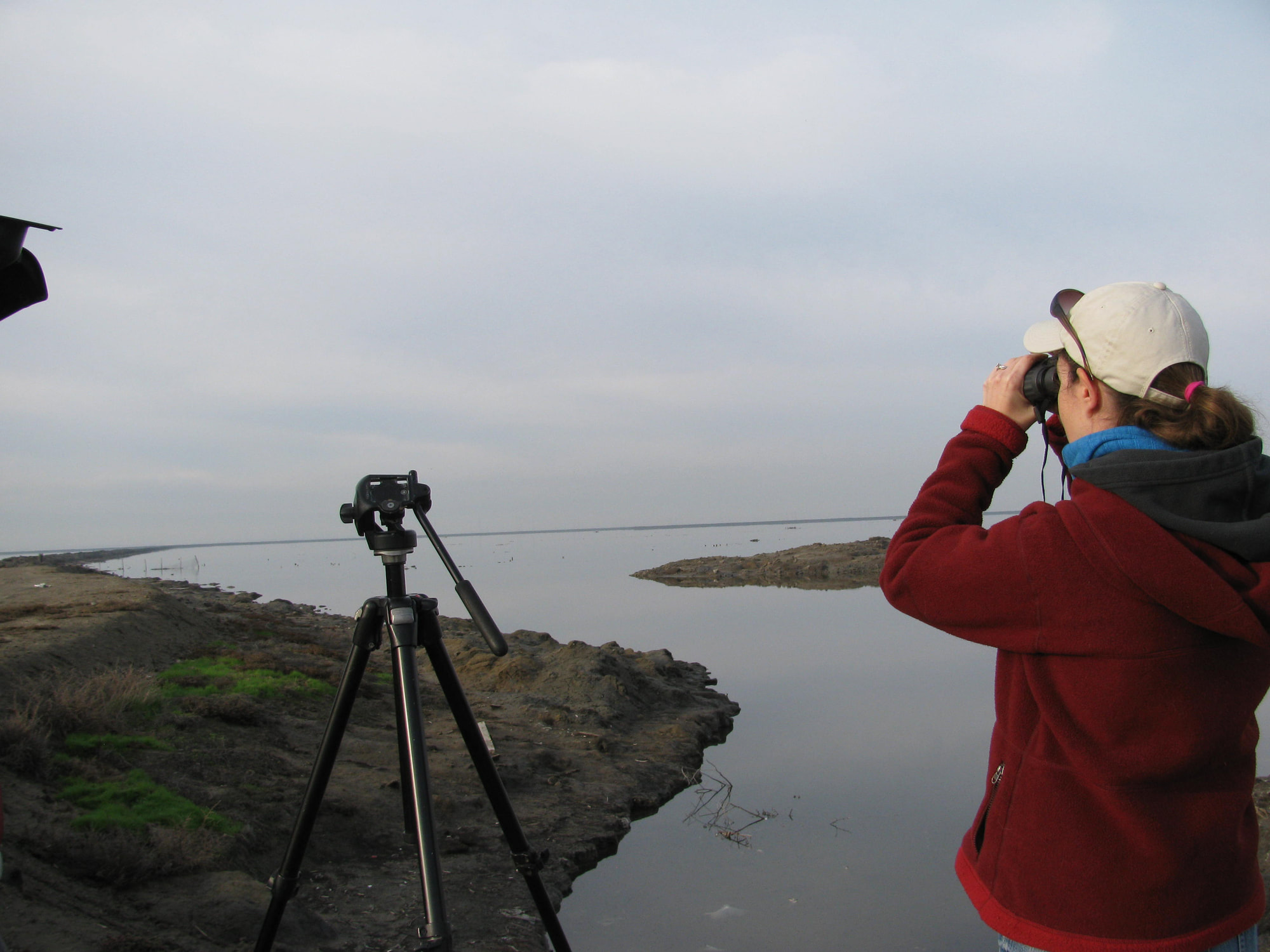
The 2018 breeding season was an eventful one for Snowy Plovers here in the South San Francisco Bay. SFBBO staff faced cold and drizzly mornings to start the season, swarms of mosquitoes and triple digit temperatures in the middle of the summer, and long days in the field throughout. Our hard work paid off, as we monitored 269 nests in 22 ponds spread throughout the South Bay, with 79% of all nests found at Eden Landing. Pond E14, where we have invested a large amount of time and resources in recent years monitoring the large oyster shell enhancement, …
was especially busy, hosting 145 nests. This is by far the most nests ever found in any pond in the Bay Area, and to add to that, E14 also hosted 141 Least Tern nests! Although plovers and terns were heavily impacted by predators at E14 and had poor reproductive success in 2018, we are hopeful that several new management actions planned for the area will improve their success in 2019.
While SFBBO staff are accustomed to the many challenges faced by monitoring breeding plovers in the South Bay, 2018 presented an unexpected challenge early on. In 2017, SFBBO secured Endangered Species Act funding for 2018 monitoring of breeding plovers at Eden Landing. However, changes in the Trump Administrations priorities resulted in a significant delay of final approval of the grant funding, and placed the funding itself in doubt. With funding for half of our work suddenly unavailable, we turned to our neighbors at Cargill Inc., who we have built an excellent partnership with over the years
Not only did the Newark office offer a generous grant to help fund our research, but with their support we applied for and were approved for a matching grant from Cargill’s corporate office. So from SFBBO and Eden Landing plovers, we say thank you Cargill!
Ben Pearl, MS, is Director of SFBBO’s Plover Program. You can read the latest Snowy Plover Nesting Summary on our Science Reports web page.
When I was very small, one of the first birds I learned to recognize was the “English Sparrow,” as it was then called. Small and brown, unlike the colorful jays and cardinals at our feeders, it was a “downtown bird,” most often seen on sidewalks or in parking lots, especially where there were trash cans. I liked it because it was tame and approachable, and there were many of them, making them easy to recognize. So it was surprising to hear adults refer to it as “that bird,” in terms more pejorative than admiring.
… (Groundwood Books, 2018), that my “little brown bird” originated not in England but in the Middle East. In prehistoric times, she tells us, it was a migratory bird of fields until the point when humans began to grow grain. That was the beginning of its long period of adaptation to humans, learning to live near them in order to forage among their grain crops, build homes in their dwellings, and give up the need to migrate.
But, she points out, as it learned to forage, it also began to gather at the end of nesting season into large flocks to glean seeds from crops, and as its numbers increased it became a pest. An Egyptian hieroglyph of a House Sparrow meant “bad,” and archaeologists have discovered that these little birds were captured to feed to hunting falcons. Just how and why is one of the most fascinating stories in this book.
From the Middle East, the sparrow spread across Europe and Asia, following settlers and explorers. So successful was it that humans hung nesting places for it in order to catch and eat it, yet it continued to multiply. Some people, particularly farmers, realized that it had a helpful side, eating insect pests and the seeds of weeds. And then, when European settlers began to spread into America, it was imported because of its familiarity, to remind settlers of the homes they had left.
As it spread in the nineteenth century, the House Sparrow was first welcomed and then, again, seen as a pest. In the twentieth century, in China, its close relative the Eurasian Tree Sparrow was such a pest that Mao declared it an enemy, instructed people to band together to destroy it, and possibly as many as a billion sparrows were killed.
Thornhill concludes with illustrations of this bird’s adaptability and the degree to which it stands, both literally and figuratively, as a “canary in the coal mine,” illustrating human destructiveness toward natural species and processes. A brief glossary, map, description of the sparrow’s life cycle, list of animals that live alongside humans, and resources are appended.
Though presented in picture book format, this story is unusually rich in surprises and should interest older readers and adults as well as those who respond first to its handsome illustrations.
SFBBO member Dudley Carlson, a biologist’s daughter, grew up in a family of birders and was Manager of Youth Services at Princeton (NJ) Public Library for 25 years. She believes that if children enjoy learning about birds and understand how important they are to our environment, then birds, nature and people will have a better chance at a healthy future.
By Outreach and Communications Director Kristin Butler
For almost 40 years, SFBBO has been deeply rooted in our Bay Area community. We were founded by professors from San Jose State University, are fueled by citizen scientists from cities around the Bay, and are supported by local people who donate goods and money to our cause. During the past few years, Bay Area corporations have become increasingly engaged in our work as volunteers and donors, and this year we plan to grow this engagement through our 2019 Corporate Campaign.
Employee Volunteerism More and more often these days, companies are encouraging their employees to serve as volunteers for local nonprofits, giving us the opportunity to share our mission with new people while accomplishing important work. In 2018, employees from Electronic Arts and Microsoft helped our Habitats Program team restore tidal marshes at Redwood City’s Bair Island, and employees from Cargill helped our Plover Program team create Snowy Plover habitat at Eden Landing Ecological Reserve in Hayward.
Employee Giving, Corporate Matching, and Profit Sharing A philanthropic strategy that has become really popular with companies lately is employee giving and corporate matching plans. Many companies have set up processes that allow employees to donate a certain amount from their paycheck each month, and often they give a matching gift to the charity their employee chose. SFBBO participates in several workplace giving programs, including Your Cause, Benevity, America’s Best Local Charities, and the California State Employees Giving at Work “Our Promise” Campaign.
In 2018 companies that donated matching gifts to SFBBO in this way included Adobe, Apple, Chevron, Genentech, Google, IBM, Intel, Microsoft, Netflix, Synopsys, and TiVo. In variations on this theme, Apple and Microsoft also donated money to SFBBO to match time their employees spent volunteering for us, and Amazon.com donated a percentage of their profits to us when their customers chose us through their AmazonSmile program. These strategies raised almost $14,000 for SFBBO in 2018.
Corporate Sponsorships and Grants In addition to these creative giving programs, the old school method of corporate sponsorship and grantmaking continues to be a powerful way companies can underwrite nonprofit work. In 2018, we received large donations from Cargill and Facebook to support our scientific research.
In Kind Giving When companies donate technology and other items to SFBBO, it saves us money we would have had to spend to do business. In 2018 Columbia Sportswear, Patagonia, Vortex Optics, and Whole Foods donated clothing, sporting equipment, and food for our fundraising events.
How You Can Help As we move into 2019, SFBBO will be growing our corporate giving program and we need your help.
If you work for a company and donate money or volunteer time to SFBBO, please check with your employer to find out if they match employee giving. You can see a list of companies that have participated with SFBBO in the past on our website.
If your company takes sponsorship recommendations from their employees, please nominate SFBBO.
Consider organizing a volunteer work day with your colleagues to help us restore tidal marsh, Snowy Plover, and Burrowing Owl habitat or maintain trails at our Coyote Creek Field Station.
Check out our Wish List to see if your company might have technology or other items that it can donate to our programs.
Invite one of our scientists to give a presentation about our work at your company or lead a bird walk for your department nearby.
Apply to serve on our Board of Directors to build a bridge between our mission and your company’s brand.
Work with me to write an article for your company newsletter or for our blog.
Invite SFBBO to have a booth at one of your company events.
Let us know if you have another creative idea about how to partner with SFBBO!
For more information or to share your corporate giving ideas, please contact me at [email protected].
Kristin Butler is Outreach and Communications Director at SFBBO and has managed fundraising programs for youth serving and conservation nonprofits for 17 years.
By Outreach and Communications Director Kristin Butler
The Colonial Waterbird Program is one of my favorite research projects at SFBBO. As one of our two longest running avian studies, it has produced a continuous data set that reaches back to the early 1980s. In addition, the project has covered vast geography from Morgan Hill to Alameda, from Pescadero to Livermore, and throughout most of the cities in between. This kind of information is rare and powerful because it tells us an important story about our region’s birds over time and gives us a chance to make decisions …
… that protect them. This enormous work is only possible because of our wonderful army of citizen science volunteers.
In 2018, the latest contingent of 67 volunteers donated 912 hours to monitor 62 potential colonies, 52 of which were active. Together they monitored 17 gull, tern, and shorebird colonies and 35 heron, egret, and cormorant colonies.
In addition, in May they helped our staff conduct walk-through surveys of 10 colonies of the most abundant waterbird species in the Bay Area: California Gulls. We’ve seen an exponential increase of this species since 1980 and are tracking how these changes impact other species like Western Snowy Plovers.
In addition to its important contribution to science, I like the Colonial Waterbird Program because it educates the community about the wonder and importance of birds. Each year, volunteers in the program help me teach kids and families about avian science by leading hands-on activities at family science events at libraries and schools around Bay, and they share their data with the public at special Birds in Your Neighborhood events at their colony sites. By connecting people to the birds that live among them, our volunteers help create more support for bird conservation, which is our ultimate goal.
For more information about the 2018 results, please visit our CWB website. To meet some of our tenacious volunteer watchdogs and bring an event to your neighborhood, library, or school, please contact us at [email protected].
Kristin Butler is the Outreach and Communications Director at SFBBO. She writes about science and the environment and her work has appeared in The Argus, Bay Area Business Woman News, Tideline, All Bird Bulletin, and Birdwatching Magazine, and on national blogs including SciStarter, P.L.O.S. CitizenSci, andDiscover’s Citizen Science Salon. You can reach her at kb[email protected].
Did you participate in the Christmas Bird Count? How many kids were along on your count? Did you count at night or by day, outdoors or from a window? The history of this important event is introduced, in simple picture-book format, in Counting Birds by Heidi Stemple. “Frank Chapman loved birds,” she says, and describes how he worried about the tradition of …
Christmas Day bird hunts and worked to redirect them toward conservation. At the end of this engaging book, Stemple gives more detail about Chapman, tells how to a count or participate in other Citizen Science projects (such as the Great Backyard Bird Count, coming in February). She reveals that her own Christmas counting is always post-midnight owling, to which she was introduced by her father. She herself is the little girl in the Caldecott Medal-winning book Owl Moon, written by her mother, Jane Yolen.
These cold winter nights, when owls are calling to find mates and pair up before nesting season, are the perfect time to introduce young children to owling. I can’t think of a better way to begin than by reading Owl Moon together, followed by Counting Birds. Then get ready to sit with your kids by a window in February, or get them out in the parks to join the Great Backyard Bird Count, and show them how many others have also submitted numbers, nationally and right here in our California backyards.
SFBBO member Dudley Carlson, a biologist’s daughter, grew up in a family of birders and was Manager of Youth Services at Princeton (NJ) Public Library for 25 years. She believes that if children enjoy learning about birds and understand how important they are to our environment, then birds, nature and people will have a better chance at a healthy future.
Greetings from south of the equator! I’m currently teaching bird language in the Amazon jungles of Ecuador. There is such a passion here to protect the rare and endangered birds. I’m grateful to share bird language in Spanish because it connects local families to their natural world without the challenge of identifying the 1638 species of birds that live here! We can just listen and learn.
I grew up with a marine biologist father. So I was always at home poking about in the tide pools, walking in the woods, and …
observing nature. I still remember father’s sea sick whisper of advice, after one of his particularly rough sea voyages, “Don’t study animals, Jeff, study PLANTS, because they don’t move around!” So in college I minored in botany. Birds especially intimidated me: too fast, always backlit, and with multiple songs and molting plumages.
In my middle-aged years, I began studying with Jon Young, author of the bird language bible, What the Robin Knows. I learned that songbirds are the inter-connected eyes and ears of our ecosystems. But can we learn what they are saying? I’m teaching a workshop for SFBBO on February 9, Decipher and Learn: Bird Language in the Field, that explores this question, as well as the following concepts:
Each species of song bird communicates through their own calls, songs and alarms, but research shows that they respond to a common language that enables them to watch and warn other animals about the house cat, hawk and curious humans!
Research is showing that human language may have had its roots in bird language.
By learning to interpret the common language consisting of bird songs, sounds and movements we can begin to develop a deeper connection with nature, birds and ourselves.
Understanding common bird language does not require you to identify the species of every bird in the field in order to understand their vocalizations and behavior, so it is accessible to both beginners and seasoned birders of all ages. The workshop will include a short lecture at SFBBO’s conference center in Milpitas followed by a morning of listening in the field at Ulistac Natural Area in Santa Clara to try to unravel the story of bird conversation and behavior.
In the workshop you will learn:
The five different common voices of song birds
How to begin to interpret their communication from sound, movement and alarm
Skills you can apply in your backyard, on a hike or sitting quietly observing in the city
How to cultivate your observation and curiosity about what’s going on in the birds’ world
I find joining this kind of “community bird sit” creates a connection between me and individual birds, and allows me to share my enthusiasm with other birders through our shared observations, questions and theories. I hope you’ll join us! Registration is required, to register click here.
Jeff Caplan weaves 30 years as a naturalist and a teacher of communication skills to cultivate a common language for connecting more deeply with nature and birds. Working privately and through the University of California, he has given workshops to hundreds of people in the Bay Area, Malaysia, and Ecuador. He combines story telling, citizen science, and strengthening observation skills to inspire connection and stewardship among his audiences.
With the closing of 2018 also comes the end of another Avian Disease Prevention Program season in the South Bay! This year we collected and removed 10 dead birds of 5 species (American White Pelican, California Gull, Double-crested Cormorant, Mallard, and Canada Goose), 17 dead striped bass, and 1 unknown fish species. In addition, we captured 10 sick or injured birds with 8 California Gulls, 1 Herring Gull, and 1 Mallard. All live birds were taken to the …
Wildlife Center of Silicon Valley and 4 were successfully rehabilitated and released.
With the season wrapped up, we would like to offer thanks to all the staff and volunteers who assisted with surveys this year helping collect sick, injured or dead birds in the South Bay sloughs and sometimes having to brave the extreme elements such as hot weather or smoke from wildfires. The ADPP would not be possible without volunteer help, as evidenced by the 160 survey hours donated by 14 volunteers this year! SFBBO thanks our dedicated volunteers: Richard Casserley, Bill Hepburn, Gabbie Burns, Jeff Englander, Brad Speno, Jessica Webb, Kevyn Adams, Susan Greenberg-Englander, Jessica Kochick, William Payton, Graham Pimm, Amy Hewett, and Don Jower.
Special thanks to Ken Smith for maintaining our boat, and to the following SFBBO staff: Victoria Heyse, Cole Jower, Anjou Kato, and Max Tarjan. We also want to give an extra special thanks to Waterbird Lead Biologist, Victoria Heyse, who after four seasons of leading ADPP surveys and coordinating volunteers, is moving on to new opportunities with Santa Clara County Parks. We wish you all the best with your new adventures and are extremely grateful for your dedication over the years!
Cole Jower is a biologist with SFBBO’s Waterbird, Plover, Landbird, and Habitats Programs.
Each Saturday morning Raptor Migration programs began with introductions in front of the 158-year-old historic ranchero house at Bernal-Gulnac-Joice Ranch. Avid bird watchers would arrive early and were easily identified with binoculars around their necks. The new additions to raptor observation in the field were still waking up at 9:50 AM on sleepy Saturday mornings as they carefully parked their vehicles in the car lot. Visitors would be greeted by a friendly easy going smile from San Francisco Bay Bird Observatory staff/volunteer Eric Lynch. Darting between Eric and the visitors wold be myself …
completing the final preparations for the two-hour interpretive program. As the new Park Interpreter for Bernal-Gulnac-Joice Ranch I had a lot to double check to ensure the park unit and the program were ready for a memorable raptor filled morning. This was the common setting for the seasonal public interpretive programs titled Raptor Migration, which was hosted by Santa Clara County Parks in collaboration with San Francisco Bay Bird Observatory.
Each free two-hour long program was offered every Saturday during the months of October and November to the public. The program consisted of an introduction to raptor identification via flight patterns/behaviors and a moderate two-mile round-trip hike on Joice Trail. Introductions began with visitors waving their arms in unique ways to characterize the most common raptors at the park. After the giggling subsided from the “Vomiting Vulture” and “Big Butt Buteo,” visitors applied their newly acquired knowledge of raptor behaviors to field identification and observation.
During the hike, a taxidermy raptor specimen investigation and an interpretive facilitated dialogue was led by Eric and I. Visitors learned about the physical adaptations of raptors by closely examining talons, wings, feathers, and skulls of raptors. We used multi-lingual (English, Spanish, simplified and traditional Chinese) prompt cards to generate discussions amongst visitors who classified obstacles and aids to raptor migration.
By the end of the program, not only did I notice each visitor had a spark of curiosity ignited within them. Even after the program was completed, I saw visitors scrambling out from under the shade of large oak trees to catch a glimpse of any flying shadow overhead, despite being tired and overdue for lunch. They had a new hunger, a hunger to learn more about migratory raptors. Success!
Kelsi Ju is a park interpreter with the Santa Clara County Parks.
Cada sábado en la mañana los programas Raptor Migration empezaron con presentaciones en frente de la casa histórica Bernal-Gulnac-Joice Ranch, en el estilo ranchero que tiene 158 años. Observadores ávidos de aves llegarían temprano y los identificamos de sus binoculares colgados en sus cuellos. Los nuevos observadores de aves de rapaz acaban despertarse, son las 9:50 AM de la mañana. Eric Lynch el personal/voluntario de San Francisco Bay Bird Observatory, saludó a los visitantes con una sonrisa sin preocupación. Me lanzaba entre y los visitantes para completar …
todas las preparaciones del programa interpretativo para esa mañana. Soy la nueva interprete de parque de Bernal-Gulnac-Joice Ranch, tuve mucha responsabilidad para confirmar que el programa fue listo para ser una mañana memorable. Eso fue el escenario de colaboración entre Santa Clara County Parks y San Francisco Bay Bird Observatory para programa interpretativos.
Cada gratis programa duró 2 horas y lo ofrecemos todos los sábados durante los meses de octubre y noviembre para el público. El programa consistió en una introducción de identificación de rapaces por sus patrones de vuelo y una caminata moderado 2 millas de ida y vuelta en Joice Trail. Las introducciones empezaron con los visitantes moviendo sus brazos en maneras especiales para significar las costumbres de rapaces más común en el parque. Cuando todos habían terminado de reír por culpa de “Vomitting Vultures” y “Big Butt Butteo,” visitantes usaron su nuevo conocimiento en el campo.
Durante del sendero, Eric y yo dirigimos una investigación de muestras taxidermia de rapaces y un dialogo facilitado interpretativo. Visitantes aprendieron de las adaptaciones físicas de aves de rapaces por sus estudios de talones, alas, y calaveras. Nosotros usamos cartas de varios idiomas para generar discusiones entre los visitantes. Ellos tuvieron que clasificar obstáculos y ayudas de migración de las aves de rapaces con las cartas. Por fin, cuando terminamos el programa yo observé una chispa de curiosidad en cada visitante.
Por el ultimo parte del programa, los visitantes tuvieron ganas y ánimo para observar mas rapaces, aunque ellos estaban cansados y tenían hambre. Yo vi que ellos se apuraron afuera de la sombra de un roble para agarrar un vistazo de sombra volando, no les importa que paso la hora del almuerzo. Ellos encontraron una hambre nueva; una hambre para aprender más de migración de las aves de rapaz. ¡Exito!
Kelsi Ju es interprete de parques en los parques de condado de Santa Clara.
Growing up, my brothers and I knew better than to expect lots of gifts at Christmas time. Nuts and oranges in our stockings, topped with a peppermint stick; new shoes; and one or two special gifts were about it, except for the handful of small packages that came in the mail from relatives. As little kids, we played with blocks, a doll or two, and Lincoln logs; as we got older, we rode bikes or skated.
Contrast that with today’s closets full of toys. With the gift-giving holidays approaching, how does a distant relative know what to …
give a much-loved child a thousand miles away? My solution is to give books. And given the state of the world, we could all do worse than give our children the best books available on natural history in hopes of sparking or encouraging their interest in the world around them and its value to all of us.
Herewith, then, is the list of books that SFBBO shares at family events. Most of the books listed are available online (and will earn a contribution to SFBBO if you order through smile.amazon.com) or at bookstores. If you can’t find what you want there, visit your public library after the holidays, and borrow a bag full for Ski Week.
SFBBO member Dudley Carlson, a biologist’s daughter, grew up in a family of birders and was Manager of Youth Services at Princeton (NJ) Public Library for 25 years. She believes that if children enjoy learning about birds and understand how important they are to our environment, then birds, nature and people will have a better chance at a healthy future.