• What It Is About Birding

    What It Is About Birding
    By Friends of Marcia Ruotolo
    Picture

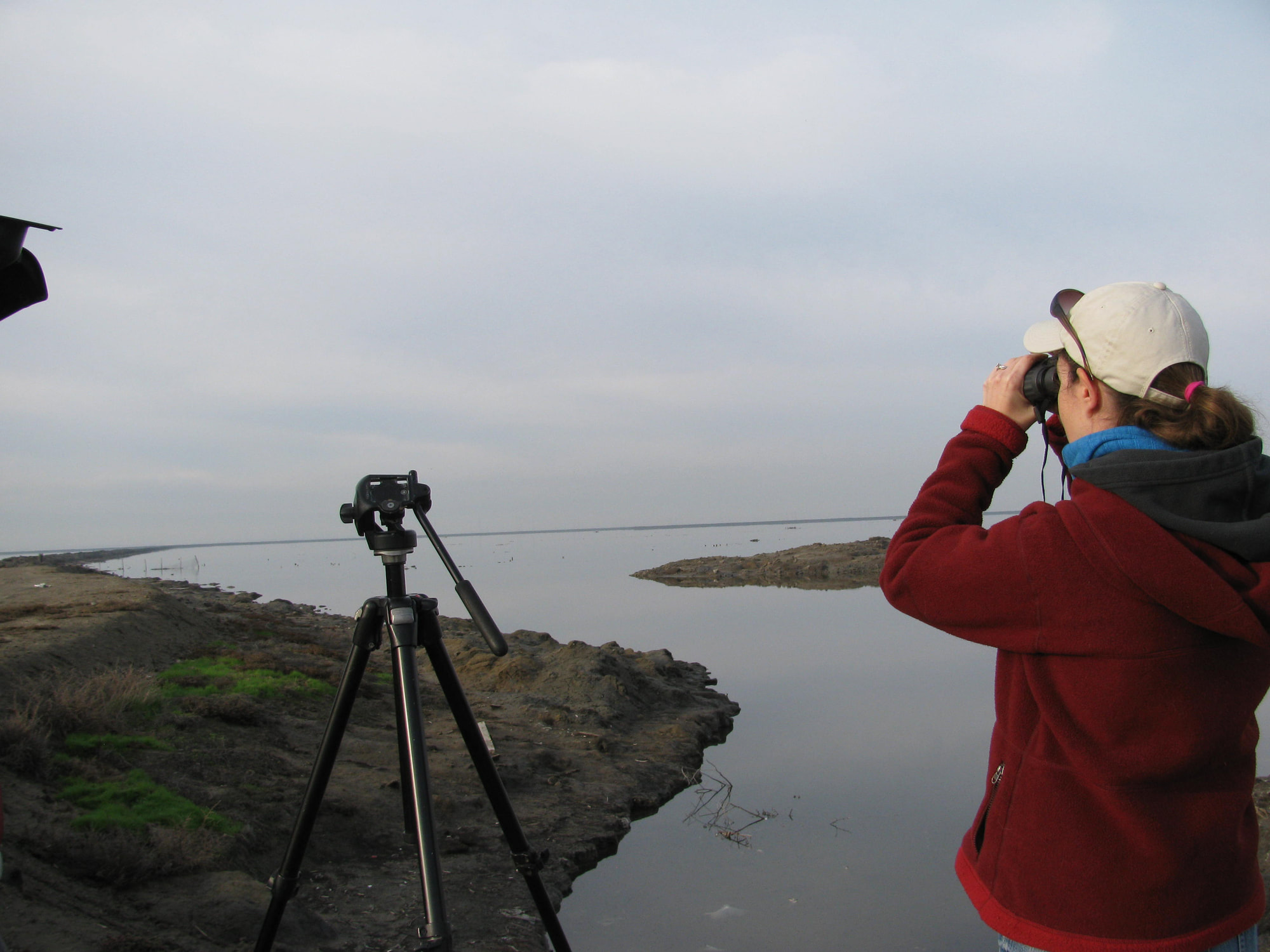
    ​In September 2004, a new, enthusiastic instructor took over the Beginning Birding class at Palo Alto Adult School, teaching novice birders the art of finding and identifying common birds of the San Francisco Bay Area. The real learning took place on our weekly field trips to local parks, beaches and yes, water treatment plants. Our class went to a bird banding demonstration offered by SFBBO. Some signed up for Alvaro Jaramillo’s SFBBO classes on shorebirds, seabirds and gulls. 

    Along the way, we became friends. Carpools on field trips gave us time to chat and develop connections. Shared snacks during our evening class break gave us more chances to know each other better. 
     
    Over the years, a core group of about ten continued our friendship while reinforcing our birding skills. We have comforted and consoled each other through illnesses and the death of spouses. Most recently, we have mourned the death of one of our own, Marcia Ruotolo, and decided to honor her memory by making a donation to SFBBO.

    Here is why we continue to bird:
    ​“Birding puts a smile on my face. I don’t need to tick off rarities on my life list. I am content to mark the passing seasons by the changing plumage and the comings and goings of migrants on the Bay.” 
     
    “Our group can put aside the ups and downs of life to take a walk and just enjoy the beauty of local birding sites, blending bird observation with a little chatting and a lot of good laughs. I never returned home without having learned or re-learned something essential about our avian friends.”

    “Birding and birders have enabled me to get outside of myself and to enjoy a really great group of people.”
     
    “Birding is a peaceful and quiet way to connect deeply with wherever you are.”

    “Stumbling into Bob Power’s Beginning Birding, I barely knew a duck from an eagle. Hundreds of hours later – after tromping through marshes, forests, riparian corridors – my life is enriched, blessed – by birds and enduring friendships. Quick! A Nuttall’s in my bird bath. There’s a White-breasted Nuthatch in the branch overhead!”
    “The marvel of flight…birds’ myriad vocalizations (music! a different & exciting language to learn)…colors and patterns…amazing variety…the intellectual stimulation of looking, learning, problem-solving…the camaraderie of other birders…feelings of awe and joy…the balm of contentment one moment/ the rush of excitement the next.”

    “Birding is an experience that can be enjoyed anywhere. It adds a new dimension to wherever one travels…even in one’s own backyard!”

    “Birding is joy, the joy of learning,  the joy of discovery,  the joy of hunting, the joy of sharing, the joy of marveling,  the joy of just sitting,  looking,  and listening,  of discussing and laughing and a little arguing,  and the joy of doing all that with new and old friends and people you love.” 
     
    “Birders are just plain friendly people with the desire to help each other out. I have not been able to join this group on most excursions during the past couple years, but my heart has always been there, eager to hear or imagine what birds were seen by this group on a particular day.”
    Thank you, SFBBO, for continuing to support birding around the Bay!

    Photographers (in order) Joshua Ryan Aloysius White, Jerry Ting, SFBBO, Mike Bolte, Katja Zuske, Carol Ann Krug Graves, Curt Bianchi, and Garrett Lau.

    Thank you to the Friends of Marcia Ruotolo for donating more than $1,000 to support scholarships to send students from underserved communities to future SFBBO bird ID workshops taught by Affiliated Senior Biologist Alvaro Jaramillo. 


  • High School Student Learns the “Tricky” Skill of Advanced Shorebird ID Thanks to SFBBO Scholarship

    High School Student Learns the “Tricky” Skill of Advanced Shorebird ID Thanks to SFBBO Scholarship
    By Guest Blogger Sebastian Casarez
    Picture

    ​First of all, I would like to thank the SFBBO donors for providing the Advanced Shorebirds Workshop for those that are from underrepresented backgrounds. I appreciate the time and effort that Mr. Alvaro Jaramillo has put into preparing this educational Shorebirds Workshop. I found this workshop to be informative and it has contributed to my California shorebirds identification skills.

    Shorebirds can often be tricky for birders to identify. The type …

    of format Mr. Jaramillo used to differentiate each shorebird was very explanatory. I knew that the names of small sandpipers are called “Peeps” in North America. I was fascinated to learn that in Europe and Asia they are called “Stints.” That was interesting to know. It is always helpful to learn different types of ID tips on Short-billed Dowitchers and Long-billed Dowitchers.
    I was curious about the differences between Black-winged Stilts and partial leucistic Black-necked Stilts. I learned from Mr. Jaramillo that the way to tell the difference between a Black-winged Stilts and partial leucistic Black-necked Stilts was by their distinguished calls and by a single black feather on the head.

    Besides Wilson’s Phalaropes being one of my favorite shorebirds, I also enjoy listening to  Wilson’s Snipe’s winnowing calls when it vibrates its tail against the wind.

    This workshop made me look forward to visiting California next spring to look for all these beautiful California birds; especially my bucket list bird the Tufted Puffin.

    Thank you, SFBBO, SFBBO Donors, & Alvaro Jaramillo! Happy Birding!

    Sebastian Casarez is 17-year-old high school student and avid Texas birder. 


  • Seasoned Birder Learned Valuable Tips on Shorebird ID Thanks to Workshop Scholarship

    Seasoned Birder Learned Valuable Tips on Shorebird ID Thanks to Workshop Scholarship
    By Guest Blogger Lara Tseng
    Picture

    ​After falling in love with birds at three years old, I discovered birdwatching, a wonderful way for me to experience nature and observe the beautiful diversity and behaviors of birds. As I have gotten older, my love for birds has only increased, along with my thirst for knowledge about them. 

    Having grown up in coastal California all my life, I had the chance to appreciate the birds on our shores and waters. This workshop gave me a further opportunity to expand my knowledge about them. Shorebirds have always been a challenging subject for me, considering that their behavior …

    and lifestyle is drastically different from inland birds. These birds also migrate and change their colorations through the seasons.

    The Shorebird and Advanced Shorebird ID workshops taught me how to ID shorebirds and remember them by not only field marks but facial expressions and shapes that are more intuitive to understand and remember. To me, these traits are generally much easier to use as means of bird identification in contrast to coloration, which is often what is seen on field guides. By covering the shorebirds by family, I could easily remember the general body shape which allows me to focus on field marks and finding the bird in my field guide.

     
    The Advanced Shorebird ID workshop was exceptionally helpful in noticing and identifying rare species – with oftentimes very little difference from the common ones. I learned that carefully examining common birds can help me familiarize myself with common traits and be helpful when identifying rare ones – especially when I only get a few glances. Very similar birds helped me understand that there is a very fine line between species and subspecies and that sometimes, there just isn’t a clear distinction between the two.
    I noticed my ability to ID our local shorebirds markedly increased as I took information from the workshop into the field. Dowitchers, yellowlegs, and sandpipers have always been extremely hard to distinguish. The way dowitchers and sandpipers were taught allowed me to ID them not by nondescript, minuscule differences but to look at the facial expression as well as where the bird was seen. These differences are often much easier to remember and can be recorded quickly, even with a few quick notes or sketches.

    Behavior was also emphasized during this workshop. For example, while sanderlings look similar to all the other little “peeps”, their behavior is like no other bird. Details in distinguishing between gender and age were also discussed. While they won’t influence my eBird list, they are fun, easy traits that can be identified easily out in the field. The stories behind why shorebirds are sexually dimorphic or their migration patterns helps me connect to the facts and make remembering details easier than straight-up memorization.

    All the beautiful pictures in the course were excellent representations of the species but also allowed me to see the variation between season and individuals. I offer my heartfelt appreciation to all the donors who contributed to the scholarship fund that allowed m
    e the opportunity to attend these workshops. Mr. Alvaro was extremely enthusiastic and inspiring. He conveyed his knowledge in a very clear, understandable way. These workshops have improved


    Lara is an avid teen birdwatcher who has loved birds since she was 3. She has a passion for combining technology and conservation and hopes to study biotechnology. She has volunteered for the Cavity Conservation Initiative, Tree Care for Birds and Other Wildlife, Sea & Sage Audubon, Laguna Coast Wilderness Park, and other environment-related organizations. She is a Western bluebird monitor and is currently doing a research project on eggshell consumption during the breeding season on these birds with the help of the Southern California Bluebird Club and has done past studies on eggshell consumption as well.
  • Shorebird Workshop Scholarship Recipient Gained Confidence and Knowledge

    Shorebird Workshop Scholarship Recipient Gained Confidence and Knowledge
    By Guest Blogger Maya Castillo
    Picture

    ​I am a proud graduate of SFBBO’s Introductory Shorebird ID Workshop with Alvaro Jaramillo that took place on the cusp of July and August. Over the course of three days, Alvaro covered the shorebirds (or “waders,” as they’re known in Europe), consisting of Sandpipers, Plovers, Oystercatchers, Avocets, and Stilts.

    ​More than just their physical characteristics, we learned about the migration patterns of migrating birds such as the Western Sandpiper and other behavioral characteristics, such as nesting patterns relative to the shore. It was powerful to put a name to the birds I had already encountered, and even more so to be introduced to the other members of the shorebird family.

    ​The interactive and supportive teaching style of Alvaro and support staff built a collaborative learning environment I felt welcome in. The teaching staff made time for questions that reinforced and built upon the intended curriculum. Alvaro was receptive and adaptable to our relative levels of bird anatomy and zoology, and never moved forward without placing the bird we were learning about in the greater context of the Shorebird family in the Bay. His walkthroughs on everyday ID-ing challenges like the Dunlin and Western Sandpiper gave me confidence in my ability to apply the knowledge I learned when on my own.
     
    As a Bay Area resident during the months before COVID-19, this workshop also helped ease the homesickness and grief of having my first year in college cut short. Learning about Bay Area shorebirds tethered me to my limited time learning about its natural ecosystems in person, in a way that my virtual schoolwork could not. Moreover, it tethered me to the physical space that is the beautiful Bay, even while I am safely at home in Los Angeles. With each day of the workshop, it was comforting to learn more information about my avian neighbors to practice until my next visit in person.
     
    I would like to thank the donors of the scholarship fund for their support of my growth over the course of the workshop. Your support has been invaluable in removing barriers for underrepresented minorities such as myself while supporting organizations like SFBBO in their mission to extend interest in birding to all communities. As a Latina interested in educational equity and knowledge of the land and its beings, being selected for the scholarship – and every moment since – has increased my confidence in further pursuing the natural sciences and reinvigorated my drive to ensure that knowledge is shared with others.

    Maya Castillo is a rising sophomore at Stanford University interested in ethnic studies and environmental sustainability. They credit the docent-training course at Jasper Ridge Biological Preserve for exposing them to birding enthusiasts and inspiring their own interest in learning about local birds. They are a proud recipient of an SFBBO scholarship for the Introductory Shorebird ID Workshop in late July 2020 with Alvaro Jaramillo.

  • Shorebird Workshop Scholarship Recipient Overcame “Bane of Birding Existence”

    Shorebird Workshop Scholarship Recipient Overcame “Bane of Birding Existence”
    By Guest Blogger Ishira Fernando
    Picture

    ​Identifying shorebirds has long been the bane of my birding existence (other than immature gulls of course). Usually all you have is a fleeting glimpse at a pale colored bird with long legs, taking off on stiff wing beats only to disappear above the waves. More often than not I’d return home with just “shorebird sp.” on my eBird list. However, after getting the opportunity to attend the Shorebird ID workshop hosted by SFBBO and Alvaro Jaramillo on a scholarship, I think I am a lot better equipped to start putting names to many of Nor Cal’s regularly occurring shorebirds!

    ​Alvaro is a Senior Biologist at SFBBO and runs his own birding tour company, Alvaro’s Adventures. Being the author of several field guides and a published researcher, Alvaro is an internationally recognized ornithologist and the recipient of the Eisenman Medal of the Linnaean Society of New York. It was an absolute pleasure to get the chance to learn from him.

    ​The workshop began by introducing us to the life histories of several shorebirds and the incredible migrations they undertake. We learnt that birds that we take for granted like the Western Sandpiper breed almost exclusively in a concentrated region in Alaska and Russia before spreading across it’s winter range. Then we broke the shorebirds down into the larger families and subfamilies that we can expect to see here in the Bay and explored them in detail. 
     
    Despite having been a birder for many years, I learnt so many new things from Alvaro: I never knew you could sex Oystercatchers just by looking at their eyes! Furthermore, he highlighted how some shorebirds can be separated strictly based on the habitats/niches they occupy. For example, Wandering Tattlers are unique from most other Tringa Sandpipers in their choice of inhabiting rocky, bouldered shorelines, unlike the choice of mud and tidal flats for other shanks. 
    ​One of my favorite takeaways from this workshop is that you can learn to ID birds by looking beyond sets of fieldmarks. In Alvaro’s words “you can look at a bird and just know it’s a Western (Sandpiper), without looking at any feathers in particular.” He highlighted that acclimating yourself with the habitat and behaviors of a bird as well as noticing its shape and structure will often bring you to a point where you are able to positively identify many species at a glance, almost subconsciously. While I’m not there yet with my shorebirds, this workshop and the copious notes I took during it will definitely help me get closer!
     
    I’d like to thank SFBBO and Alvaro for hosting this incredible workshop. It wouldn’t have been possible for me to attend this workshop without the help of the donors who contributed to SFBBO’s racial justice scholarships, to whom I am very thankful. I’m looking forward to attending Alvaro’s next workshop on Advanced Shorebird ID where we hope to tackle rarer and more difficult shorebirds to positively identify.
     
    Ishira is a rising senior at Stanford University. Currently studying Physics and Math, he looks forward to applying his skills in a graduate role as an experimental ecologist. Born and raised in Sri Lanka, he has been a lifelong birder and a passionate wildlife photographer. You can find some of his work on his instagram page @ishirafernando
  • Workshop Scholarship Recipient Inspired to Help People Appreciate Shorebirds

    Workshop Scholarship Recipient Inspired to Help People Appreciate Shorebirds
    By Guest Blogger Brandon Kong
    Picture

    Shorebirds are a fascinating group which have enlightened me to the importance of wetland and estuary habitats and have informed my understanding of ecological concepts like niche partitioning. Despite my appreciation of these birds, the fact remained that my ability to tell a Lesser from a Greater Yellowlegs was far less than great. If I were to come across a Whimbrel or a Long-billed Curlew, there wasn’t much I could do but begrudgingly write “Numenius sp.” into my notebook. Shorebird identification was not my forte…

    Luckily for student naturalists like myself, there are talented educators like Alvaro Jaramillo who can help with this sort of ornithological shortcoming. My mentor and former instructor, Leticia Gallardo, who had guided me through West Valley College’s Ecology, Biodiversity, and Conservation program told me that Alvaro’s Shorebird ID Workshops would be an

    excellent opportunity to further develop my birding skills. I was immensely grateful for the generosity shown by the donors who contributed to the scholarship fund and made these workshops more accessible.

    ​​Everyone enjoys an enthusiastic teacher and Alvaro’s love for his subject is obvious. Far from a monotonous listing of differential features among the covered taxa, Alvaro’s beginning workshop was engaging and informative. He expertly layered insight to the biology of the birds he was talking about and expressed to us what makes them special. It is a pleasure to hear about the species in the local area from someone that knows them so well.
    The beginner’s workshop was very useful for someone who isn’t very experienced with shorebirds like myself. At the same time, there seemed to be bountiful details provided that even a seasoned shore-birder could add to their bank of knowledge. You may know that Godwits participate in one of the most intense migrations on the planet but did you know you can tell the sex of a Black Oystercatcher by looking at their pupils? There’s always more to learn.

    In the advanced shorebird ID workshop, Alvaro gave us a lesson on sonograms and bird song before taking a deeper dive into the different species an attentive shorebirder might encounter. We learned that getting to know the more common species could allow us to pick out the oddities. There’s no birding sixth sense required to recognize a Stilt Sandpiper mingling with a group of Dowitchers. Patience and practice are the key.

    I take great joy in getting to know different groups of organisms more deeply. As I enter UC Santa Cruz’s Ecology and Evolutionary Biology program, I’m excited to apply the knowledge I have gained through this experience and to help others learn about these beautiful creatures as well. We have taken so much from shorebirds in terms of their habitat. If people can only get to know them, then maybe they will feel more compelled to protect them.

    I would highly recommend participating in a workshop with Alvaro Jaramillo if you get the chance. You will surely walk away with new knowledge, appreciation, and inspiration in regard to the birds we share our world with.

    Brandon is a junior in UC Santa Cruz’s Ecology and Evolutionary Biology program and a new field technician for the Stanford Conservation Program. He is an avid naturalist and aspiring biologist in the making. Both avian reptiles and traditional reptiles are a passion of his and he is grateful to gain a knowledge of shorebirds through an SFBBO scholarship
  • Falconer Gained Shorebird ID Skills Thanks to Workshop Scholarship

    Falconer Gained Shorebird ID Skills Thanks to Workshop Scholarship
    By Guest Blogger Grace Chung
    Picture

    As a falconer, I’ve always loved and admired birds of prey. Observing, photographing, and identifying wild raptors is one of my favorite pastimes. Even just this summer, my family and I spent many weekends driving up to Pacifica to watch the Peregrine Falcons fledge and feed. 

    But peregrines are rarely the only birds that we spot upon approaching the shoreline. In fact, we often saw hundreds or thousands of shorebirds scattered in flocks across the area. Even with my binoculars, however, I could hardly tell the different species apart. My shorebird ID skills were clearly quite lacking.

    ​When my school’s local ecological society told us about this opportunity to learn about native shorebirds from the San Francisco Bay Bird Observatory, I was thrilled. 

    I immediately applied for a scholarship to the class, and my application was successful. I was and still am very grateful for this chance to improve my shorebird ID skills and would like to thank the scholarship donors for this gift!

    Alvaro Jaramillo was an amazing instructor, and I got more from the class than I expected. We started the class by learning about shorebirds’ basic biology (in particular, their breeding, migration, and molt) and moved more deeply into the different types of shorebirds – from avocets to sandpipers to plovers to oystercatchers, and so many more. Although it was a beginner’s birding course, Alvaro went into great detail about everything from each bird’s subtle sexual dimorphism, to feeding and migrating habits, to distinctions between juveniles and adults, and even named locations where we can find certain species. 

    Now when my family makes our weekly drive down to Pacifica, I hope that I can identify all the different shorebirds, including Sanderlings, Snowy Plovers, and Black Oystercatchers, just as well as I can identify birds of prey. Beyond species identification, however, I also hope to improve my awareness and understanding of coastal ecology, and how different birds like peregrines and shorebirds interact in the wild. As a conservationist and birdwatcher, I find it very important to watch such interactions and study shorebirds, especially during a time when many shorebird species are in decline. It is thanks to the San Francisco Bay Bird Observatory that I now have an enhanced understanding of shorebirds, and I cannot wait to apply this knowledge in my future birding experiences.

    Grace Chung is a second-year student at Stanford University. She loves all things related to birds and ecology, and is an avid licensed falconer who has experience with several kinds of bird of prey. She is also an avid birder and wildlife photographer, and her favorite destination to go birding is Costa Rica. Her avian photography has been published by multiple journals and competitions, including Nature’s Best Photography.
  • Dudley Carlson’s Kids Bird Book Recommendation – Teach Our Children Well

    Dudley Carlson’s Kids Bird Book Recommendation – Teach Our Children Well
    By Guest Blogger Dudley Carlson
    Picture

    ​This is a blog about birds in books for children; but these are no ordinary times. Some readers may remember the film “South Pacific” and the song that goes,
               
    …You’ve got to be taught /To be afraid
    Of people whose eyes/Are oddly made
    And people whose skin/Is a different shade…
     
    The recent encounter between noted birder Christian Cooper, a member of the New York City Audubon Society board of directors and an African American, and a white woman who accused him of threatening her reminds us …

    all that we must, as another song says, teach our children well. 

    And for those of us engaged in raising or teaching children about birds and their environment, it is astonishingly difficult to find good books about birds – or nature in general – in which any of the people shown are other than white. Birds go everywhere from the North Pole to the South Pole, touching every continent. They are known to and by people of every sort. But in the United States, few of our books for children show black or brown children looking at them or even enjoying the out-of-doors. And for the many inner-city children who are taken to the Bay to experience its wonders, there are few books showing characters that look like many of them to follow up with when they go back to the classroom.

    So here are a few suggestions. And while these are books featuring children of varied colors, mostly brown, they are inviting for any child interested in the natural world. One way to teach our children is by example: show them that all kinds of children enjoy nature. If our children are brown, here is someone just like them. If they aren’t, here are others who enjoy the same things they enjoy. Come, read; share together.  

    Carme Lemniscates, in Birds, points out to very young children the wide variety of colors, sounds, shapes, and behaviors among birds before adding some of the reasons people enjoy them. On the cover is a brown girl with dark hair; inside she shares her enjoyment with others who look different. The message is subtle but clear.

    ​Another picture book for somewhat older (4-8 years) children, Birdsong follows a young Cree girl who moves with her mother from their home in a city by the sea to a new home in a colder countryside. Agnes, an older neighbor who shares her love of art and of nature, helps her to become comfortable there and learns a few of her Cree words. Birds are in the background as the girl draws; but when Agnes becomes ill her daughter helps the young girl to hang her drawings of birds all over Agnes’s bedroom walls. “When we’re done, Agnes says it’s like a poem for her heart.” Visual and emotional learning are deeply embedded in both text and pictures.
    In Hiking Day, a young brown girl in cornrows sets out with her parents for a day hike. Among the animals they see in the woods are a toad, a porcupine, a chipmunk and a Pileated Woodpecker. The story is young and simply told, but the message is clear: hiking is for anyone, and it’s fun.
     
    And then there are fears. A boy and his brother, both African-American, set out from their family’s lake house in We Are Brothers to swim to “the rock,” where the older brother jumps from the top of a high promontory into the water. Afraid to go so high, this is the year the younger brother is challenged to try.  Gripped by fear, he tries to climb and is surprised to find that he can do it; but at the top of the rock he realizes how far down the water is. Still, challenged by his brother, he spreads his arms, makes the leap and thinks, “I am bird.” Shared fear and accomplishment are enhanced by handsome charcoal and pastel illustrations.
    ​Finally, Where’s Rodney? follows an antsy city boy who can’t pay attention in class. It’s more interesting to watch a bird out the window, but Rodney’s antics prompt his teacher’s threat to leave him behind when the class goes on a field trip “to the park on Friday.” Thinking that she means the tiny park down the street, all too familiar, he doesn’t care. But when Friday comes and he’s included, he thinks the bus driver has made a mistake when they pass the little park and head into the countryside. Fascinated by all that he sees, Rodney is truly excited when they reach Yosemite and he can run, climb, yell, look and enjoy – just what he’s been missing in the classroom. And when, on the way home, the teacher asks whether he liked the park, he demonstrates that he’s been learning all along. Floyd Cooper’s splendid illustrations capture Rodney’s boredom, his frustration, and finally his delight as he experiences something new and wonderful.
     
    Please share these books with the young children you know, whoever and wherever they are. And if you know or discover others that show black and brown children enjoying the natural world, especially the world of birds, please let us know. There aren’t enough out there, but they’re beginning to show up. And we need them. All of us. Together.
     
    SFBBO member Dudley Carlson, a biologist’s daughter, grew up in a family of birders and was Manager of Youth Services at Princeton (NJ) Public Library for 25 years. She believes that if children enjoy learning about birds and understand how important they are to our environment, then birds, nature and people will have a better chance at a healthy future. You can see all of Dudley’s book recommendations here
  • Science Teacher Connects Students to Israel’s Birds

    Science Teacher Connects Students to Israel’s Birds
    By Guest Blogger Wendy Gibbons
    Picture

    As a Bay Area science teacher, I love finding ways to connect my students’ learning to the natural world around them. I recently had the opportunity to do just that while chaperoning the junior class from Kehillah Jewish High School on an experiential learning program for 3 weeks in Israel. Did I bring binoculars in my tightly packed suitcase? You bet! I even lugged a second pair just in case a student or two wanted to take a closer look at a winged marvel. What follows is a brief summary of some adolescent as well as avian highlights from the trip. 

    Our adventure began in Southern Israel at the Negev Desert, where we were rewarded with views of Pale Crag Martins, Fan-tailed Ravens, …

    Trumpeter Finches, and White Storks. 

    ​As we continued our trip exploring the dynamic cultural, historical, and political life of one of the world’s most fascinating countries, we enjoyed many new experiences, from an archaeological dig to the Western Wall and a night-time boat ride on the Sea of Galilee. Birding on the side was a nice distraction during bus rides and bathroom breaks, and I did my best to point out the more colorful species. A Eurasian Hoopoe flashed among the rocks as the bus roared through a desert rock-cut. We saw Spur-winged Lapwings prancing in a park in Tel Aviv, Rose-ringed Parakeets carousing in palm trees, and a Eurasian Jay haunting a picnic ground.

    The Galilee and Jordan River area gave us a couple of more relaxed days, and I offered optional morning bird walks for a small group of 4-5 students. We meandered along the wetland, ogling easy-to-spot showstoppers such as Grey Herons, Purple Herons, Little Egrets, and Pygmy Cormorants (below, left). We even managed to snag some Whiskered Terns (below, middle), Common Moorhen, and a Graceful Prinia. Several students had already spotted the snazzy turquoise and copper White-Throated Kingfishers as they zoomed noisily above the hotel and the kids enjoyed trying to take pictures.
    After the Galilee, we spent a day at Gamla Nature Preserve hiking out to the waterfall in the rain. No binocs were needed here to view the half-dozen or so Eurasian Griffon Vultures (above, right) with their 2.5-meter wingspans cruising mightily a few meters away from us off the cliffs and over the ancient valley with its Byzantine ruins. 

    While sheltering in place at home during the pandemic definitely puts a crimp in our birding lives, nothing stops us from fantasizing about (and perhaps even preparing for) future birding trips. If you have time, take a look at Israel (see links below). The cornucopia of cultural experiences there is paralleled by an amazing array of biological diversity. 

    Birding in Israel, The Society for the Protection of Nature in Israel

    The World of Birds and Bird Watching in Israel


    Wendy Gibbons is a Bay Area science teacher at Kehillah Jewish High School.
  • Dudley Carlson’s Kids Bird Book Recommendation – Belle’s Journey: An Osprey Takes Flight

    Dudley Carlson’s Kids Bird Book Recommendation – Belle’s Journey: An Osprey Takes Flight
    By Guest Blogger Dudley Carlson
    Picture

    ​The season of returning migrants is a good time to look at one up close; and while we’re all sheltering in place, an adventure with a young osprey is a great place to start. In his book “Belle’s Journey: An Osprey Takes Flight,” ornithologist Bierregaard’s introduction calls attention to the curiosity that sparks scientific inquiry and the kinds of questions that have led scientists to develop new means of tracking long-distance migrants.

    ​On Martha’s Vineyard a young osprey is born. In the same area, a boy and girl walking on the ​beach encounter a scientist and his partner who are …

    capturing a newly fledged osprey for tagging with a radio transmitter. Invited to watch, the two youngsters become fascinated and begin two years of following the travels of this individual bird as online reports come back from the transmitter.

    As he follows the young osprey’s first foray over the open ocean and then traces her progress from Massachusetts down the Atlantic, through a Caribbean hurricane to Colombia and across the mountains to the Amazon and Brazil, where she spends 18 months, Bierregaard inserts information about the life cycle of this amazing raptor and about what scientists are learning for the first time through new technology. Belle’s journey is brought to life through beautiful illustrations in lush colors. Also included is an illustration by one of the children in the story, who was inspired to use ospreys in her art classwork while her brother based his science project on Belle’s travels.
     
    For housebound kids looking for distraction, the SFBBO booklist (https://zfd.suv.mybluehost.me/kids-bird-book-recommendations.html) includes a number of related titles. Dorothy Hinshaw Patent’s The Call of the Osprey follows scientists in Montana studying ospreys to learn about the impacts of pollution. Carol Lerner’s On the Wing looks at migration as a process, why and how it occurs and why only some birds migrate.  And perhaps the best book written about an individual is Philip Hoose’s Moonbird, which follows the migrations of a Rufous Red Knot from the Canadian arctic to southern Argentina and back. Other titles on migration and migrants are also listed.
     
    There is also a live nest cam on Hog Island, Maine (https://explore.org/livecams/ospreys/osprey-nest) that may lead young osprey-watchers to other species. Nest-cams are another great way to spark interest in youngsters and to occupy them when they’re bored with staying indoors. And if they’re curious about the birds out the window, there’s also Cornell’s All About Birds website (https://www.allaboutbirds.org/news/), a great place to learn more. At the back of Belle’s Journey, Dr. Bierregaard gives other sites where readers may follow ospreys and other birds.  But beware! Be prepared to fill requests for binoculars when the holidays or birthdays come around again.

    SFBBO member Dudley Carlson, a biologist’s daughter, grew up in a family of birders and was Manager of Youth Services at Princeton (NJ) Public Library for 25 years. She believes that if children enjoy learning about birds and understand how important they are to our environment, then birds, nature and people will have a better chance at a healthy future.