
By Guest Blogger Clara Millecamps

This summer, I gathered my courage to do something completely different and flew to the United States. My main goal was to improve my English, but because I have always been passionate about nature, I also looked for an association or organization where I could volunteer so I could deepen my knowledge in biology while practicing my English.
Thanks to the advice of Dr. David Ainley, I had the amazing opportunity to volunteer at the San Francisco Bay Bird Observatory (SFBBO). While there this summer, I worked on different projects such as Snowy Plovers with Plover Program Director Ben Pearl and bird banding with Landbird Program …
Director Josh Scullen. My job was initially to enter the data that scientists (and volunteers) collected in the field into a spreadsheet for further analysis. This was important work that allowed me to see the different aspects of several research projects and help scientists gather the information they need to draw conclusions or ask new questions that might lead to future research.
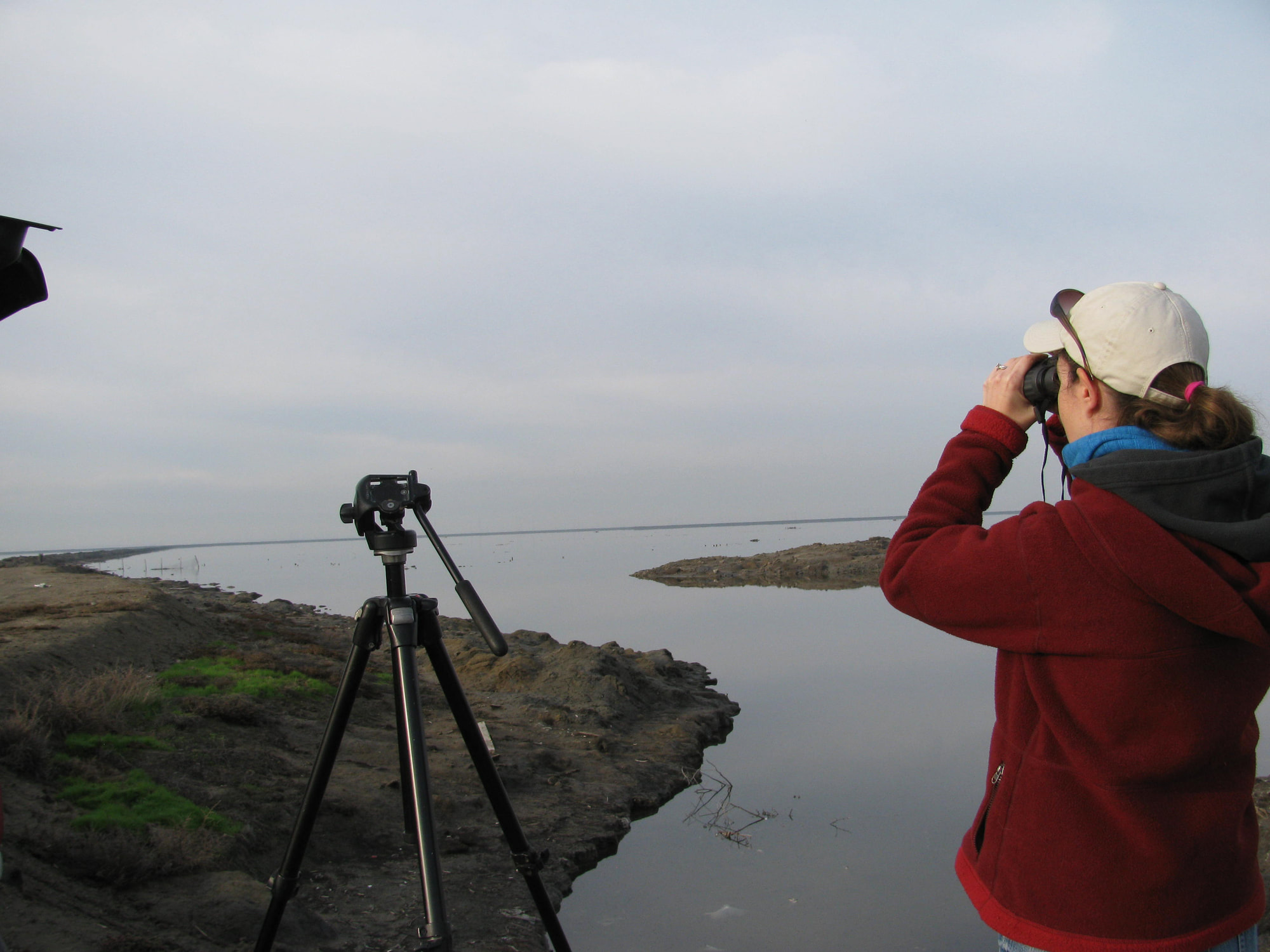
However, the part I loved most was working in the field. The Bay Area is an amazing place filled with life and diversity where you can learn so much. My first field mission was with SFBBO Biologist Anjou Kato helping her search for sick or injured birds in South Bay sloughs. During the 1980s, a pathogenic bacterium, Clostridium botulinum, appeared in the waters of the Bay, causing many birds to become sick or die. Since then, SFBBO has searched South Bay sloughs to prevent the spread of such diseases. Ajou and I searched for birds by car and watched them with binoculars. We did not find any sick birds. The lack of new data was initially a little frustrating because when we go on the field we always expect to find something. But if you think about it, it was very good news because it proved that all birds are healthy and not contaminated by bacteria. It is sometimes necessary to accept that, as a scientist, the fact of not having data is not a bad sign but on the contrary that it is a good thing.
However, the part I loved most was working in the field. The Bay Area is an amazing place filled with life and diversity where you can learn so much. My first field mission was with SFBBO Biologist Anjou Kato helping her search for sick or injured birds in South Bay sloughs. During the 1980s, a pathogenic bacterium, Clostridium botulinum, appeared in the waters of the Bay, causing many birds to become sick or die. Since then, SFBBO has searched South Bay sloughs to prevent the spread of such diseases. Ajou and I searched for birds by car and watched them with binoculars. We did not find any sick birds. The lack of new data was initially a little frustrating because when we go on the field we always expect to find something. But if you think about it, it was very good news because it proved that all birds are healthy and not contaminated by bacteria. It is sometimes necessary to accept that, as a scientist, the fact of not having data is not a bad sign but on the contrary that it is a good thing.


The second time I went in the field was with Landbird Program Director Josh Scullen to see how SFBBO tracks birds throughout the year. This was done through very large mist nets. While the nets are large, they are made of fine mesh that is hard for the birds to see so they flew directly into it. Once in the net, scientists extracted the birds carefully, being very sure not to hurt them or break a wing or a leg. After detaching the bird, we determined its species, saw if it was banded or not, then placed it gently in a small cloth bag in order to transport it to the laboratory located in the field. Once there, we could “examine” the bird.
We looked at different information about the birds such as height, weight, sex, and age. In general, it was easy to distinguish a male from a female because of the color of the feathers or the size. As for whether it was an adult or a juvenile, we looked at the bones of the skull, at the state of the feathers, and at markings on the beak (chicks have orange markings around the beak). Once all the information was collected, all that remained was to release the bird in a safe place. That day, we were able to capture 14 birds, including Song Sparrows and Common Yellowthroats.
Working as a volunteer at the SFBBO was a very rewarding experience that allowed me to learn so much in the field as well as in the office. I would like to thank all the people working at SFBBO for their kindness (as well as for helping me improve my English) and especially Josh and Ben who allowed me to work on their projects and helped me learn what scientists do: an extraordinary job that can be so different from one day to the next.
Clara Millecamps is a student pursuing a bachelor’s degree in biology, with a specialty ecology, at the University of Lille in France. She volunteered at SFBBO this summer during her visit to the Bay Area.
We looked at different information about the birds such as height, weight, sex, and age. In general, it was easy to distinguish a male from a female because of the color of the feathers or the size. As for whether it was an adult or a juvenile, we looked at the bones of the skull, at the state of the feathers, and at markings on the beak (chicks have orange markings around the beak). Once all the information was collected, all that remained was to release the bird in a safe place. That day, we were able to capture 14 birds, including Song Sparrows and Common Yellowthroats.
Working as a volunteer at the SFBBO was a very rewarding experience that allowed me to learn so much in the field as well as in the office. I would like to thank all the people working at SFBBO for their kindness (as well as for helping me improve my English) and especially Josh and Ben who allowed me to work on their projects and helped me learn what scientists do: an extraordinary job that can be so different from one day to the next.
Clara Millecamps is a student pursuing a bachelor’s degree in biology, with a specialty ecology, at the University of Lille in France. She volunteered at SFBBO this summer during her visit to the Bay Area.


