• Learn What Birds Are Saying at a Bird Language Workshop March 14

    Learn What Birds Are Saying at a Bird Language Workshop March 14
    By Guest Blogger Jeff Caplan
    Picture

    ​I’m just back from teaching bird language in the tropical jungles of Ecuador and the Galapagos. You know what? The same sounds that birds here in California have taught us to listen for also work to understand bird language on the Equator and in the Amazon.
     
    For example, listening to the rather friendly Galapagos Flycatcher, you can understand who’s looking for a mate and who’s just making casual conversation in the same way you can understand flycatchers here in the United States. You may not be able to speak Spanish when you head south, but you can learn …

    bird language here and take it with you when you travel!

    You can learn more about bird language by joining me at my Bird Language Workshop on Saturday, March 14! We will start with a short lecture at the Sobrato Center in Milpitas and then practice our skills together on a field trip at Ulistac Natural Area in Santa Clara.

    The workshop is great for adults and families and the focus will be on helping people connect with nature rather than on identifying species. I’ve also found that learning bird language is not only fun, it also helps me with a skill I have been practicing for years, mindfulness. It’s what I use to keep my calm in the midst of the everyday stresses of life and helps me find focus and practice gratitude.
     
    Using bird language skills also makes for better birding because the birds really notice and display more when I am calm and relaxed in my sit spot and listening! I have to admit I’m not great at sitting on a pillow in a lotus position, but somehow when the Golden-crowned Sparrow arrives from Alaska and starts to sing, it enables me to sit quietly without worrying for a fully engaged and relaxing hour.
     
    If you want to learn the skills of interpreting bird communication through posture, movement and sounds, please register for my workshop today!

    Jeff Caplan weaves 30 years as a naturalist and a teacher of communication skills to cultivate a common language for connecting more deeply with nature and birds. Working privately and through the University of California, he has given workshops to hundreds of people in the Bay Area, Malaysia, and Ecuador. He combines story telling, citizen science, and strengthening observation skills to inspire connection and stewardship among his audiences.
  • Intern Contributes to Bay Area Waterbird Research

    Intern Contributes to Bay Area Waterbird Research
    By Waterbird Intern Sarah Cantwell
    Picture

    My experience at SFBBO for the last five months has been one I will never forget. It was my first time in California and my first time working with birds along the Pacific Flyaway. I’ve thoroughly enjoyed counting birds with SFBBO and getting the chance to experience seeing the sheer abundance of birds in the area.

    ​As a Waterbird Intern, I’ve accomplished many tasks to benefit other staff at SFBBO, volunteers, and future waterbird interns. Along with monitoring waterbird use in the South Bay’s salt ponds, I designed a new system for monitoring historic colonial waterbird nesting sites, contributed to the annual salt pond report, and participated in the annual shorebird survey. Most recently, I’ve worked on a project to help answer the question “How can island design help promote breeding colonies of declining waterbirds, …

    such as stilts, avocets, and terns, while simultaneously deterring predatory gulls from nesting?” This project will compare characteristics of islands that are used for nesting by each species. The results will be used to develop guidelines for island design in the South Bay Salt Pond Restoration Project. As for my future, I will be saying goodbye to the West Coast and heading back east to work with endangered marsh birds in their breeding habitat. 

    Sara Cantwell was an intern in SFBBO’s Waterbird Program. 
    She completed her B.S. in Wildlife and Conservation Biology at the University of New Hampshire. She has a passion for birds and has always been interested in helping conserve wildlife and all natural resources. She spent the last couple of years working with threatened loons and other waterbirds in the Northeast and worked closely with other wildlife species in California.

  • Intern Makes an Impact for Waterbirds and Joins Plover Team

    Intern Makes an Impact for Waterbirds and Joins Plover Team
    By Plover Intern Parker Kaye
    Picture

    I’m very grateful to have spent the last six months as a part of SFBBO’s Waterbird Team. Prior to joining SFBBO, I had no experience working with birds and am amazed by how much I have learned in what seems like such a short amount of time. The majority of my time has been spent conducting salt pond surveys and learning the waterbirds of the Bay Area, but I have also had the opportunity to develop other skills that will help me as I move forward with my career. I helped generate maps and graphs …

    using GIS and other programs, developed web pages and training videos for our Colonial Waterbird program, and worked on grants to help fund projects at SFBBO. It has been great being able to work on so many projects that contribute to producing good science. While I’m sad my time with the waterbird team is coming to an end, I’m excited for my next chapter. I will be staying here at SFBBO as a Snowy Plover intern, assisting the plover team with Snowy Plover and Least Tern monitoring this breeding season.

    Parker Kaye was a waterbird intern at SFBBO. He completed his B.S. in Marine Biology at UC Santa Cruz where he also conducted multiple small mammal surveys throughout the greater Bay Area. Through this internship, he developed new skills and knowledge relating to bird and wildlife research and now serves as an intern in the Plover Program.
  • The Latest on Least Terns

    The Latest on Least Terns
    By Plover and Tern Program Director Ben Pearl
    Picture

    ​California Least Terns were once abundant along the Pacific Coast from Monterey Bay to the tip of Baja California. But once people began to flock to the California coast in the late 1800’s, their population began a steep decline.As colonial ground nesting seabirds, Least Terns are highly vulnerable for a number of reasons. Their primary breeding habitat, coastal sand dunes, have been largely developed, and those that have not often host large numbers of beachgoers. Least Terns are very sensitive to human disturbance, and thus few suitable breeding sites remain. Where they do still breed, they face high levels of egg and chick predation, especially from predators such as corvids, gulls, …

    … skunks and foxes that are well adapted to humans. Furthermore, the small fish that they feed on, including anchovies and sardines, among others, have seen their own populations affected by the overfishing. All of these impacts culminated in their being listed as Federal and State Endangered in 1970 and 1971. Since that time, intensive conservation efforts have resulted in the population rebounding from a low of 600 pairs in 1973 to an estimate of 4100-5600 pairs in 2017.

    Although Least Terns did not historically nest in the San Francisco Bay, wide scale changes to the bay ecosystem created suitable habitat for them. Currently, there are five breeding colonies spread across the bay, including one that SFBBO monitors at Eden Landing Ecological Reserve. The colony was established in 2017, initially attracted to the reserve by a large oyster shell enhancement that was spread for Snowy Plovers. Although Least Terns were successful breeders in 2017, since then they have experienced poor breeding success due to predation. 

    ​Beginning this coming breeding season, SFBBO plans to help improve their breeding success by enhancing their nesting habitat. On March 7, 2020, we will hold a volunteer event to remove vegetation and predator perches and spread two types of chick shelters, ceramic roofing tiles and wooden A-frames constructed by Dean and Nathan McCully. Both types of chick shelters are widely used at Least Tern breeding sites and have been shown to greatly reduce predation on chicks. To ensure that Least Terns take advantage of this enhanced habitat, SFBBO will deploy Least Tern decoys and an audio playback system to attract them to the site. SFBBO plans to more than double the amount of time spent monitoring the colony by our biologists and our volunteer monitoring program, for which we are currently accepting new volunteers.

    If you are interested in attending the Least Tern Habitat Enhancement Event or becoming a Least Tern Volunteer monitor, contact me at [email protected] for more information.    

    Ben Pearl, MS, is the plover and tern program director at SFBBO. Ben grew up in San Luis Obispo, where he attained an early love for nature exploring the nearby tide pools and oak forests. He completed his B.S. in Ecology and Evolutionary Biology at U.C. Santa Cruz, and first came to SFBBO while beginning his Masters at San Jose State University. For his Master’s thesis, he examined how various factors affect plover foraging habitat selection during the winter in the South San Francisco Bay. His favorite part of field work is seeing plover and tern chicks hatch and grow to become adults, especially when they are banded and he can keep track of them over the years. He also enjoys sharing his knowledge of these special birds through guided bird walks and public presentations.
  • An Update on Snowy Plovers

    An Update on Snowy Plovers
    By Plover and Tern Program Director Ben Pearl
    Picture

    ​SFBBO has been intensively monitoring Snowy Plovers in the South Bay since 2003, when the U.S. Fish and Wildlife Service and CA Department of Fish and Wildlife acquired large tracts of former salt production ponds and began managing them for wildlife. During that time, the South Bay Snowy Plover population has significantly increased, in large part due to management actions designed specifically to provide them with quality breeding habitat. However, Snowy Plover populations still face many challenges to recovery, especially predation from a diverse group of species, including corvids, gulls, raptors, and mammals. Since 2018, SFBBO has attempted to improve …

    … Snowy Plover breeding habitat at Eden Landing Ecological Reserve in Hayward by holding a one day volunteer event known as the Mud Stomp. This year’s events will be on March 28. As the name implies, a core component of this event is to stomp in the mud (though not too deep) to create more texture on the otherwise flat ponds. When available, we have also spread oyster shells or gravel afterwards to add additional texture and color to the pond. Since Snowy Plovers rely upon camouflage to evade predators at all life stages, stomping on the mud and spreading shells or gravel help to increase the effectiveness of Snowy Plover camouflage, helping to improve survival of adults, nests, and chicks. In addition, Snowy Plovers will often use footprints to nest in, so we are helping them get a head start on the breeding season by providing nest scrapes!

    Joining us this year for the Mud Stomp (and future SFBBO events) will be Andytown Coffee Roasters!  Located in San Francisco, and widely considered one of the best coffee roasters in the Bay Area, they are also the only other organization in the Bay Area whose love for Snowy Plovers can rival our own! Our biologists have been venturing up to San Francisco for years to get one of their signature drinks, the Snowy Plover, so when Andytown approached us about forming a partnership to work together for Snowy Plover recovery, we were more than thrilled. To start the partnership off, on Sunday, March 22nd they will celebrate their 6th Anniversary at their original Lawton location in the Outer Sunset District, including a fundraiser that will benefit SFBBO’s Snowy Plover Program! The following weekend, Andytown will be sending down their staff to the Mud Stomp to serve up coffee and pastries to get everyone fueled up to stomp.

    If you are interested in attending  the Mud Stomp event or becoming a Snowy Plover volunteer surveyor or docent, contact me at [email protected] for more information. 

    Ben Pearl, M.s., is the plover and tern program director at SFBBO. Ben grew up in San Luis Obispo, where he attained an early love for nature exploring the nearby tide pools and oak forests. He completed his B.S. in Ecology and Evolutionary Biology at U.C. Santa Cruz, and first came to SFBBO while beginning his Masters at San Jose State University. For his Master’s thesis, he examined how various factors affect plover foraging habitat selection during the winter in the South San Francisco Bay. His favorite part of field work is seeing plover and tern chicks hatch and grow to become adults, especially when they are banded and he can keep track of them over the years. He also enjoys sharing his knowledge of these special birds through guided bird walks and public presentations.     

  • Dudley Carlson’s Kids Book Recommendation: Hawks Kettle, Puffins Wheel, and Other Poems of Birds in Flight

    Dudley Carlson’s Kids Book Recommendation: Hawks Kettle, Puffins Wheel, and Other Poems of Birds in Flight
    By Guest Blogger Dudley Carlson
    Picture

    Those of us who read to or with children tend to be word people as well as bird people. A recent picture book from Canada recalls “An Exaltation of Larks” as it presents a dozen bird species and the group names associated with their flight styles. In Hawks Kettle, Puffins Wheel, And Other Poems of Birds in Flight, Susan Vande Griek offers brief, free-verse poems about each bird, followed by a short statement about its style of behavior when flying, fishing, diving, or protecting itself. Crows, for example, “mob” intruders or threats; Bald Eagles “cartwheel” during their courting flight; Northern Gannets “plunge-dive” when fishing. Mark Hoffman’s large, boldly stylized illustrations add visual impact to the descriptions and extend the book’s reach to young listeners. This is a book likely to spark …

    conversations as both children and adults recognize behaviors they have seen as well as unfamiliar ones. At the back of the book are brief descriptions of each bird, along with a glossary and a page illustrating flight feathers.

    For young readers who’re also word people, it may be interesting to have a dictionary handy. While “skein” is defined as “a flock of flying geese, usually in a V shape,” there’s no mention of the more common definition: a coil of yarn or thread, or something suggesting a thread. Similarly, “mob” means “to attack or harass an intruding animal, often to protect offspring,” but there’s no mention of the human crowd, or of rioting. The young listener may want to learn the meanings from which these bird words derive, as well as their descriptive meanings. That said, these are a dozen good words to learn as part of being an early birder.

    SFBBO member Dudley Carlson, a biologist’s daughter, grew up in a family of birders and was Manager of Youth Services at Princeton (NJ) Public Library for 25 years. She believes that if children enjoy learning about birds and understand how important they are to our environment, then birds, nature and people will have a better chance at a healthy future.

  • Oilapalooza 2019

    Oilapalooza 2019
    By Guest Blogger Jackie Vargo
    Picture

    ​Oilapalooza is an annual convention put on by the organization OWCN, the Oiled Wildlife Care Network. This year, on October 16th and 17th, I got the pleasure to attend my first Oilapalooza in Eureka.  It was also my first time in Eureka. As a San Jose resident, it was lovely to enjoy such a lush environment for a couple days. 

    OWCN partners with local organizations like SFBBO to train and provide volunteers for potential oil spills. Oilapalooza is a good way to meet everyone in the OWCN team, learn more about oil spills …

    and oiled wildlife response, as well as receive oil spill response training. Needless to say, I was excited to be a part of this convention.  

    The educational talks were set at a lovely conference center, and after breakfast, everyone sat to enjoy information related to oiled wildlife response, natural oil seeps, rehabilitation challenges and solutions throughout the world, and highlights about new organizations that have joined OWCN. Despite the sometimes emotionally heavy topics, most of the speakers donned frog hats because this year’s convention logo was the California red-legged frog. That evening,  convention attendees had a chance to mingle with each other at a reception in downtown Eureka, where food was served and raffle tickets were drawn.      
    The second day consisted of workshops, of which each person was only able to attend two. I decided to attend both the “Washing Oiled Birds” workshop and the “Washing Semi-Aquatic Mammals” workshop.  While training and experience with the handling of birds and mammals would likely be imperative before cleaning them in oil spills, these workshops did not use live animals and mainly focused on cleaning off oil while keeping the health and safety of yourself and the animal in mind. Both workshops had students put on safety gloves, waterproof boots, a waterproof apron, and eye masks before even attempting to pick up the not-live animal we would clean. 

    Rather than clean an animal right away upon arrival to a clinic, we were taught it would improve chances of survival if we gave oiled animals 24 hours to de-stress. We also learned proper water temperatures for cleaning, proper techniques for monitoring the stress of the animals and the heartrate of an anesthetized mammal, and the best way to clean the animals’ heads without dunking them in the soapy water. We were also taught how to clean oil off of a feather (see photo above) utilizing pre-soaking techniques in addition to dish detergent, and how to properly rinse the animals to ensure there is no soap left before they are properly dried. I learned too many things to count during this convention! 

    Jackie Vargo has volunteered as a citizen scientist in SFBBO’s Colonial Waterbird, Snowy Plover, and Coyote Creek Field Station programs. 
  • 2019 California Fall Challenge a Big Success!

    2019 California Fall Challenge a Big Success!
    By Outreach and Communications Director Kristin Butler
    Picture

    Thanks to great participation from all of our staff, voluntees, and SFBBO community, we reached our goal to raise $30,000 through our 2019 California Fall Challenge (CFC)! 

    We also had a great Annual Membership Meeting on Oct. 27! Thank you to our great guest speaker Dorian Anderson, to our t-shirt designer Julie Ho, to volunteer photographer Rachel Podlishevsky of Pro Bono Photo, and to all of our event volunteers that day! Read more below for highlights! 

    Thank you to the following trip leaders for leading great guided trips: Karen DeMello, Alvaro Jaramillo, Dave Johnston, Lisa Myers, Kitty O’Neil, Kay Partelow, Bill Petellier, Ryan Phillips, Mike Rogers, and Merav VonShak! Congratulations, also to The Refugees for winning the Mewaldt Cup bird-a-thon by counting 150 species, and to The Sharpies for being great competitors!
    Thanks to the following volunteers who raised money through peer-to-peer fundraising: Gina Barton, Barbara Coll, Karen DeMello, Chuck Coston, Jan Hintermeister, Robin Leong, Mike Mammoser, Marty Michael, Lisa Myers, Anastasia Neddersen, Kay Partelow, Mike Rogers, Vivek Tiwari, Lynne Trulio, Anna Zivian, and Jing Zhu
    Thank you to the following people and businesses for donating items for our silent auction, raffle, and contest prizes: American Adorn, Anne Hepburn, Gina Barton, Better Every Ride, Camels Garden Hotel, Cheesemans’ Ecology Safaris, Columbia Sportswear, Cornell Lab of Ornithology, CuriOdyssey, Karen DeMello, Don Edwards San Francisco Bay National Wildlife Refuge, Sharry Dunn, Family Giving Tree, Filoli Gardens, Christina Garcia, Elton Glover, Jessica Gonzalez, Guglielmo Winery, Heyday Press, Julie Ho, John Muir Laws, Los Gatos Birdwatcher, Betty McDonald, Anastasia Neddersen, Oakland Zoo, Pacific Locomotive Association Inc., Patagonia, Santa Cruz Pianos, Larry Spivak, Touchstone Studio Climbing, Lynne Trulio, Wildside Nature Tours, Vortex Optics, Zanker, Christine Zack, and Jing Zhu!
    Congratulations to the following photographers for their achievements in the Click Off bird photo contest: Kathy Raffle, “People’s Choice Award” and Birds and Their Habitats Category winner with “Roadrunner Takes Flight;” Jon d’Alessio, World Birds Category Winner with “Emperor Penguin Parent”; Jackie Deely, Bird Humor Category Winner with “Marbled Godwits: Don’t Touch Me;” and Mark Rauzon, Bird Behavior Category Winner with “Anna’s Hummer.”
    Congratulations to the following artists for their achievements in our Kids Bird Art Contest: Nikita Mylavarapu in the Ages 3-17 Category for “My Fun with Turkey Hen;” Michelle Hsu in the Ages 8-11 Category for “California Scrub Jay;” and Mars Trinh in the Ages 12-17 Category for “Juvenile Western Bluebird.” 
  • Dudley Carlson’s Kids Book Recommendation: Project Puffin

    Dudley Carlson’s Kids Book Recommendation: Project Puffin
    By Guest Blogger Dudley Carlson
    Picture

    Early in September I spent a week on Hog Island, Maine, where Audubon runs summer camps and research projects. Among many fascinating stories and observations, we visited Eastern Egg Rock and heard the story of biologist Steve Kress’s restoration of the Atlantic Puffin population exterminated in the 19th century by hunters of meat, eggs and feathers. Kress describes this project in moving detail in his 2015 book, Project Puffin; The Improbable Quest to Bring a Beloved Seabird Back to Egg Rock (Yale University Press). ​But there’s …

    also an accessible version for young people, illustrated with photographs, in Project Puffin: How We Brought Puffins Back to Egg Rock (A National Audubon Society Book), by Stephen W. Kress as told to Pete Salmansohn (Tilbury House, 1997).

    ​After sketching the reasons for the puffins’ disappearance from tiny Egg Rock, Kress describes the painstaking process by which chicks from a Newfoundland colony on Great Island, the largest puffin colony in North America, were taken to Egg Rock, introduced into burrows there, and fed daily until they were old enough to fledge and fly out to sea. Between 1973 and 1981, 954 chicks were introduced to Egg Rock. In 1981, the first chicks to return to breed there signaled the success of the experiment, and today there is a thriving colony. 

     
    Kress describes a host of challenges: preventing predatory gulls from nesting on the island, creating puffin decoys to help attract returning birds, banding the chicks in order to identify them and monitor their success, and keeping records of the project in order to better understand the birds’ life cycle. The photos bring these charismatic birds to life, showing details such as the barbed roof of the mouth that makes it possible for them to carry many small fish at once.
     
    My trip was arranged by Bird Watcher’s Digest, which organizes several “Reader Rendezvous” each year.  Hog Island, however, runs week-long camps all summer, some for adults and some for teenagers. If your teen has an ornithological bent, it’s a great learning experience in a beautiful spot. And of course with careful planning and some luck, you can see Tufted Puffins closer to home, at Año Nuevo State Park or Point Reyes. Better yet, learn more about banding birds at SFBBO’s banding events and at the Coyote Creek Field Station!

    SFBBO member Dudley Carlson, a biologist’s daughter, grew up in a family of birders and was Manager of Youth Services at Princeton (NJ) Public Library for 25 years. She believes that if children enjoy learning about birds and understand how important they are to our environment, then birds, nature and people will have a better chance at a healthy future.
  • Une visiteuse de France passe son été à aider les oiseaux de la région de la Baie

    Une visiteuse de France passe son été à aider les oiseaux de la région de la Baie
    Par la blogueuse invitée Clara Millecamps
    Picture

    ​Cette année, pour l’été, j’ai décidé de faire quelque chose de complètement différent. C’est alors que j’ai pris mon courage à deux mains et que je me suis envolée pour les Etats-Unis toute seule. J’avais pour principal objectif d’améliorer mon anglais mais étant passionnée depuis toujours par tout ce qui a un  rapport avec la nature, je me suis vite mise à la recherche d’une association ou d’un organisme dans lequel je pouvais être bénévole. Trouver cet organisme me tenait vraiment à cœur car c’était un moyen pour moi d’approfondir mes connaissances en biologie mais aussi de faire quelque chose que j’aimais vraiment tout en pratiquant mon anglais.

    Grâce à l’intermédiaire du Dr. Ainley, j’ai eu l’extraordinaire chance d’être bénévole à la San Francisco Bay Bird Observatory (SFBBO). J’ai ainsi eu l’occasion de travailler sur différents projets tels que Snowy Plovers avec Ben Pearl et Landbird …

    program avec Josh Scullen.​ Mon travail consistait en un premier temps à entrer toutes les données informatiques que les scientifiques (et bénévoles) pouvaient récolter sur le terrain. J’avais alors pour mission de tout répertorier dans des programmes Excel (dans des tableurs), de tout traiter. Ce travail fût intéressant car il m’a permis de voir les différents aspects de la recherche,  car oui tout ne se passe pas uniquement sur le terrain, il faut également travailler par moments dans un bureau afin de répertorier toutes les informations et pouvoir en tirer des conclusions ou de nouveaux questionnements qui amèneront à de futures recherches.

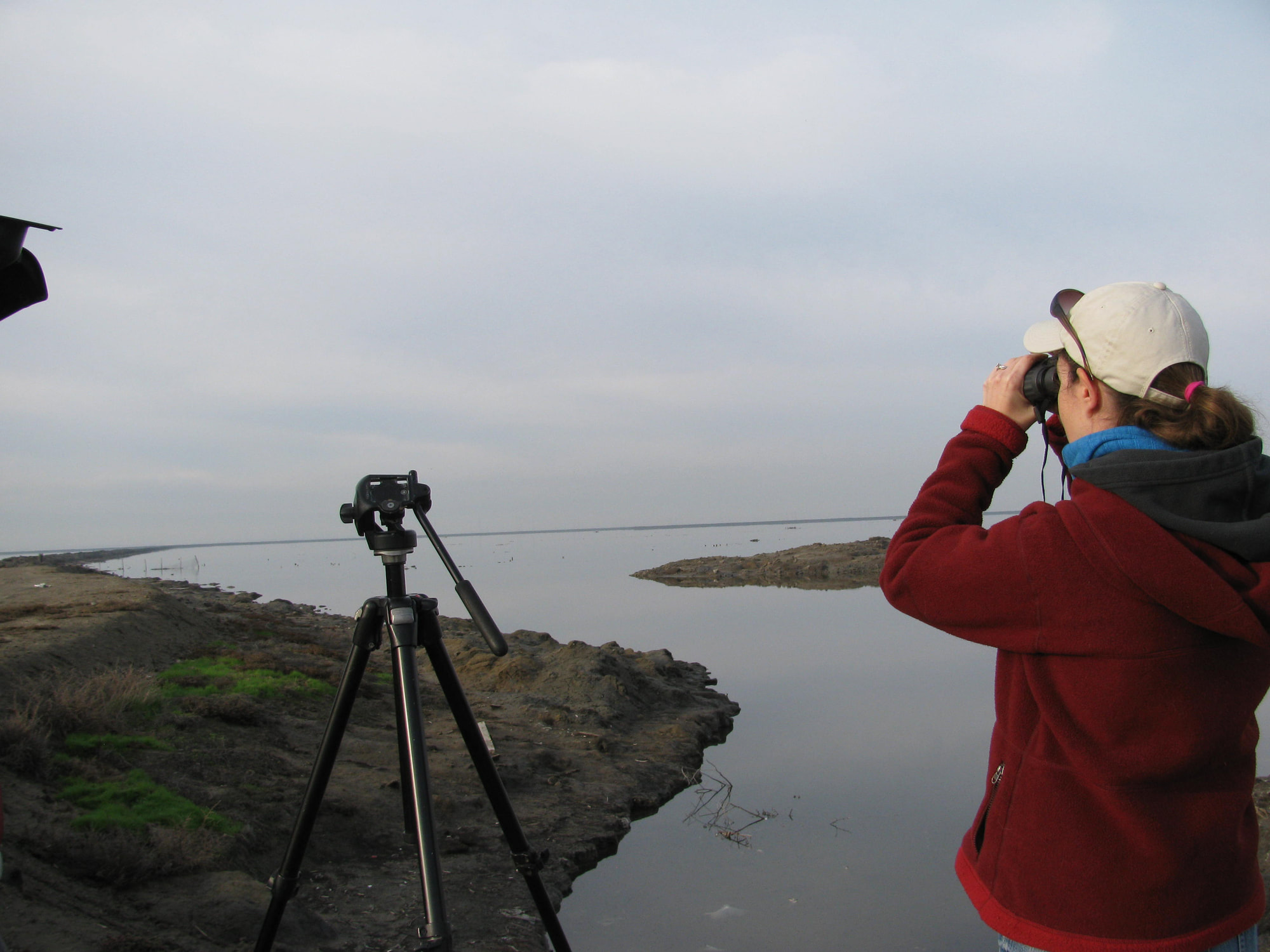
    Cependant, je pense que la partie que j’ai le plus aimée dans mon travail a été le terrain. C’est un endroit extraordinaire où l’on peut apprendre tellement de choses, où il y a tellement de vie, de diversité. J’ai eu l’occasion d’aller deux fois sur le terrain durant mon bénévolat. Ma première mission sur le terrain a été avec Anjou Kato et avait pour but d’observer s’il y avait des oiseaux malades dans la baie de San Francisco. En effet, durant les années 1980, une bactérie pathogène, Clostridium botulinum est apparue dans les eaux de la baie et a ainsi rendu les oiseaux malades, entrainant une forte mortalité.  Pour effectuer ce suivi, nous avons fait le tour de la baie en voiture et nous avons observé les oiseaux à l’aide de jumelles. Ce jour-là, nous n’avons trouvé aucun oiseau malade. Le fait de n’avoir aucune donnée a été au début un peu frustrant car quand on part sur le terrain, on s’attend toujours à trouver quelque chose, à avoir des informations. Mais si nous réfléchissons bien, c’est une très bonne nouvelle de n’avoir aucune donnée car cela prouve que tous les oiseaux vont bien et qu’ils ne sont pas contaminés par la bactérie. Il faut donc parfois accepter, qu’en tant que scientifique, le fait de ne pas avoir de donnée n’est pas un mauvais signe mais au contraire que c’est une bonne chose.
    La deuxième fois que je suis allée sur le terrain, c’était avec Josh Scullen. J’ai eu la chance de voir comment on pouvait faire du suivi d’oiseaux lors de migrations ou non. Ceci se fait grâce à de très grands filets (aussi long que haut). En effet, les filets étant très imposants mais à la fois très discrets, les oiseaux ne peuvent les voir et volent donc directement dedans. Une fois dans le filet, il faut  détacher délicatement les oiseaux en faisant très attention à ne pas les blesser ni de leurs casser une aile ou une patte. Après avoir détaché l’oiseau, il nous faut déterminer son espèce, voir s’il est bagué ou non puis nous devons le placer délicatement dans un petit sac en tissu afin de pouvoir le transporter vers le bureau/ laboratoire qui se trouve sur le terrain. Une fois au bureau, nous pouvons « examiner » l’oiseau. 

    Pour pouvoir faire du suivi, nous avons besoin de différentes informations à propos des oiseaux comme la taille, le poids, le sexe, l’âge. C’est donc ce que nous allons faire au bureau/ laboratoire. En général, il est facile de distinguer un mâle d’une femelle grâce à la couleur des plumes ou la taille. Quant à savoir si c’est un adulte ou un juvénile il suffit de regarder au niveau des os du crâne, au niveau des plumes mais aussi au niveau du bec (les oisillons porteront des marques oranges autour du bec). Une fois toutes les informations recueillies, il ne nous reste plus qu’à relâcher l’oiseau dans un endroit sûr. Lors de cette journée, nous avons pu capturer 14 oiseaux dont des Bruants chanteurs et des Parulines masquées. Ce n’est pas énorme mais c’est un nombre correct qui nous permet un bon suivi. 

    Travailler en tant que bénévole à la SFBBO a été pour moi une expérience très enrichissante qui m’a permis d’apprendre tellement de choses autant sur le terrain qu’au bureau. Je tiens à remercier toutes les personnes travaillant à la SFBBO pour leur gentillesse (ainsi que pour m’avoir aidé à améliorer mon anglais) et plus particulièrement Josh et Ben qui m’ont permis de travailler sur leurs projets et m’ont montré à quoi ressemble le métier de scientifique : un métier extraordinaire qui peut être tellement différent d’un jour à l’autre.

    Clara Millecamps est étudiante en biologie avec spécialisation en écologie à l’Université de Lille en France. Elle a fait du bénévolat à la SFBBO cet été lors de sa visite dans la région de la Baie.